Posted on

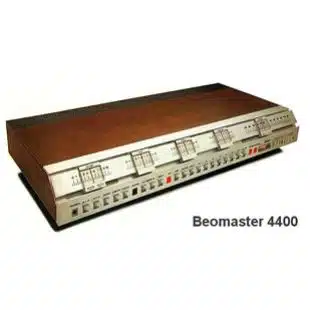
BeoMaster 4400

Beomaster 4400 was an advanced high-fidelity FM receiver which represented significant refinements in the design of domestic sound equipment. It incorporated a number of technical innovations and highly creative circuit designs which would not be out of place in a professional unit. In terms of technical finesse and power output, Beomaster 4400 was Bang & Olufsen’s top of the line stereo receiver in 1979 – 80.

The amplifier’s rated output of 75 watts RMS per channel (into 4 ohm speakers) provided more than enough power even in large rooms. There were DIN sockets for connecting a record-player, two tape or cassette recorders (one socket allowed monitoring), headphones and two pairs of stereo speakers. One pair of speaker outputs could be switched to ambiophonic use. In addition to the more usual controls and adjustment facilities, Beomaster 4400 had switchable high and low filters, a loudness control for physiologically compensated output at low volume settings and a linear function which caused the signal to by-pass all tone and filter circuits for truly unadulterated output. An overload indicator was provided to show when the amplifier’s limit for undistorted sound had been reached. Transient Intermodulation Distortion (also called transistor sound) was reduced substantially thanks to carefully designed circuits upon special research at Bang & Olufsen.

Receivers and amplifiers with the ambio function were products which, apart from stereo, could also reproduce the ambience or sound information of a room. Ambient information was included on most stereo vinyl recordings but could not be reproduced by a sound system with two loudspeakers or an ordinary stereo amplifier. Bang & Olufsen systems with the ambio function had facilities which electronically subtracted the difference signal (i.e. the difference between left and right channels) which contained ambient information. This information was fed into two extra loudspeakers which were placed as side speakers in a room. Ambiophony was an extension of stereo reproduction and enhanced the sense of realism. It could be used with nearly all stereo programme materials

The tuner was extremely sensitive and had low distortion levels over the entire FM waveband. Naturally, it incorporated all the latest technical and scientific advances such as a symmetrical Quadrature detector with the Phase Locked Loop stereo decoder which guaranteed low distortion and long-term channel separation on FM stereo programmes. The AFC (Automatic Frequency Control) circuit had characteristics which reduced inter-station noise during tuning. This circuit was also triggered automatically to eliminate loud ‘switch’ noise when changing between radio, record or tape programmes. There were six small dials for pre-tuning FM radio stations, so subsequent programme selection was just a matter of pressing a switch.

Beomaster 4400 could be made up as part of the Beosystem 4400, when linked together with other compatible Bang & Olufsen products.
Posted on

BeoGram 3000 (1967) Thorens

BeoGram 3000 (1967) Thorens

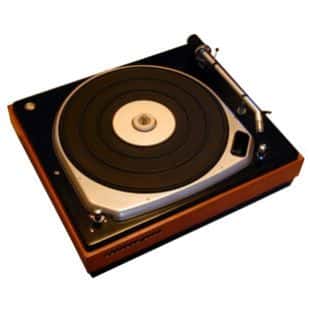
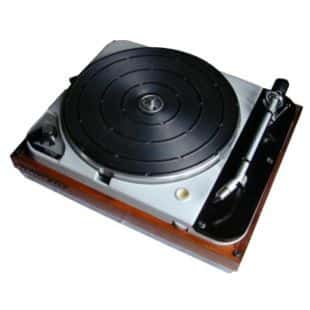
In 1967, B&O found themselves with a world leading Hi-Fi system in the Beolab 5000 but no suitable source for the reproduction of LPs. In a move now commonplace, they simply outsourced and used the motor unit of the Thorens TD124 Mk II – probably the best available to them at this time. They added their own ST/L arm and re-christened it the Beogram 3000.

This deck was sold in those areas allowed by Thorens which initially did not include the UK. A different model was supplied there.Highly sought after by collectors now despite really having little to do with B&O! Some even dispensed with the B&O arm and use an SME tone-arm.

These days the Beogram 3000 Thorens is a sought after model, offering probably the best performance of any Beogram. Because it is basically a Thorens deck, parts are readily available in re manufactured form.

The standard arm was the ST/L but a few were fitted with the rare ST/P arm. This was a 12″ arm but used the earlier SP2 cartridge rather than the SP8 which was fitted to the ST/L when used in the Beogram 3000.

The lid fitted was a lift off device and was high to clear the lift mechanism of the arm.

Posted on

BeoVision L 4500

BeoVision L 4500

Beovision L 5500 / 4500 – Alternative theatre

A classic Bang & Olufsen TV has always been a good investment. However, if you didn’t need the advanced features that Beovision LX had to offer, the alternative TV was the ‘L’ range. It offered same design, same engineering, same quality, but different pricing and different colours.

Posted on

BeoVision L 5500

BeoVision L 5500

Beovision L 5500 / 4500 – Alternative theatre

A classic Bang & Olufsen TV has always been a good investment. However, if you didn’t need the advanced features that Beovision LX had to offer, the alternative TV was the ‘L’ range. It offered same design, same engineering, same quality, but different pricing and different colours.

Posted on

BeoVision LS 6000

BeoVision LS 6000

Beovision LS5000 and LS6000 TV and video in all simplicity

A Bang & Olufsen TV is always a good investment. But perhaps you didn’t want all the highly advanced functions in Bang & Olufsen’s video systems. In that case, you could choose a television like Beovision LS instead. It had the same classic lines as Beovision LX and the quality again was extremely high. There was just a slight difference in design and technical specifications. For example, unlike Bang & Olufsen’s video systems, Beovision LS and its VCR partner, Beocord V3000, could not be included in a Beolink® system.

Beovision LS was available as a 66cm or a 63cm TV – the LS5000 and LS6000 (as well as two further models – LS4500 and LS5500). All materials were of the finest quality and as always, attention to detail was meticulously made. For example, it was real wood that was used in the rosewood model and not plastic laminate. The glass screen in front of the picture tube was made of a high-quality glass, from Europe’s leading glassmaker. It served two functions: it captured the light reflections that struck the screen, minimising their effect on the picture. And at the same time, it unified the appearance of the television.

Picture and sound in high quality
You obtained the same distinguished picture on a Beovision LS as on the more advanced TVs in Bang & Olufsen’s range. The philosophy behind Bang & Olufsen’s TV picture is that it should appear as natural as possible. One of the reasons for this choice is that your eyes tire quickly if colours are too strong. In comparison with other brands, this philosophy can make a Bang & Olufsen picture seem less like a picture postcard. But Bang & Olufsen would rather be compared to reality than to glossy reproduction.

The sound in Beovision LS5000 and LS6000 also lived up to the expectations you had for a Bang & Olufsen TV. The amplifier in the built-in two-way bass-reflex speakers was, in fact, the same fine quality that was used in audio systems.

Beovision LS6000 66cm television was the result of generations of development and provided superb natural colour which is balanced automatically up to 50 times every second. Its powerful loudspeakers were set smoothly on each side of the screen which stretched from the very top to the bottom of the cabinet. Fast Teletext access was provided together with, satellite compatibility and NICAM digital stereo sound including Beolink 1000 remote control.

Beovision LS5000 and LS6000 could be happily married to Beocord V3000 video cassette recorder and both Teletext and NICAM stereo sound were standard on both the Beovision LS5000 and LS6000.

Posted on

BeoVision LX 2502

BeoVision LX 2502

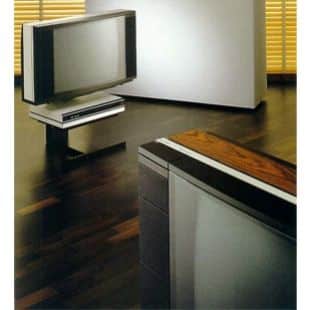
Advanced TV technology at its most elegant
Beovision 2802 was the latest version of the classic Bang & Olufsen TV. Fully remote controlled, it was created specially for those who require all the features of today’s TV – and who also seek a timeless design that would blend perfectly into their living environment. Slim and elegant, Beovision LX2802 came in either traditional natural woods or a contemporary white finish.

To the finest detail
B&O is renowned for its attention to detail and craftsmanship. You won’t find any fussy buttons on B&O’s sets – because, with full remote control, they simply aren’t necessary. Absolutely nothing looks out of place or superfluous with a Bang & Olufsen TV. The materials are always selected with the utmost care. The closest attention is always paid even to the design of the back of the TV. The company believes that appearances matter a great deal, because you’ve got to live with a TV day in, day out. On or off, it should be easy on the eye.

The perfect picture – from any angle
You don’t have to sit bang in front to get a good view of Bang & Olufsen TV sets. The 66cm flat-square picture tube of these Beovisions gave a clear, undistorted picture even when viewed from the side. Combine that with the specially developed VisionClear system, and you’ve got eye-opening picture quality. The colour balance and contrast are regulated automatically, 50 times every second. There’s even a contrast screen to make sure that your picture’s always in harmony with the light levels in the room. Razor-sharp quality – and it’s built to last.

Posted on

BeoVision LX 2802

BeoVision LX 2802

Advanced TV technology at its most elegant
Beovision 2802 was the latest version of the classic Bang & Olufsen TV. Fully remote controlled, it was created specially for those who require all the features of today’s TV – and who also seek a timeless design that would blend perfectly into their living environment. Slim and elegant, Beovision LX2802 came in either traditional natural woods or a contemporary white finish.

To the finest detail
B&O is renowned for its attention to detail and craftsmanship. You won’t find any fussy buttons on B&O’s sets – because, with full remote control, they simply aren’t necessary. Absolutely nothing looks out of place or superfluous with a Bang & Olufsen TV. The materials are always selected with the utmost care. The closest attention is always paid even to the design of the back of the TV. The company believes that appearances matter a great deal, because you’ve got to live with a TV day in, day out. On or off, it should be easy on the eye.

The perfect picture – from any angle
You don’t have to sit bang in front to get a good view of Bang & Olufsen TV sets. The 66cm flat-square picture tube of these Beovisions gave a clear, undistorted picture even when viewed from the side. Combine that with the specially developed VisionClear system, and you’ve got eye-opening picture quality. The colour balance and contrast are regulated automatically, 50 times every second. There’s even a contrast screen to make sure that your picture’s always in harmony with the light levels in the room. Razor-sharp quality – and it’s built to last.

And the sound to match
One of the things that make Bang & Olufsen TVs so special is the sound – because it’s just as breathtakingly good as the picture. The L and LX TVs have a bass reflex loudspeaker system – which, in words of one syllable, means great sound. You’ll be amazed at the difference it makes, even listening to the news! Of course, you’ll also appreciate Bang & Olufsen sound quality when you listen to music from your sound system through the TV. (Perfectly possible – all Bang & Olufsen’s latest audio, TV and video systems can talk to each other). Close your eyes and it sounds like you’ve just acquired a splendid pair of new hi-fi speakers for your music centre. Which is exactly what you HAVE done.

A view to the future
Your LX 2802 TV was also ready for satellite broadcasts when they became available. It’ll be able to receive broadcasts either through communal aerials and a hybrid network, or through your own parabolic ‘dish’ antenna. Just add the BeoSat LX module when the future arrives.

No-wait Teletext
The live information bank of Teletext is a tremendous benefit, whether you want an instant weather update, flight times or racing results. Now we’ve added even more of a bonus, with the computer-controlled Teletext module. This allows you to flip through the Teletext pages without having to wait. You can also call up four different pages instantly on the screen (in the order you want) by pressing the Teletext button. So you can hop easily from one topic to another, with quicker access to the facts you need.

The right connections
When you buy a Bang & Olufsen video recorder to partner your TV, you’ll be able to operate both with one remote control – the Beolink 1000. Needless to say, our video recorders are as intelligently designed as our TVs: Beocord VX5000 and VHS 82.2 even have a visual display to make operation and programming absolute child’s play. But your connection options don’t stop there. Your TV can team up with your music system. It can even form part of your Bang & Olufsen ’round-the-house’ TV, video and music system. All under the command of the ingenious Beolink 1000 remote control. You can also connect headphones, your personal computer, video games and a loop amplifier for the hard of hearing.

Take four
You could choose one of four models: the 63cm L2502 and LX 2502, and the 66cm L2802 and LX 2802. In all the most important technical respects, these TVs shared the same advanced features.

Fine finishes
The Beovision LX series was available in rosewood, teak, white and White Line (B&O’s modern colour and styling treatment).

Posted on

BeoVision 8000

BeoVision 8000

The BeoVision 8000 was the non remote version of the Beovision 8800 but, apart from this feature, shared all the other qualities with this set.

In common with the Beovision 8800 it had a 14W amplifier with a two way speaker system – a feature that made it stand out from other sets at the time. Not a big seller as those willing to buy a 26″ set were likely to opt for the Beovision 8800 with the remote control.

Posted on

BeoVision 8100

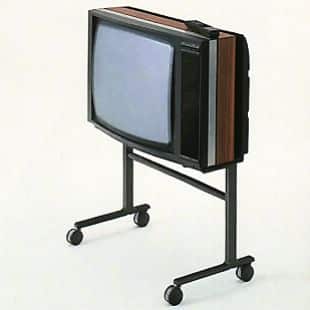
These high quality remote control colour TVs had 8 channels which could be pre-tuned for instant access via the infra-red Video Terminal. Volume level and picture adjustments could also be made without moving more than a finger. Bass and treble tone and picture contrast adjustments were made via the controls sited behind the set’s front fascia.

All models used the 30AX in-line self-converging picture tube with its High Bright characteristics. Bang & Olufsen’s unique Permanent Colour Truth circuitry ensured that the balance between colours was always correct. Together, these features guaranteed a top quality picture that would not deteriorate as the set got older.

Teletext was available as an optional feature on all three models. When fitted, Teletext was accessible via the same Video Terminal used for ordinary entertainment viewing.

Beovisions 5100, 7100 and 8100 came complete with a smooth gliding undercarriage. Apart from screen size and cabinet options, they were technically identical in all respects.

Sound output was 6 watts RMS. Connections were provided for an extension speaker and tape recorder; the tape socket had an alternative function – you could use it to feed the TV sound through your hi-fi system. (From B&O Catalogue Supplement Winter 1982/83)