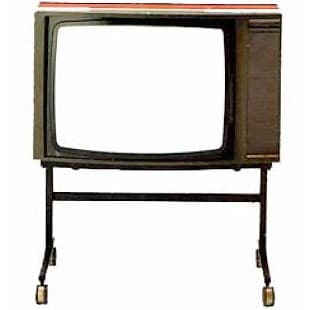
BeoVision 8202
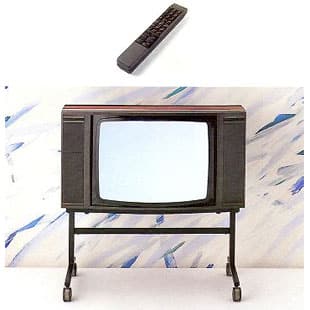

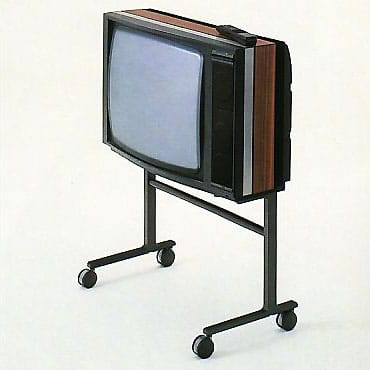
Beovision 8800 marked a brand-new generation of televisions with significant technical improvements. One of the most important enhancements was probably the remote control, which now worked with infrared light instead of ultrasound, and had practically all the same functions we use today. Thus, it could also operate text-TV, a brand-new service offered to viewers, introduced in 1983. The remote control took on something of a cult status. Being cast in zinc, the remote control was much more pleasant to handle; as zinc conducts heat, you didn’t get clammy hands from handling it for an extended period.
Beovision 8800 had remarkable sound compared to other televisions. The engineers had managed to incorporate a built-in two-way loudspeaker system driven by a 14W amplifier. The energy consumption was only 75W, which is in fact on a par with today’s standards. But, back then, a television used more energy if you turned up the volume or increased the picture contrast. These factors are no longer very significant.
This system concept was new. It was now possible to use the same remote control for both the TV and the video recorder. Bang & Olufsen blazed new trails by fusing two remote control units into one. The technology should exist for the sake of people – not the other way around. This philosophy has been pervasive from the very beginning. And it is refreshed at regular intervals. For example, quoting a sales brochure from the 1970s asserts: “There is something that distinguishes Bang & Olufsen radically from everybody else. We are just as interested in what our products are used for as we are in their technological capabilities.
To us, coming up with a technically satisfying design is not enough. It also needs to be satisfying to use. It should operate intuitively. Knobs, buttons and dials need to be positioned logically and consistently so they can be understood and operated by children and adults alike. This might make people think the technology is less advanced. Nothing could be further from the truth. On the contrary, well-thought-out operation makes heavy demands on ingenuity, often requiring unconventional, sometimes radical solutions.
The objection is frequently heard that people quickly become accustomed to operating technical equipment even if it is complicated and illogical. We do not believe that this is necessarily so. In fact, people often find complicated things annoying – and give up trying to make sense of each of the functions they have paid for. There is simply no excuse for not thinking through the functions and their operation. Even when we’re talking about the most advanced high-fidelity equipment, the technology is there for the sake of the people – and not the other way around.”
Beovision 8800 became a classic, remaining in production until the launch of the Beovision LX family.
(Taken from Beolink Magazine: ‘The First 50 Years of Television’ © Bang & Olufsen a/s 2002)
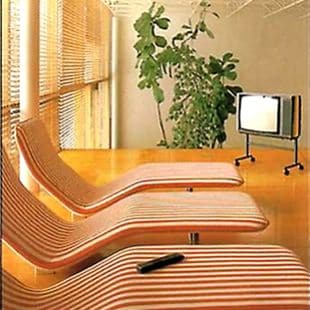
“As yet, none of us need 32 TV channels, let alone 100. But satellite re-broadcasting systems and cable TV, including regional and community networks, might soon change that” (1983 catalogue)
Therefore, Bang & Olufsen equipped all the luxury Beovision models with an advanced digital tuner that had the capacity for receiving 100 UHF channels, 32 of which could be stored in the set’s microcomputer memory for instant recall at the touch of a button.
Beovisions 5502, 7702, 8802 and 9002 all shared the same advanced chassis design and offered the same user-benefits. They were true “luxury” sets because many ‘extras’ offered by other companies, were given as standard by Bang & Olufsen.
The Beovision Video Terminal supplied with Beovisions 5502, 7702, 8802 and 9002 offered a plethora of operational benefits. In addition there was also an advanced ‘tune and store’ function that allowed you to operate the automatic tuning system from the comfort of your chair.
One touch of the ‘tune’ button started the digital tuner scanning the wavelengths of the UHF band. When it found a station, it stopped – giving you the opportunity to either reject or accept it. If it was an unsatisfactory reception from a distant transmitter (or simply a station you don’t like!), you just pressed ‘tune’ again to continue the search. When you found a station you enjoy, on a channel giving a good, clear reception, you could instruct the set’s microcomputer to remember that transmission frequency by pressing ‘store’ followed by your own choice of pre-set programme number (e.g. for BBC2 you might designate pre-set number 2). Thereafter, whenever you wanted to watch BBC2, you simply touch button ‘2’ on your remote Terminal.
Up to 32 different TV stations could be located and stored in this way, so your Beovision really is ‘future-safe’ because it has plenty of spare capacity to accommodate new programme sources as and when they come ‘on stream’.
The latest type of Beovision Video Terminal also had a button marked ‘sound’. This was only effective with Bang & Olufsen stereo TVs – Beovision 7802 and Beovision 8902.
Beovision 5502 had a 50cm screen and measured 62cm wide, 40cm high (71.5cm including stand) and 39cm deep.
Beovision 7702 had a 22″ screen. Dimensions were 67.5cm wide, 43.5cm high (76cm including stand) and 41.5cm deep.
Beovision 8802 had a 26″ screen and measured 77cm wide, 49cm high (80cm including stand) and 45.5cm deep.
All three models had slim cabinets finished in a choice of natural teak or rosewood. White finish was available to special order.

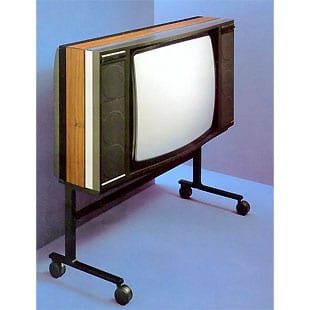
Beovisions that put the future at your fingertips
As yet, none of us need 32 TV channels, let alone 100. But satellite re-broadcasting systems and cable TV, including regional and community networks, may in the future change that.
Therefore, Bang & Olufsen equipped all their luxury Beovision models with an advanced digital tuner that had the capacity for receiving 100 UHF channels, 32 of which could be stored in the set’s microcomputer memory for instant recall at the touch of a button.
The real boon for most viewers is that you could locate, store and recall any of these stations without leaving your armchair. All you had to do was to touch a key on the Beovision Video terminal. So although the company gave their “future-safe” luxury TV range more micro-electronics, more features and more connection possibilities than ever before, they had, at the same time, made all this complex technology even more accessible – instantly. To borrow a phrase from the computer industry, Bang & Olufsen’s ’02-Series’ TVs were (and still are) extremely “user-friendly”.
Beovisions 5502, 7702, 8802 and 9002 all shared the same advanced chassis design and offered the same user-benefits. They were true “luxury” sets because all the features and facilities which, in other brands, are offered as ‘extras’ were offered as standard on Bang & Olufsen sets.
The Beovision Video Terminal supplied with Beovisions 5502, 7702, 8802 and 9002 offered a plethora of operational benefits. In addition there was also an advanced ‘tune and store’ function that allowed you to you operate the automatic tuning system from the comfort of your chair.
One touch of the ‘tune’ button started the digital tuner scanning the wavelengths of the UHF band. When it found a station, it stopped – giving you the opportunity to either reject or accept it. If it was an unsatisfactory reception from a distant transmitter (or simply a station you didn’t like!), you just pressed ‘tune’ again to continue the search. When you found a station you enjoyed, on a channel giving a good, clear reception, you could instruct the set’s microcomputer to remember that transmission frequency by pressing ‘store’ followed by your own choice of pre-set programme number (e.g. for BBC2 you might designate pre-set number 2). Thereafter, whenever you wanted to watch BBC2, you simply touched button ‘2’ on your remote Terminal.
Up to 32 different TV stations could be located and stored in this way, so your Beovision really was ‘future-safe’ because it had plenty of spare capacity to accommodate new programme sources as and when they come ‘on stream’.
The (then) latest type of Beovision Video Terminal also had a button marked ‘sound’. This was only effective with Bang & Olufsen stereo TVs – Beovision 7802 and Beovision 8902, for example.
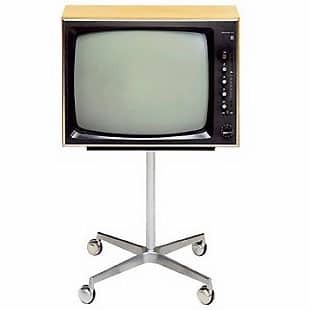
Beovision 700 won the iF Design Award in 1966

Beovision 7000 offered identical performance as the Beovision 7700 but with direct manual operation of up to 12 stations.
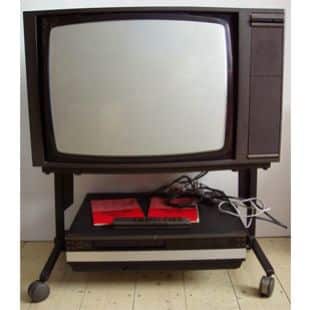
These high quality remote control colour TVs had 8 channels which could be pre-tuned for instant access via the infra-red Video Terminal. Volume level and picture adjustments could also be made without moving more than a finger. Bass and treble tone and picture contrast adjustments were made via the controls sited behind the set’s front fascia.
All models used the 30AX in-line self-converging picture tube with its High Bright characteristics. Bang & Olufsen’s unique Permanent Colour Truth circuitry ensured that the balance between colours was always correct. Together, these features guaranteed a top quality picture that would not deteriorate as the set got older.
Teletext was available as an optional feature on all three models. When fitted, Teletext was accessible via the same Video Terminal used for ordinary entertainment viewing.
Beovisions 5100, 7100 and 8100 came complete with a smooth gliding undercarriage. Apart from screen size and cabinet options, they were technically identical in all respects.
Sound output was 6 watts RMS. Connections were provided for an extension speaker and tape recorder; the tape socket had an alternative function – you could use it to feed the TV sound through your hi-fi system. (From B&O Catalogue Supplement Winter 1982/83)
In the days before widescreen, active speakers and Dolby Digital modules, the catalogue of 1985 stated that: “it would be foolish to spend more money that you needed. Why pay for multiple features and facilities when all you wanted was the best possible picture quality, good sound and instant remote access to all available UHF TV channels?”. Unfortunately, those days have long since gone!
The most sensible and economic answer to such a modest set of demands was right there, it stated, in the ‘traditional’ Beovision 5102, 7102 and 8102. All three sets were identical; it was only the size of the tubes that differed. You obtained the same type of picture tube as in the luxury sets (the Beovision 5502, 7702 and 8802 range, for example): automatic colour balance, high reliability… and a bright, clear, natural-looking picture. Sound quality was 6 watts RMS.
The remote control was identical too – the Beovision Video Terminal was used on all of the sets. You could tune across the entire UHF band and store up to 32 station frequencies in the set’s microcomputer memory for instant recall. The Beovision Video Terminal made it easy to control.
Sound output was 6 watts. Connections were provided for an extension speaker and a tape recorder; the tape socket had an alternative function – you could use it to feed the TV sound through a hi-fi system. And connecting a Loop Amplifier would allow a person with a hearing aid to enjoy TV sound more fully.
All three models could be supplied with or without Teletext facilities. The slim-line cabinets were identical in design but offered an alternative in materials and finish: a furniture-crafted wood cabinet finished in rich-grained natural teak or rosewood; Beovision 5102 was also finished in natural grey.