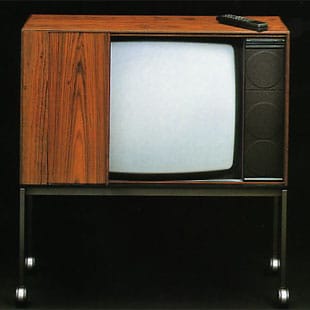
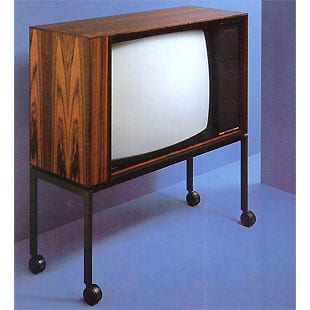
As an alternative in furnishing styles, the high-technology chassis of the Beovision 8800 was combined with the traditional skills of Danish furniture craftsmanship. The result was the luxurious Beovision 9000.
When you purchased this model, you obtained all the quality and convenience of modern TV technology plus the pride and pleasure of owning and living with a fine piece of furniture.
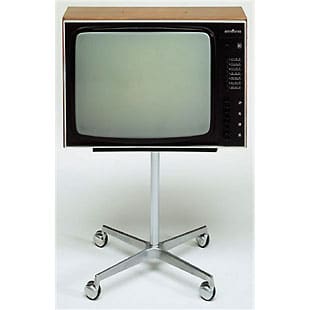
Beovision 9000’s cabinet was finished in genuine, rich-grained teak and rosewood and had a beautifully crafted tambour screen door that rolled back to reveal the screen – and switched the set on at the same time. When you had finished viewing, you just slid shut the door. The set shut itself off automatically. The screen was protected from dust and accidents, and you were never confronted with a blank staring screen every time you entered the room.
All the technical features and facilities of the Beovision 8800 were included in this luxury 26″ model. The infra-red remote control Terminal allowed you to operate all primary functions from your armchair – including Teletext and the Beocord 8800 video cassette recorder if you chose those options.
Beovision 9000 was a replacement for Beovision 6002 – its predecessor was similar in looks to Beovision 9000 but was fitted with an ultrasonic remote control Commander. In turn, the model was superceded by Beovision 9002 in 1984.
The cabinet of the Beovision 9002 was finished in genuine, rich-grain teak or rosewood and had a beautifully crafted tambour screen door that rolled back to reveal the screen – and switched the set on at the same time. When you had finished viewing, just slide the door shut. The set switches off automatically. The screen was protected from dust and accidents, and you were not confronted with a blank, staring screen every time you entered the room. Beovision 9002 replaced Beovision 9000 when it came to the end of its production run in 1983.
All the technical features and facilities of the Beovision 8802 were included in this luxury 66cm (viewable screen) model. The infra-red remote control terminal allowed you to operate all the primary functions from the comfort of your chair – including Teletext and Beocord video cassette recorder.
Beovisions that put the future at your fingertips
All Bang & Olufsen’s ‘luxury’ Beovision models of the time were fitted with an advanced digital tuner that had the capacity for receiving 100 UHF channels, 32 of which could be stored in the set’s microcomputer memory for instant recall at the touch of a button.
The real boon for most viewers is that you could locate, store and recall any of these stations without leaving your armchair. All you had to do is touch a key on the Beovision Video terminal. So although B&O gave their “future-safe” luxury TV range more micro-electronics, more features and more connection possibilities than ever before, they made all the complex technology even more accessible – instantly. To borrow a phrase from the computer industry, Bang & Olufsen’s ’02-Series’ TVs were “user-friendly” (1983 catalogue)
Beovisions 5502, 7702, 8802 and 9002 all shared the same advanced chassis design and offered the same user-benefits. They were true “luxury” set because all the features and facilities which, in other brands, are offered as ‘extras’ are included as standard with their Bang & Olufsen counterparts.
The Beovision Video Terminal supplied with Beovisions 5502, 7702, 8802 and 9002 offered a plethora of operational benefits. In addition there was also an advanced ‘tune and store’ function that allowed you to operate the automatic tuning system from the comfort of your chair.
One touch of the ‘tune’ button started the digital tuner scanning the wavelengths of the UHF band. When it found a station, it stopped – giving you the opportunity to either reject or accept this station. If it was an unsatisfactory reception from a distant transmitter (or simply a station you didn’t like!), you just pressed ‘tune’ again to continue the search. When you found a station you enjoyed, on a channel giving a good, clear reception, you could instruct the set’s microcomputer to remember that transmission frequency by pressing ‘store’ followed by your own choice of pre-set programme number (e.g. for BBC2 you might designate pre-set number 2). Thereafter, whenever you wanted to watch BBC2, you simply touched button ‘2’ on your remote Terminal.
Up to 32 different TV stations could be located and stored in this way, so your Beovision really is ‘future-safe’ because it has plenty of spare capacity to accommodate new programme sources as and when they come ‘on stream’.
The latest type of Beovision Video Terminal also had a button marked ‘sound’. This was only effective with Bang & Olufsen stereo TVs – Beovision 7802 and Beovision 8902.
B&O’s long awaited answer to replacing the long running Beovision MX range of stand alone televisions which dated back to 1985, the Beovision 8 was released first as a 26″ model and was followed by the 32″ model later in the same year.
Sharply styled
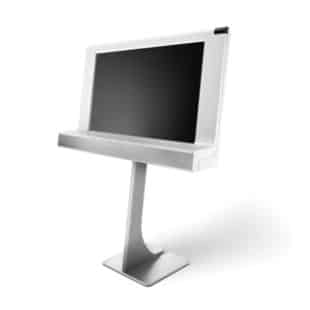
The set was a marked change in direction in styling with the trademark contrast screen no longer fitted. Instead a radical new look with a prominent speaker box was seen and the same Sharp LCD screen as seen in the Beocenter 6 26″ was fitted. Resolution was set at 768p – completely acceptable for a screen of this size. Particular care had been taken with the speaker which had been optimised for speech reproduction. It utilised three drive units – a 50mm treble/midrange unit mounted at the two opposite ends and a central 100mm woofer. This was separately enclosed and unlike the midrange/tweeter was in a bass reflex box to enhance the output. In some ways this set up resembled that of the Beosound 1 thought that unit had separate midrange and tweeters rather than relying on a full range unit.
Connected to the future
Unlike the other LCD sets in the B&O range, an HDMI socket was fitted which allowed the connection of a digital source. The set also came as standard with two SCART sockets though one extra cost option was the so called System Module which provided a Masterlink socket, an RF modulator and a third SCART socket.
Dark smoothie
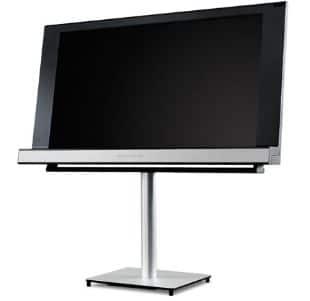
Soft touch plastics predominated with an aluminium grille for the speaker with the brand name prominently displayed. Only black with a silver grille was available at the launch. A range of stands were provided with options for storage of other source boxes or a minimalist black metal single leg.
Digitally challenged
However what attracted a fair bit of attention was not only the daring styling but also some omissions to the specification. With some countries actually starting to turn off the analogue transmitters, the absence of a DVB-T module for the Beovision 8 was a surprise. B&O’s argument that this was a set designed for use in a kitchen or small bedroom and would be likely to be attached to the main room digital tuner was reasonable if possibly a little mean. Full STB-C connections were fitted and, to be fair, offered considerable scope for upgrading, something that would be far more expensive should an internal tuner have been fitted.
Not easily surrounded
Of rather more concern to some was the absence of a surround sound option. A single Powerlink socket was fitted to allow the use of stereo Beolab speakers with the option of Centre Balance control, a feature seen on Beovision sets in the early nineties. However there was no Dolby or DTS surround, implying that this set was not designed to be part of a main room set up.
Remotely attractive?
And there was one more surprise! In the UK the set was supplied with no remote control – although it was not able to be operated without one. The rationale behind this was two fold. Firstly, much like the Beovision 3 28″,which was another of the models it replaced, the Beovision 8 offered a very low headline price to attract customers more used to buying other brands into the showroom. And secondly, the customer was then offered the choice between the Beo4 remote and the brand new and much more expensive Beo5.
Mounting Options & Stands
This model was supplied with adjustable tilt feet designed to allow the screen angle to decline when placed on furniture. The original Bang & Olufsen Floor Stand did not allow rotation or screen adjustment and was soon replaced by a three position, open front cabinet, supplied with wheels. The wall bracket allowed limited rotation to the left or right and screen tilt adjustment.
B&O’s long awaited answer to replacing the long running Beovision MX range of stand alone televisions which dated back to 1985, the Beovision 8 was released first as a 26″ model and was followed by the 32″ model later in the same year.
Sharply styled
The set was a marked change in direction in styling with the trademark contrast screen no longer fitted. Instead a radical new look with a prominent speaker box was seen and the same Sharp LCD screen as seen in the Beocenter 6 26″ was fitted. Resolution was set at 768p – completely acceptable for a screen of this size. Particular care had been taken with the speaker which had been optimised for speech reproduction. It utilised three drive units – a 50mm treble/midrange unit mounted at the two opposite ends and a central 100mm woofer. This was separately enclosed and unlike the midrange/tweeter was in a bass reflex box to enhance the output. In some ways this set up resembled that of the Beosound 1 thought that unit had separate midrange and tweeters rather than relying on a full range unit.
Connected to the future
Unlike the other LCD sets in the B&O range, a HDMI socket was fitted which allowed the connection of a digital source. The set also came as standard with two SCART sockets though one extra cost option was the so called System Module which provided a Masterlink socket, an RF modulator and a third SCART socket.
Dark or light smoothie
Soft touch plastics predominated with an aluminium grille for the speaker with the brand name prominently displayed. Only black with a silver grille was available at the launch.
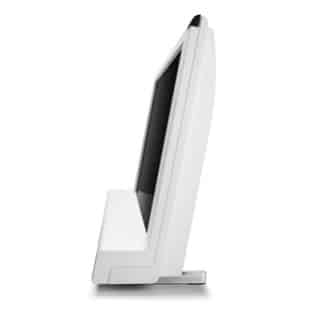
Currently, Beovision 8 is also available in white.
A range of stands were provided with options for storage of other source boxes or a minimalist black or white metal single leg.
Digitally challenged
However what attracted a fair bit of attention was not only the daring styling but also some omissions to the specification. With some countries actually starting to turn off the analogue transmitters, the absence of a DVB-T module for the Beovision 8 was a surprise. B&O’s argument that this was a set designed for use in a kitchen or small bedroom and would be likely to be attached to the main room digital tuner was reasonable if possibly a little mean. Full STB-C connections were fitted and, to be fair, offered considerable scope for upgrading, something that would be far more expensive should an internal tuner have been fitted.
Not easily surrounded
Of rather more concern to some was the absence of a surround sound option. A single Powerlink socket was fitted to allow the use of stereo Beolab speakers with the option of Centre Balance control, a feature seen on Beovision sets in the early nineties. However there was no Dolby or DTS surround, implying that this set was not designed to be part of a main room set up.
Remotely attractive?
And there was one more surprise! In the UK the set was supplied with no remote control – although it was not able to be operated without one. The rationale behind this was two fold. Firstly, much like the Beovision 3 28″, which was another of the models it replaced, the Beovision 8 offered a very low headline price to attract customers more used to buying other brands into the showroom. And secondly, the customer was then offered the choice between the Beo4 remote and the brand new and much more expensive Beo5.
Mounting Options & Stands
This model was supplied with adjustable tilt feet designed to allow the screen angle to decline when placed on furniture. The original Bang & Olufsen stand did not allow rotation or screen adjustment and was replaced by a three position, open front cabinet, supplied with wheels. The wall bracket allowed limited rotation to the left or right and screen tilt adjustment.
The newly introduced 40″ version of B&O’s entry level television. This time it features surround sound and a 40″ screen and is designed as main room set.
Mounting Options & Stands
This model was supplied with adjustable tilt feet designed to allow the screen angle to decline when placed on furniture. The original Bang & Olufsen floor stand allowed the screen to rotate.
The BeoVision 8000 was the non remote version of the Beovision 8800 but, apart from this feature, shared all the other qualities with this set.
In common with the Beovision 8800 it had a 14W amplifier with a two way speaker system – a feature that made it stand out from other sets at the time. Not a big seller as those willing to buy a 26″ set were likely to opt for the Beovision 8800 with the remote control.
These high quality remote control colour TVs had 8 channels which could be pre-tuned for instant access via the infra-red Video Terminal. Volume level and picture adjustments could also be made without moving more than a finger. Bass and treble tone and picture contrast adjustments were made via the controls sited behind the set’s front fascia.
All models used the 30AX in-line self-converging picture tube with its High Bright characteristics. Bang & Olufsen’s unique Permanent Colour Truth circuitry ensured that the balance between colours was always correct. Together, these features guaranteed a top quality picture that would not deteriorate as the set got older.
Teletext was available as an optional feature on all three models. When fitted, Teletext was accessible via the same Video Terminal used for ordinary entertainment viewing.
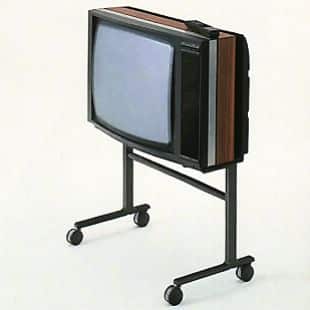
Beovisions 5100, 7100 and 8100 came complete with a smooth gliding undercarriage. Apart from screen size and cabinet options, they were technically identical in all respects.
Sound output was 6 watts RMS. Connections were provided for an extension speaker and tape recorder; the tape socket had an alternative function – you could use it to feed the TV sound through your hi-fi system. (From B&O Catalogue Supplement Winter 1982/83)
In the days before widescreen, active speakers and Dolby Digital modules, the catalogue of 1985 stated that: “it would be foolish to spend more money that you needed. Why pay for multiple features and facilities when all you wanted was the best possible picture quality, good sound and instant remote access to all available UHF TV channels?”. Unfortunately, those days have long since gone!
The most sensible and economic answer to such a modest set of demands was right there, it stated, in the ‘traditional’ Beovision 5102, 7102 and 8102. All three sets were identical; it was only the size of the tubes that differed. You obtained the same type of picture tube as in the luxury sets (the Beovision 5502, 7702 and 8802 range, for example): automatic colour balance, high reliability… and a bright, clear, natural-looking picture. Sound quality was 6 watts RMS.
The remote control was identical too – the Beovision Video Terminal was used on all of the sets. You could tune across the entire UHF band and store up to 32 station frequencies in the set’s microcomputer memory for instant recall. The Beovision Video Terminal made it easy to control.
Sound output was 6 watts. Connections were provided for an extension speaker and a tape recorder; the tape socket had an alternative function – you could use it to feed the TV sound through a hi-fi system. And connecting a Loop Amplifier would allow a person with a hearing aid to enjoy TV sound more fully.
All three models could be supplied with or without Teletext facilities. The slim-line cabinets were identical in design but offered an alternative in materials and finish: a furniture-crafted wood cabinet finished in rich-grained natural teak or rosewood; Beovision 5102 was also finished in natural grey.