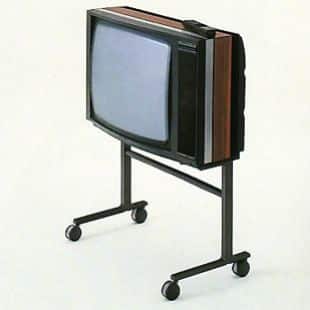
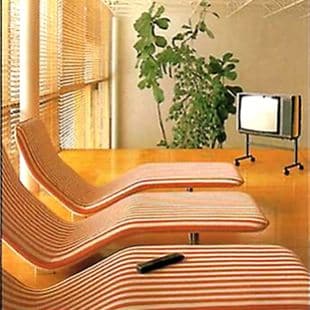
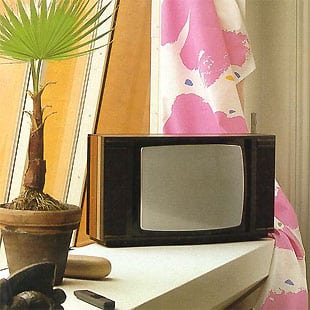
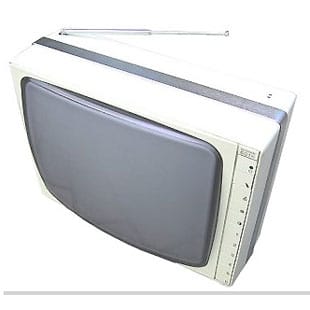
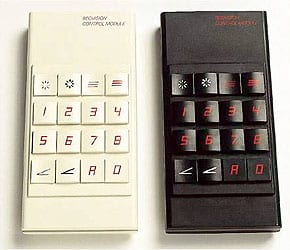
Beovision 7700 was a 22″ colour TV with remote control of up to 16 stations. You could also adjust brightness, colour and sound levels – and switch the TV off – without moving from your chair.
True high fidelity sound was a natural accompaniment to the excellent video performance of this set, thanks to a 14 watts sound amplifier and log-line dual speaker system. There were also sockets for connecting optional headphones and an extension loudspeaker, and an additional connection for recording the TV sound on a cassette deck or feeding it through your hi-fi system.
“As yet, none of us need 32 TV channels, let alone 100. But satellite re-broadcasting systems and cable TV, including regional and community networks, might soon change that” (1983 catalogue)
Therefore, Bang & Olufsen equipped all the luxury Beovision models with an advanced digital tuner that had the capacity for receiving 100 UHF channels, 32 of which could be stored in the set’s microcomputer memory for instant recall at the touch of a button.
The real boon for most viewers is that you could locate, store and recall any of these stations without leaving your armchair. All you had to do was touch a key on the Beovision Video terminal. So although B&O gave its “future-safe” luxury TV range more micro-electronics, more features and more connection possibilities than ever before, they made, at the same time, all the complex technology even more accessible – instantly. To borrow a phrase from the computer industry, Bang & Olufsen’s ’02-Series’ TVs were “user-friendly”.
Beovisions 5502, 7702, 8802 and 9002 all shared the same advanced chassis design and offered the same user-benefits. They were true “luxury” sets because many ‘extras’ offered by other companies, were given as standard by Bang & Olufsen.
The Beovision Video Terminal supplied with Beovisions 5502, 7702, 8802 and 9002 offered a plethora of operational benefits. In addition there was also an advanced ‘tune and store’ function that allowed you to operate the automatic tuning system from the comfort of your chair.
One touch of the ‘tune’ button started the digital tuner scanning the wavelengths of the UHF band. When it found a station, it stopped – giving you the opportunity to either reject or accept it. If it was an unsatisfactory reception from a distant transmitter (or simply a station you don’t like!), you just pressed ‘tune’ again to continue the search. When you found a station you enjoy, on a channel giving a good, clear reception, you could instruct the set’s microcomputer to remember that transmission frequency by pressing ‘store’ followed by your own choice of pre-set programme number (e.g. for BBC2 you might designate pre-set number 2). Thereafter, whenever you wanted to watch BBC2, you simply touch button ‘2’ on your remote Terminal.
Up to 32 different TV stations could be located and stored in this way, so your Beovision really is ‘future-safe’ because it has plenty of spare capacity to accommodate new programme sources as and when they come ‘on stream’.
The latest type of Beovision Video Terminal also had a button marked ‘sound’. This was only effective with Bang & Olufsen stereo TVs – Beovision 7802 and Beovision 8902.
Beovision 5502 had a 50cm screen and measured 62cm wide, 40cm high (71.5cm including stand) and 39cm deep.
Beovision 7702 had a 22″ screen. Dimensions were 67.5cm wide, 43.5cm high ( 76cm including stand) and 41.5cm deep.
Beovision 8802 had a 26″ screen and measured 77cm wide, 49cm high (80cm including stand) and 45.5cm deep.
All three models had slim cabinets finished in a choice of natural teak or rosewood. White finish was available to special order.
Beovisions that put the future at your fingertips
As yet, none of us still need 32 terrestrial TV channels, let alone 100. But satellite re-broadcasting systems and cable TV, including regional and community networks, may change that.
Bang & Olufsen, in the mid-1980s equipped all their luxury Beovision models with an advanced digital tuner that had the capacity for receiving 100 UHF channels, 32 of which could be stored in the set’s microcomputer memory for instant recall at the touch of a button.
The real boon for most viewers is that you could locate, store and recall any of these stations without leaving your armchair. All you had to do was to touch a key on the Beovision Video terminal. So although B&O gave their “future-safe” luxury TV range more micro-electronics, more features and more connection possibilities than ever before, they had, at the same time, made all this complex technology even more accessible – instantly. To borrow a phrase from the computer industry, Bang & Olufsen’s ’02-Series’ TVs were “user-friendly” (1983 catalogue).
In 1985, to celebrate Bang & Olufsen’s diamond anniversary – 1925 – 1985 – a special edition of Beovision 7802 was released. The television was finished in a dark veneer (ivory-coloured) in place of the standard teak and rosewood finishes.
A small ’emblem’ was included on the top right-hand side to commemorate this special occasion.
Beovisions 5502, 7702, 8802 and 9002 all shared the same advanced chassis design and offered the same user-benefits. They were true “luxury” sets because all the features and facilities which, in other brands, were offered as ‘extras’ were standard in Bang & Olufsen sets.
The Beovision Video Terminal supplied with Beovisions 5502, 7702, 8802 and 9002 offered a plethora of operational benefits. In addition there was also an advanced ‘tune and store’ function that allowed you to operate the automatic tuning system from the comfort of your chair.
One touch of the ‘tune’ button started the digital tuner scanning the wavelengths of the UHF band. When it found a station, it stopped – giving you the opportunity to either reject or accept it. If it was an unsatisfactory reception from a distant transmitter you just pressed ‘tune’ again to continue the search. When you found a station on a channel that offered good, clear reception, you could instruct the set’s microcomputer to remember that transmission frequency by pressing ‘store’ followed by your own choice of pre-set programme number (e.g. for BBC2 you might designate pre-set number 2). Thereafter, whenever you wanted to watch BBC2, you simply touched button ‘2’ on your remote Terminal.
Up to 32 different TV stations could be located and stored in this way, so your Beovision really was ‘future-safe’ because it had plenty of spare capacity to accommodate new programme sources as and when they came ‘on stream’.
This latest type of Beovision Video Terminal also had a button marked ‘sound’. This was at that time only effective with Bang & Olufsen stereo TVs – Beovision 7802 and Beovision 8902.
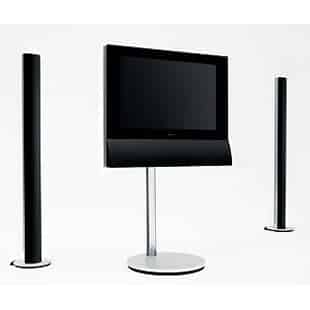
BeoVision 6 – 22 is an LCD 16:9 TV set introduced on 10 November 2003. It is fitted with a 51cm (diagonal) LCD screen which is coated similar to the Avant. Active speakers are positioned at the base of the monitor, similar to the MX range of television sets. The rear of the unit is curved, similar to that of BeoSound 1.
The unit is available in one colour only – Black – and is primarily designed for link-rooms: i.e. as an extra set for the kitchen or bedroom.
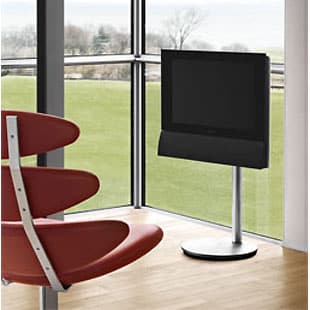
BeoVision 6 – 22 may be fitted with a motorised base which turns the set and also regulates the inclination. Standing possibilities include a low floor stand similar to BeoVision 5, wall bracket or a high floor stand high (as with BeoVision 1).
This new LCD TV can be used as a PC monitor, too. When watching normal TV programmes, ‘TV’ on the Beo4 is selected; however, by combining the BeoVision 6 to your PC as a monitor via the rear-mounted DVI socket (see further details at BeoTech) and selecting ‘PC’ on the remote control, BeoVision 6 may be used in conjunction with your home computer.
In 2004 BeoVision 6-26 was introduced to complement this 51cm model.
Press release Struer – November 2003
BeoVision 6 does away with the limits to LCD technology
Bang & Olufsen’s first LCD television is compact, simple and can be placed anywhere. And it also gives a sharp picture, no matter where you are in the room.
A compact television that can be placed… well, where there isn’t any space. A television that can hang on the wall or stand on a chest of drawers, and that can be tilted and turned in all directions – that is the idea behind BeoVision 6 from Bang & Olufsen.
BeoVision 6 is the first television based on LCD technology offered by Bang & Olufsen.
“Nevertheless, LCD technology has been extremely interesting to Bang & Olufsen ever since it came on the market, because it fits in perfectly with our philosophy of compact, simple and stylish televisions – televisions that don’t visually dominate the room you’ve put them in. But not until now has the technology been mature enough for both the image quality and durability to measure up to Bang & Olufsen’s standards,” says President and CEO Torben Ballegaard Sørensen.
A range of technologies patented by Bang & Olufsen, such as Adaptive Black, Motion Adapted Progressive Scan and Digital Adaptive Luminance Peaking, put this LCD monitor in shape to deliver the image quality the company is known for. See the appendix “VisionClear”.
Fits in anywhere
One of the biggest problems of LCD technology has been the restricted viewing angle – in other words, the image is not visible if you look at the screen from an oblique angle. Although LCD technology has made considerable progress in this area, too, Bang & Olufsen’s engineers were still not satisfied.
“Our ambition was to create a television that you could hang somewhere like the kitchen wall. And it would be no good if you could only enjoy it if you were seated at the dining table, and couldn’t see the picture if you stood at the worktop,” explains Sørensen.
The solution was to equip the BeoVision 6 with a range of stands and wall fittings that make it easy both to turn the television from side to side and to tilt it up and down. The tilt function was a challenge to Bang & Olufsen’s developers. The first prototypes were either too clumsy and complicated or they were too difficult to operate. When the answer occurred one day to one of Bang & Olufsen’s engineers, it was so simple that it was difficult to understand why nobody had thought of it before.
A design that allows the television to revolve around its own centre of gravity is both simple and discreet – and at the same time it makes it possible to tilt a television weighing 18 kilos at the push of a finger. The rear of the BeoVision 6 is curved. Visually, this makes it appear even flatter than it is in reality, and at the same time its curved shape makes it possible to turn the television through greater angles, both on and off the wall.
The sound is half the experience
It has always been Bang & Olufsen’s philosophy that the sound is half the experience of a television. For this reason, equal effort has been put into sound and picture in the BeoVision 6. The slightly slanting sound panel under the screen contains two 7,5cm bass reflector speakers and an ingeniously designed bass port. This integrated speaker system gives BeoVision 6 what it takes to deliver a stereo sound that surprises most people!
Press release Struer – November 2003
VisionClear
Bang & Olufsen brings together objective parameters of image quality with subjective elements of viewing comfort into a combined whole, in which the perceived image is unsurpassed. At Bang & Olufsen, the designation VisionClear means that image quality and viewing comfort are inseparable. The exceptionally high image quality is achieved by elements such as Motion Adaptive Progressive Scan, Adaptive Luminance Peaking, Colour Transient Improvement (CTI) and Adaptive Black.
The further development of Bang & Olufsen’s own Adaptive Luminance Peaking system increases the image quality further by reinforcing powerful fields of light in relation to the change in light signal present in the image. This function strengthens large light shifts proportionally less than small ones, resulting in amore uniform visual experience. The Colour Transient Improvement used in BeoVision 6 also ensures a high degree of dimensional precision.
How black is black?
The correct level of black is ensured through the use of advanced Adaptive Black hardware. The right colour setting is obtained by allowing BeoVision 6 to adjust the light automatically while the television is in use. The electronics “read” the image on the screen and automatically increase the colours if the image is very pale, while the technology prevents black details from gradually turning grey during image shift.
Screen, user, surroundings
By focusing on a number of elements, viewing comfort – which involves an interplay between screen, user and surroundings – is accorded a high priority. Automatic image control sensors meter the background light in the room where the television is located, and ensure the best possible image at all light levels. A special anti-reflection-treated contrast screen also reduces the effect of external light incidence by over 80%. The result is that the contrast is markedly improved, which in turn provides a richer screen colour experience. Elements such as Hollywood-like electronic curtains, that open and close automatically, and Active Image Format Optimisation (in which the current screen image is automatically scanned and the best image format then presented on the screen) are included to add extra dimensions to the viewing experience. BeoVision 6 also uses digital noise reduction to decrease the noise in the image.
Mounting Options & Stands
The tilt table mount was available for counter top mounting, designed to allow the bass port on the underside of the TV to ‘breath’. Motorised floor and table stands were complimented by a wall mount bracket which gave manual tilt and turn
BeoVision 6 – 26 is a flat 26″ widescreen television based on LCD technology. It is the second member of the BeoVision 6 family and holds all the virtues and conceptual elements of the current 22” version. This new model is provided with the newer – Mark III version of the Beo4 remote control.
LCD technology makes it possible to offer a television that combines an extremely slim depth with an outstanding picture quality. Complemented by a powerful integrated loudspeaker system the 26″ widescreen makes BeoVision 6 – 26 very suitable as a main room television which can function as a Beolink master and even as master unit in a home-cinema setup.
The compact and flat design makes BeoVision 6 – 26 a very flexible television which will fit most homes. With a broad and unique stand selection, the user is offered great freedom in placing the TV to blend in with most environments.
BeoVision 6 – 26 Press Release September 2004
Bang & Olufsen has now released the BeoVision 6 – 26 television, the newest addition to the BeoVision 6 family. With a 26” widescreen, a powerful loudspeaker system, and the option of a digital surround sound module, the BeoVision 6 – 26 can fill the role as a main room television, and yet at only 18 cm deep, still offers the flexibility and versatility of the smaller 22” BeoVision 6 – 22.
“The BeoVision 6 idea is for an elegant and simple plug-and-play television concept that integrates picture and sound in a compact cabinet, designed to integrate easily into your home,” says Torben Ballegård Sørensen, CEO, Bang & Olufsen and adds: “The BeoVision 6 – 26 has a bigger screen and optional surround sound, and those who wish to experience the BeoVision 6 idea as their home cinema can now do so.”
The flexible TV
In addition to connections for BeoLab loudspeakers, external entertainment sources and earphones, the BeoVision 6 – 26 television offers digital interface with a PC. It can also enter into any home system with all Beolink-enabled Bang & Olufsen products. Beolink is Bang & Olufsen’s unique home integration system, based on the principle of ‘move and share the experience – not the equipment’, with everything controlled by the Beo4 remote control.
The 26” widescreen LCD monitor and the two-way active stereo loudspeakers positioned full-length below the screen are placed against a frame of brushed aluminium. The curved rear of the cabinet is coated in a resilient black soft-touch lacquer, making the BeoVision 6 – 26 television attractive to look at from all angles.
A complete viewing and listening experience
Bang & Olufsen’s VisionClear picture competences ensure the best possible picture from the LCD monitor in all situations. VisionClear covers a range of technologies that the viewer experiences in the form of greater viewing comfort, but hardly notices.
BeoVision 6 – 26 represents the complete application of VisionClear. When BeoVision 6 – 26 is switched on, the TV automatically adjusts contrast levels, brilliance and colour to match the current light conditions – and will carry on doing so until the television is switched off again. The anti-reflection coating on the contrast screen reduces significantly the effect of incoming light on the screen. The dark-tinted contrast screen in front of the LCD monitor makes the screen darker when not showing an image.
At Bang & Olufsen, the listening experience is considered as important as the viewing experience. The compact, two-way active stereo loudspeakers are placed attractively under the picture and indicate a strong sound performance. The BeoVision 6 – 26 television offers the viewer a superior home cinema listening experience when used with any BeoLab loudspeakers, with the television’s loudspeakers functioning as a powerful mono centre loudspeaker.
Place it anywhere
The many placement options complement the compact design perfectly. The motorised turn function on the floor and table stand is controlled from the Beo4 remote control, turning the television towards the viewer, and reducing the viewing angle. The manual tilt mechanism also contributes to the best possible viewing conditions and means the BeoVision 6 – 26 can be placed at the height that suits best on the floor, table, or wall.
“A genuine Bang & Olufsen product is more than the sum of the parts that went into its manufacture. The comprehensive stand programme, to name but one example, provides more than placement flexibility for BeoVision 6 – 26; it also changes the identity of the television, depending on where and how the television is used,” concludes Torben Ballegård Sørensen.
Founded in 1925 in Struer, Denmark, Bang & Olufsen a/s is world renowned for its distinctive range of quality consumer electronic products that represent our vision: Courage to constantly question the ordinary in search of surprising, long-lasting experiences.
The following stands are all available for use with BeoVision 6 – 26:
Motorised floor stand, Motorised table stand, Table stand and Wall bracket:
Item & Part Number:
BeoVision 6 – 26 – 1816125
Table Stand – 1409066
Motorised Floor Stand – 1409111
Motorised Table Stand – 1409211
Wall Bracket – 1409311
Dolby Digital Surround Sound – 1400501
Mounting Options & Stands
The tilt table mount was available for counter top mounting, designed to allow the bass port on the underside of the TV to ‘breath’. Motorised floor and table stands were complimented by a wall mount bracket which gave manual tilt and turn.
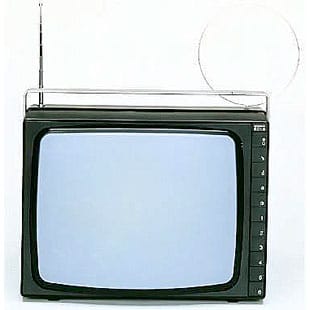
In 1970, a young designer, David Lewis, created one of the world’s first transportable TVs – Beovision 600 – long before small portable TVs became widespread. Beovision 600 was a black and white TV with a solid handle and weighed just over 13kg. Compared to the pocket-sized TVs of today, it could hardly be called portable. Nevertheless, it was transportable with a 44cm screen and excellent sound quality. The TV set won the iF Design Award in 1970.
Full transistorisation meant that sound and picture appeared at the press of a button, a new and unusual feature at the time. The cabinet was made of plastic and the handle was concealed when not in use. Six pre-set stations could be operated by one press of a button and all settings were concealed in small compartments to prevent inquisitive little fingers fiddling with them. It also featured a retractable flex.
All in all, a pioneering TV design which, in later years, was copied by many other TV manufacturers. Beovision 601 replaced its predecessor in 1973, fitted with several new features which were missed out on Beovision 600.
Beovision 6000 was a luxurious colour TV receiver with a 66cm screen and cordless, ultrasonic remote control (designed by David Lewis).
The slim remote control module allowed you to select up to eight TV programmes, adjust volume, brightness and colour strength from the correct viewing and listening position. You could also switch the set off without moving away from your armchair. The ‘recall’ facility provided a digital on-screen display indicating the channel currently being viewed. The reset function automatically returned volume, colour and brightness to pre-set levels.
Beovision 6000 was the first TV with dedicated remote control. Successor to the Beovision 3000 (1967) which was Bang & Olufsen’s first colour TV. The design of the TV set itself was by Henning Moldenhawer.
Picture quality was outstanding, with sharp, bright, precise image definition and natural colours. The automatic cut-off circuit monitored the balance of colours fifty times a second, guaranteeing long-term colour truth.
Sound reproduction was of hi-fi quality because Beovision 6000 was fitted with a 6,5 watts RMS amplifier which had a wide frequency range and less than 0,8% harmonic distortion. The loudspeaker was of a pressure-chamber construction as used in many hi-fi audio systems. There were separate controls for bass and treble and sockets for connecting headphones and additional speakers. The receiver could also be equipped with a module for Teletext reception and video cassette programmes could be reproduced without additional technical adjustment.
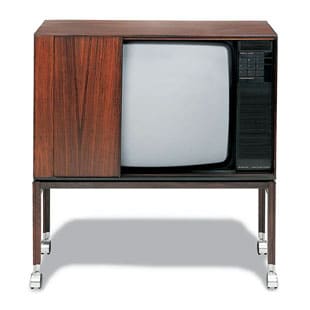
Beovision 6000’s genuine wood-finished cabinet had a unique tambour screen door for protecting the screen when the set was not in use. The self-styled wooden undercarriage with smooth-running castors was both practical and elegant.
Beovision 6000 was replaced by Beovision 6002 in 1977, again with the same stylish cabinet and sliding, tambour door.
Henning Moldenhawer (Beomaster 900 designer) once dubbed the concept of remote control Terminals as “feel commanders”. This meant that the product could be operated by the thumb on one hand – almost as if the user was feeling his way through a new type of Braille, allowing the eye to concentrate on the TV picture itself.
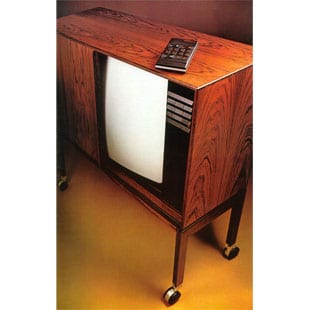
Beovision 6002 was a luxurious colour TV receiver with a 66cm (viewable) screen and cordless, ultrasonic remote control. The slim remote control module allowed you to select up to eight TV programmes, adjust volume, brightness and colour strength from the correct viewing and listening position. You could also switch the set off without moving away from your armchair. The ‘recall’ facility provided a digital on-screen display indicating the channel currently being viewed. The reset function automatically returned volume, colour and brightness to pre-set levels.
Picture quality was outstanding, with sharp, bright, precise image definition and natural colours. The automatic cut-off circuit monitored the balance of colours fifty times a second, guaranteeing long-term colour truth.
Sound reproduction was of hi-fi quality because Beovision 6002 was fitted with a 6,5 watts RMS amplifier which had a wide frequency range and less than 0,8% harmonic distortion. The loudspeaker was of a pressure-chamber construction as used in many hi-fi audio systems. There were separate controls for bass and treble and sockets for connecting headphones and additional speakers. The receiver could also be equipped with a module for Teletext reception and video cassette programmes could be reproduced without additional technical adjustment.
Beovision 6002’s genuine wood-finished cabinet had a unique tambour screen door for protecting the screen when the set was not in use. The self-styled wooden undercarriage with smooth-running castors was both practical and elegant.
The Beovision 601 was visually very similar to the Beovision 600, but it used a mildly redesigned chassis. The changes centred mostly around the receiver section, which made greater use of integrated circuits that the previous model had done.
The Beovision 601 was the last true Bang & Olufsen portable television, in as much as it was designed and produced by them in Denmark. It would be the late 1980’s before another portable model would appear, which was the disappointing MX 1500, a Philips set made in a Philips factory in Italy.
Very clever design allowed this remote to be used easily in the dark. The Hill and Dale effect of the control keys allowed one to navigate the remote with one’s thumb easily. Made not only for the top of the range 6002 but also for the 3802.