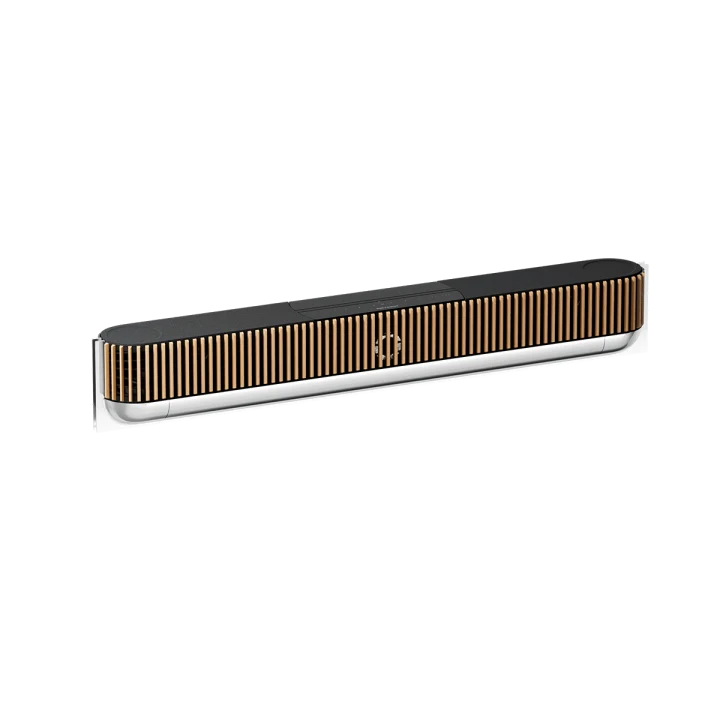
Eyes front. Ears everywhere.
Beosound Theatre doesn’t just lead from the front. Twelve custom drivers direct sound above, below and to the sides of your screen, creating a room-filling soundscape that immerses you in the moment. Dolby Atmos allows for true surround sound experiences, and a coaxial centre channel ensures crisp and clear speech. You won’t miss a word or whisper.
As you see fit
Make Beosound Theatre your own with a range of materials and finishes that cater to any taste, and any room. Need help picturing it? Our visualiser makes things simple. Select your style, and watch it come alive.
Timeless quality
Made with materials as beautiful as they are durable, Beosound Theatre proves that good things do last. There’s the timeless touch of aluminium, milled and shaped in our own Factory 5. There’s the swappable solid oak or fabric covers. This is style and longevity in unity.
Evolves over time
Beosound Theatre is made to move with the times, with advanced software that allows for future features. Time for a bigger screen? Simply slot a new one in. This modular approach means Beosound Theatre will continue to deliver a spine-tingling experience for years to come.
Lights up when you’re around
Step close to Beosound Theatre and the minimal interface springs into life. Use the glass touch panel to explore your music, choose your presets or pair with a Bluetooth device. All this with just a touch.
Stream and connect
Screen off? Beosound Theatre still streams the music you love. Connect with other speakers around your home hassle-free – through Beolink, Google Cast, Spotify Connect or Airplay.
Tuned to your space
Setting up Beosound Theatre only takes a few taps in the B&O app. For ultimate fidelity, use the included microphone to analyse your space and tune the soundbar to its unique character. The result is a truly bespoke sound experience.
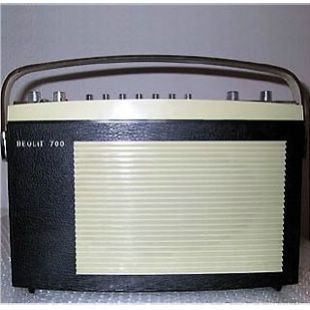
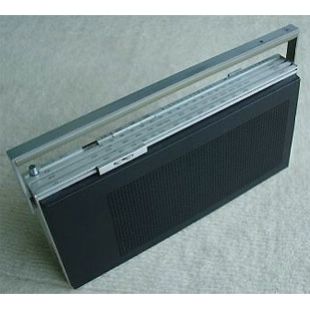
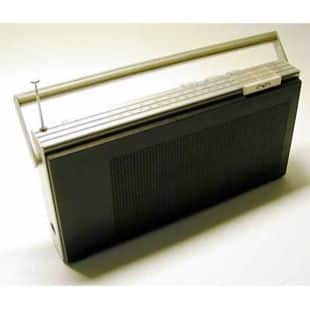
Beolit 700: equipped with FM, LW, MW and SW (the 49 metre waveband) this portable radio offered excellent audio quality and had good ability to pick up even faint radio signals/stations.
The radio had a leather handle and case and came equipped with two extendable FM antennas. It included connections for an extra antenna, an extension loudspeaker and connections for tape or record deck. The Beolit 700 could run off batteries, making it truly portable. It accommodated six size D, 1,5V batteries.
“Bang & Olufsen (the Volvo of electronics) have [one transistor] radio so elegant you can’t tell what it is, a completely anonymous plastic box that might well contain paper tissues, did it not appear to have a slide rule glued to one edge. That’s not the real trannie market, of course,; that’s just an executive toy for the man who already has hi-fi” – The art historian Rayner Banham in New Society 1974
Rayner Banham was one of the first to acknowledge that the youth and pop culture had the same artistic value as that all too objective modernistic demonstrating an anonymous anti-design. The first portable transistor radios appeared at the end of the 1950s, and during the 1960s they became part of youth culture. The early portable radios, including those from B&O, looked like ladies’ handbags and were anything but exclusive.
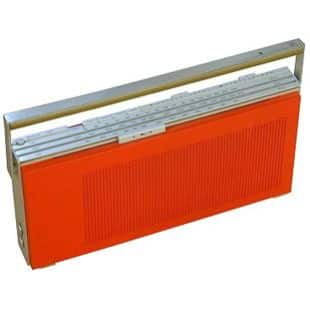
The Beolit 600 is an example of how Jensen goes in exactly the opposite direction from his competitors. Now the radio has become a design icon, a cult object, but in reality is something as banal as a redesign of B&O’s earlier, somewhat uninteresting, wood-clad transistor model – the Beolit 1000. Jensen compressed the cabinet until it was completely flat, very long and not very deep – an exciting and very architectonic shape. The openings for the loudspeakers were square and together constituted an asymmetrically placed rectangle.
People would take the transistor radio to the beach, so Jensen did what he could to make is sand proof and robust. A Plexiglas plate would not be appropriate, as it would be scratched if sand got underneath it. Jensen had the idea of taking the indicator down into the actual aluminium profile. It became a metal ball down in a groove. Jensen’s friend, the brilliant engineer Karl Gustav Zeuthen (the creator of Danish KZ aeroplanes), developed the system so that a magnet dragged the ball along down in the aluminium profile – flush again.
The sandwich construction consists of two plastic trays that can be removed in order to change batteries. They click into place on the aluminium frame. The plastic had a special velvety texture, a rough effect exuding quality. The model in black resembles charcoal. A smart detail is in the handle which can be tipped to one side as a support so that the radio can conveniently lie obliquely with the controls in front of you or on your work desk. After one of B&O’s factory buildings burned down, one of the employees happened to switch on a Beolit that had completely melted down and it played quite happily in spite of it all! ” taken from ‘Jacob Jensen’ by Christain Holmsted Olesen.
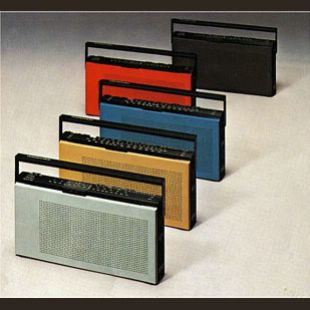
Beolit 400 – 600 range
A new range of transportable radios – the Beolit – was launched in 1970. The sound reproduction was unusually good – so good that many of the Beolits are still in use. In principle, the units were battery-powered, but the 600 version could also be connected to the mains. An amusing detail was the indication, of the selected station. This was shown by a small metal ball which moved behind a glass cover in parallel with a magnet on the exterior control slide and was thus encased and protected. Despite its sophisticated exterior, the Beolit was extremely robust.
With Beolit 600 the designer Jacob Jensen set a new standard for the manufacture and design of transistor radios. In its construction, details and finish the radio pursued the same straight lines which have always characterised B&O’s products. The radio was very functional and easy to operate.
Beolit 600: The transistor radio was one of Bang & Olufsen’s greatest sales success stories. At one time the B&O factory in Struer manufactured 600 units a day!
Even though it was light and compact it had surprisingly good sound. The solution of the scale by means of magnetic balls was both elegant and functional even though it was later overhauled by digital methods. An example of good-quality design work is the technique that can be developed and refined through time; another is the longevity of quality design. Jensen’s Beolit 600 was special because it took design seriously. Jacob Jensen was awarded the Danish Design Centre’s ID Prize in 1970 for his work with this product range.
Beolit 600 was a more comprehensive version of Beolit 400; the main difference being that AM was also included. Those radios sold in the UK offered MW and LW; in other markets the radio was fitted with two SW bands in their place. These sets also included fine-tuning controls for these bands. Another addition was that by pressing two of the band switches at the same time, the set became an amplifier and loudspeaker for use with a record player or tape recorder. An external loudspeaker or a pair of headphones could also be connected, either muting the internal loudspeaker or not, depending on how the plug was inserted.
The tuning pointer was also slightly different to that fitted to the Beolit 400. Instead of the plastic pointer, a magnet was fitted to the tuning slider inside the set, and this moved two steel balls in the grooves in the dial. Transparent plastic strips stopped them falling out should a jolt make them become detached from the magnet. This system would not work with the station markers, so these were not fitted.
In 1970, three Bang & Olufsen products designed by Jacob Jensen received the IF award. The winning products were: Beomic 2000 microphone, Beomaster 1200 tuner/amplifier and the Beolit 600 transistor radio.
“Congratulations! Well, we have done this before”, said Prince Henrik – The Queen of Denmark’s husband – when he presented the Danish ID award of the Society of Industrial Design to Bang & Olufsen, represented by Jacob Jensen, the designer. The remark made reference to the fact that B&O had also received the award the year before. The 1970 ID award was given to the Beolit 600 transistor radio, creating new norms for construction and design. That same year Beolit 600 also received the IF award.
This was the development of the Beolit 400 and like that model was FM only. However it usefully included a mains transformer so the BeoPower transformer was no longer required.
A renamed Beolit 611T, with novel features such as the rubberised feet that extended from the cabinet when the handle was moved downwards, allowing the set to be positioned on its side without danger of marking the cabinet. This wood-clad model was positioned towards the top of the Beolit range at the time, with only the mighty Beolit 1000 its superior in terms of looks and performance.
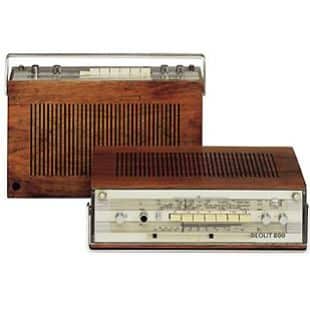
Essentially a Beolit 700 chassis with some minor modifications, mounted in a wooden cabinet, the Beolit 800 fitted neatly in the Beolit range between the 700 and the very well specified 1000. The set was powered by 6 ‘D’ sized cells, and covered FM, LW, AM and SW wavebands, with the latter having its own dedicated rod antenna (both could be used for FM coverage). These were positioned at opposite ends of the chassis, unlike the Beolit 700 where they were placed next to each other, and gave a particularly pleasing symmetry when deployed when the set was operating on its side using the handle as a stand and the feet built into the cabinet.
For its time the Beolit 800 was a well specified portable radio and commensurate with its price tag, B&O equipped the set with features that would be expected of a radio at the higher end of the market. Connections for an external speaker or headphones, and a tape recorder or gramophone were located at the bottom of the set, with cut outs on the bottom plate for the cables to exit if connected. Treble and bass controls were provided, as was a separate tuning scale for the FM band. A duplex drive was fitted to allow a single tuning knob to be used on both the LW/AM/SW and FM tuning scales depending on which band had been selected. Like many of the other Beolits, the 800 included a ‘Radicator’, which served the dual purpose of showing the battery voltage when no station was tuned in, or the extent to which the receiver was tuned to a particular station. This latter function was particularly useful if the owner wished to use the set to take bearings using the internal ferrite rod antenna.
One interesting feature not copied on other Beolits was the use of a series of sliding indicators in a channel running underneath the FM tuning scale. Presumably an early and simple form of pre-sets, these could be lined up with a particular station’s frequency, and used to quickly line up the tuning pointer to these frequencies. A useful feature no doubt, but a disappointing one aesthetically as the sliders were made of flimsy plastic, and did not do justice to an otherwise visually pleasing set that was well constructed using mostly wood and metal parts. Overall though, the Beolit 800 was a well thought through addition to the Beolit range, offering as it did a range of placement options in an elegant wooden cabinet for the discerning customer. When it was withdrawn in 1968 it was not replaced directly, and the mainstay of the Beolit range to come in the form of the Beolit 600, took some of its styling cues from the Beolit 1000, leaving the 800 and the 1000 as the last Beolits to be offered with a wooden cabinet.
Review kindly written by Beoworld member John Barker
Beolit 700 Type 1505 was equipped with FM, LW and MW. The radio was compact and light and offered extremely high quality sound. There were sockets for one external speaker and for a record player or tape player/recorder. The portable radio was produced for the European marked and used 220-240V, 50Hz 0,7-5W, or a set of five size-D, 1,5V batteries.
The Beolit was one of the very few portable radios that were suitable for reproducing more than just news broadcasts. Sound quality was so good that music programmes could be reproduced with a quality that made them worth listening to. The Beolit was fitted with a mains transformer and a detachable lead. Operation was simple and problem-free. And since portable radios can end up in unenviable situations, the Beolit was constructed to withstand some rough treatment. A robust chassis protects the internal circuitry and a special surface treatment protects the radio from scratches. Dirty marks were easily removed with a damp cloth.
Beolit 707 received radio programmes on FM, long and medium wavebands. This portable radio was Bang & Olufsen’s handiest music system. Its sound reproduction quality was so outstanding that it invites even critical music lovers to listen to music programmes when they are away from home.
Power input was specified at a pure 1 watt and frequency range was 65-20 000 Hz: exceptional for a transportable radio receiver. A large tuning scale with thumb wheels made tuning easy. Bass and treble was adjusted separately and there was an AFC facility to keep FM stations correctly tuned.
Beolit 707 could be plugged into the mains supply or run from batteries. The cabinet was finished in coloured Nextel – a synthetic material with a suede-like finish which is washable ands scratch-proof. It was designed by Jacob Jensen, the same as its FM-only sibling, Beolit 505.
The Beolit was one of the very few portable radios that were suitable for reproducing more than just news broadcasts. Sound quality was so good that music programmes could be reproduced with a quality that made them worth listening to. The Beolit was fitted with a mains transformer and a detachable lead. Operation was simple and problem-free. And since portable radios can end up in unenviable situations, the Beolit was constructed to withstand some rough treatment.
A robust chassis protects the internal circuitry and a special surface treatment protects the radio from scratches. Dirty marks were easily removed with a damp cloth.
“FM, Long Wave, Medium wave and Marine band. Push-button band switching. Built-in AM aerial. Telescopic whip for FM. Flywheel tuning. Separate bass and treble controls. Jacks for external aerial, extension speaker and gramophone. Rugged weather-resistant cabinet of impact-proof polystyrene in four elegant two-colour combinations. Car mounting bracket available. Dimensions: 223 mm high, 320 mm wide, 109 mm deep. ” – taken from the 1967 – 1968 Bang & Olufsen product catalogue (Read more on the BeoWorld Connoisseurs’ Club)
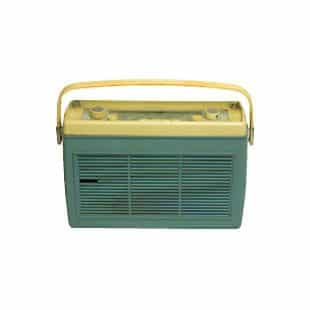
Beolit 600 was a very popular transistorised radio set of the mid-1960s. Unusually for the time, it featured an FM band, made possible by special transistors which had recently become available. These, like the others in the set, were sourced from Siemens, but were similar to those being made by Philips/Mullard. The output level was high for a transistor set, so a lot of power was needed. This came from six “D” size batteries mounted in an internal box. Access was through the bottom of the set, and would have been frequent if high volume settings were regularly used! There was no option of mains power for this model, the Beopower 600 mains adaptor was only suitable for sets made after 1970, which were of a completely different design.
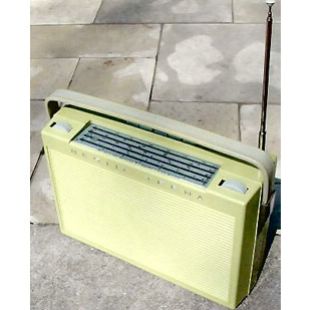
The set was solid and sturdy, the plastic panels on the outside being purely cosmetic. Inside, there was a metal framework holding all the internal parts including the loudspeaker. Damping materials were fitted in places where it was thought resonance may occur. The styling was much admired, particularly by Murphy Radio, who copied it accurately in one of their models.
Beolit 600 included features such as proper treble and bass controls, a dual function battery and tuning meter (this changed function automatically when a broadcast was received), headphone and tape recorder sockets and coverage of the marine band (on the lower frequency short waves).
In 1970 Beolit 600 was replaced by the new Beolit 600 ‘colour radio’ range.