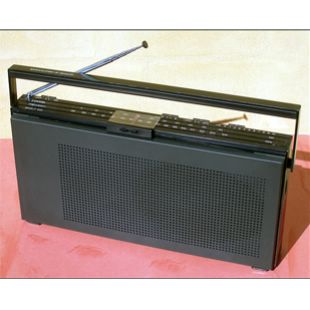
Beolit 505 was a pure FM radio with AFC facility to ensure clean, sharp reception. It had an in-built large, high quality speaker together with a built-in telescopic aerial. It had six programme indicators (affixed to sliding tuning scale) and connection for a tape recorder. It was designed by Jacob Jensen, the same as its FM and AM bigger brother, Beolit 707.
The Beolit was one of the very few portable radios that were suitable for reproducing more than just news broadcasts. Sound quality was so good that music programmes could be reproduced with a quality that made them worth listening to. The Beolit was fitted with a mains transformer and a detachable lead. Operation was simple and problem-free. And since portable radios can end up in unenviable situations, the Beolit was constructed to withstand some rough treatment.
A robust chassis protects the internal circuitry and a special surface treatment protects the radio from scratches. Dirty marks were easily removed with a damp cloth.
In the 1960’s, small, transistorised radios became extremely popular. This was a result of miniaturisation of electronics products. The world leaders on the road to miniaturisation as we know it today, were the Japanese. Bang & Olufsen eager to come up with its own idea of making products smaller, designed its own transistorised radio: the Beolit 500.
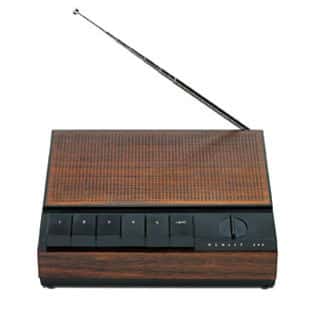
An FM transistor set, entirely without dial, with push-button selection of up to five pre-tunable stations. The Beolit 500 has a large high-performance speaker, a telescopic FM whip, jacks for tape recorder, gramophone and extension speaker, automatic frequency control, and good battery economy. An attractive extra feature: the Beolit 500 can be used as an intercom system. Dimensions: 76 mm high, 264 mm wide, 191 mm deep. Choice of teak or Brazilian rosewood finish. Not available in the UK.
Beolit 500, type 1101 is one of those so-called ‘transistor radios’ – a small portable radio that could be carried around. However, Bang & Olufsen worked on the assumption that these small ‘portable’ radios were most often stationary. As well as an FM radio receiver, Beolit 500 could be used as an intercom via an extra loudspeaker (that it could also be adapted to receive police radio communications by short-circuiting a couple of switches was an entertaining, but unintentional side-effect).
Sockets for an external 7.5V power supply (via Beopower 600) and a tape recorder were fitted.
A new range of transportable radios – the Beolit – was launched in 1970. The sound reproduction was unusually good – so good that many of the Beolits are still in use. In principle, the units were battery-powered, but the 600 version could also be connected to the mains. An amusing detail was the indication, of the selected station. This was shown by a small metal ball which moved behind a glass cover in parallel with a magnet on the exterior control slide and was thus encased and protected. Despite its sophisticated exterior, the Beolit was extremely robust.
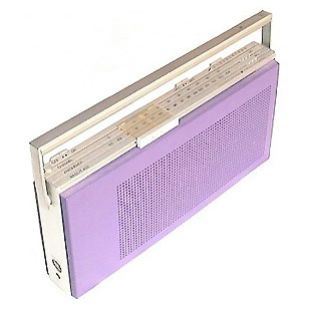
Beolit 400 was a basic FM-only portable radio, in much the same way as its replacement, Beolit 505. The case was partly aluminium, partly coloured plastic, which formed the front and rear panels. Bright colours such as red, yellow, green and purple were offered, along with black. As the panels were only clipped on and did not form part of the chassis, they could be replaced with different coloured ones at a later date.
The design allowed the set to be used vertically or horizontally, supported by its handle. Even though there was only one loudspeaker, there were grilles on both sides of the radio, so that sound was distributed evenly from both directions. The sliding dial on the top of the radio was similar to that offered on Beomaster 901. A transparent plastic pointer, like that of a slide rule, was slid across the top in order to adjust the tuning, little wheels fitted to the side could be used for accurate setting. Little markers could be set, whose projecting tops slightly blocked the pointer on its way past, providing a reference to frequently-used stations.
A powerful AFC system, which could be turned off during tuning, was also included. The amplifier could provide 3 watts of output, unusually high for such a small set. Sockets for an external 7.5V power supply (via Beopower 600) and a tape recorder were fitted.
The Bang & Olufsen Beolit 400 transistor radio, designed by Jacob Jensen was presented with the IF Award in 1971 and the ID AWARD the year before. In 1972 the Museum of Modern Art in New York (MoMA) chose seven Bang & Olufsen products designed by Jacob Jensen to be included in their Design Collection as representing excellent examples of the Museum’s criteria for quality and historical importance; design, in fact, which had influenced the twentieth century. Beolit 400 was were one of those seven products.
The Socket Unit contains most of the electronics, as well as all external connections. This greatly helps the organising and concealment of the numerous cables needed in a typical A/V set-up. In BeoCenter 2 only a single thin cable, available in 1.8, 3, 5 and 10 metre lengths, connects the Master Unit to the Socket Unit. A 1.8 metre cable is delivered as standard.
The Socket Unit is fitted with MasterLink, RGB, PowerLink, power connections and other connectors so that you may connect a pair of BeoLab active speakers or link it to a home cinema system.
A great advantage of the compactness and relative lightness of the BeoCenter 2 Master Unit is great flexibility in placement. It can be wall mounted, attached to a dedicated floor or table stand, or simply placed on a table or shelf.
Digital Radio Module
BeoCenter 2 DAB digital radio module: this module allows users access to terrestrial free-to-air broadcasting of high quality audio and data. DAB digital radio is a new way of broadcasting radio via a network of terrestrial transmitters. It provides listeners with more choice, better sound quality and more information. DAB digital radio is like analogue radio, only much better. When available – from 3 November 2004 – the module will become a standard feature of BeoCenter 2 in the UK.
In order to make the module compatible it has been necessary to update both the Socket Unit and the Master Unit. This, however, means that DAB will not be available with past and current BeoCenter 2 models. It was originally stated upon the launch of BeoCenter 2, that it would be possible to ‘upgrade’ to DAB. Where customers purchased the model on that understanding, Bang & Olufsen will honour that commitment. The first Master Unit serial number with software suitable for the DAB functionality is 18139286.
Note: To have the DAB module fitted to your BeoCenter 2 is essential that both the Socket Unit and Master unit are the latest versions. Mixing existing stock of Master Units (pre-serial number 18139286) and DAB Socket Units (part number 1280020) is not possible.
Master unit connections: MasterLink x 1, Digital Out, SCART, S-VHS, FM Aerial, AM Aerial, audio in (L&R), audio out (L&R), PowerLink x 1 (See Specifications).
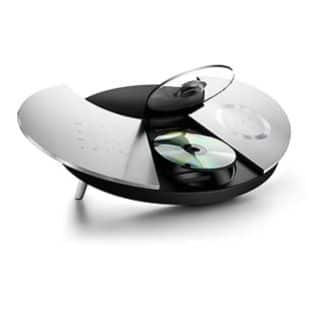
By touching ‘load’ on the anodised aluminium top panel, BeoCenter 2 opens to receive your chosen media. The product is made up of two units linked together by a special cable: the Master Unit (or Media Unit which is the player itself) and the Socket Unit.
BeoCenter 2 Press Release October 2003
Bang & Olufsen’s new music system, the BeoCenter 2, is in many ways a classic Bang & Olufsen product. It has mystique, it is elegant, it is simple and logical.
If you look at the BeoCenter 2 from a distance, the design says nothing about the many functions the system contains. Only when you make physical contact is the content behind the symmetrical polished aluminium doors revealed. If you press “load” lightly, the two wing-shaped aluminium doors slide aside elegantly to reveal a combined CD and DVD player. When the music or film is playing, the doors slide back to conceal the disc, clearly signalling that the experience is more important than the source.
It is by no means unusual for a DVD player to play CDs, but a system that offers radio, CD, DVD and MP3 CD playback is a new way of combining all sources of entertainment in one unit. “At Bang & Olufsen we always focus on integrating technologies and with the BeoCenter 2 we give our customers the chance to combine music and video sources in one unit,” says President and CEO Torben Ballegaard Sorensen.
With the oval shape of the master unit, BeoCenter 2 is yet another design step away from the traditional box-shaped units of yesteryear for playing music and images. The size of the display ensures that it can be read at a distance and a light meter behind the glass adjusts the intensity of the display according to the brightness of the room. This avoids the display completely illuminating a dark living room.
In addition to RDS (Radio Data System), the tuner in BeoCenter 2 allows you to program and name up to 60 radio stations. And, of course, the BeoCenter 2 can be integrated into a Beolink network. When connected to a Beolink PC2 it can also play digital music files stored on a computer.
Clean up the Mess
It has always been important for Bang & Olufsen to make it nice and easy for consumers to enjoy music and moving pictures. Most obviously, the concept helps to eliminate the many remote controls that typically pile up on the coffee table, replacing them with one remote control – the Beo4 – which can control all the functions of all the appliances connected, plus the lighting in the room.
Another example is the tradition of concealing cables in stands and behind screens so that the necessary cables do not mar the visual appearance of the products. And where it is not possible to conceal the cables completely, special holders are provided for the cables, making a virtue out of necessity. Finally, there is the design itself. By avoiding visual trivialities and unsightliness, which can mar an audio/video product in themselves, the products look simple and elegant.
BeoCenter 2 is a continuation, a natural development, of this line of thought. The division of the product into two separate parts means that there is great freedom to place the elegant master unit where it is best suited in the room. This may be on a table, mounted on the wall or on an aluminium floor stand specially designed to match the oval shape of the master unit.
From the master unit there is just one cable to the socket unit containing the sockets for all the cables connecting BeoCenter 2 to the mains, speakers, TV, aerials, etc. The socket unit can be concealed under a piece of furniture or behind a curtain. This means that the visible part of the BeoCenter 2 is not spoiled by the jumble of cables required to integrate it into the network of the TV and speakers.
World Class Aluminium Processing
BeoCenter 2’s two sliding aluminium doors were a challenge to Bang & Olufsen. Both doors are cut from the same piece of aluminium, but only after the front has been polished in the oval shape that follows the lower edge of the display. This ensures that all details in the polishing are echoed on both doors. Both these sliding doors stay together throughout the complicated process of milling and the two surface treatments. So the doors on the final product match perfectly.
The precision requirements Bang & Olufsen sets for the visual appearance of the product mean that the machine which grinds the edges of the doors works to very small tolerances. For every 1/100 millimetre along the edge, the machine calculates and self-corrects to ensure a perfect oval shape.
When the aluminium is surface-treated in the anodisation plant, tiny pores appear in the surface. These pores are used in the screen printing employed to apply numbers and characters to the front of the doors of the master unit. By pressing the coloured lacquer down into the pores and then surface-treating the doors, very durable printing is achieved. As a result, it is virtually impossible to wear the printing off, even with very frequent use.
Controlling the BeoCenter 2 is a masterpiece of precision. The area beneath the master unit is milled down to 0.5 millimetres. So when the user presses the unit, the thin aluminium sheet bends very easily. This activates the electrical circuits used for the control function. You can neither see nor feel this, but it is enough for it to make contact with the film of conductive material underneath.
The precision processing goes one stage further with the “wheel” on the right-hand door. In a wide circle around the control areas, a further 0.1 millimetre of aluminium has been milled off. The functions of the wheel include adjusting the volume, and it functions according to the same mechanical principle as the rest of the master unit.
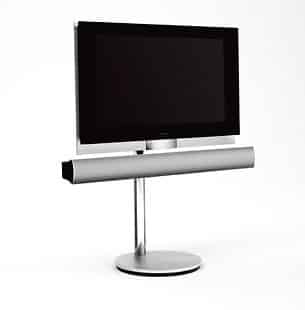
“BeoVision 7 is more than just a TV; it’s a complete entertainment system specially created to offer a sound and picture experience far beyond expectations. With its 81cm LCD screen, built-in DVD player and powerful active loudspeaker system, BeoVision 7 offers all the benefits of flat-screen viewing, but with exceptional sound performance as well.”
BeoVision 7 combines both an 81cm LCD monitor with an integrated DVD Player, DSS surround sound module and a dedicated loudspeaker in BeoLab 7-1. The concept emphasises the separation of picture and sound together with a good number of placement options. With BeoLab 7-1 the very highest level of acoustic performance is delivered. BeoVision 7 has a higher display resolution than that of BeoVision 6 – 26: 1366 x 768 (WXGA) pixels against 1280 x 768 pixels of BeoVision 6.
BeoVision 7 may be used as either a stand-alone television set or as a large-screen monitor within a domestic surround-sound system. There are five different stand placement options available to the user:
Mounting Options & Stands
Original Bang & Olufsen stands available at launch included: Fixed position Table Stand, motorised Table Stand, motorised Table Stand, moveable Wall Bracket for TV and Loudspeaker (close or extended versions) and a motorised Floor Stand. A fixed Wall Bracket for BeoVision 7 32 was added to the stand portfolio after launch.
Each of the above options hold both the monitor and the BeoLab 7-1 active speaker; with the exception of the Table Stand, each has the vertical tilt feature.
BeoVision 7 offers the following as standard:
Dolby Digital/DTS Surround Sound
MasterLink Module
Set-Top Box Controller
RF Modulator
Anti-Reflex Coated Contrast Screen
DVI PC input
Part Numbers:
BeoVision 7 – 1816089
Table Stand – 1409766
Wall Bracket – Fixed – 1409511
Motorised Floor Stand – 1409111
Wall Bracket – Moveable – 1409611
Motorised Table Stand – 1409211
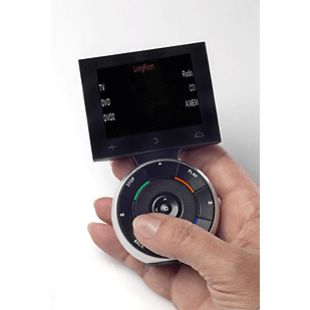
The Beo5 is expected to become an important part of the new B&O range. It is designed to work with all of the range but is particularly suited to use with the TV range when partnered with the BeoMedia devices.
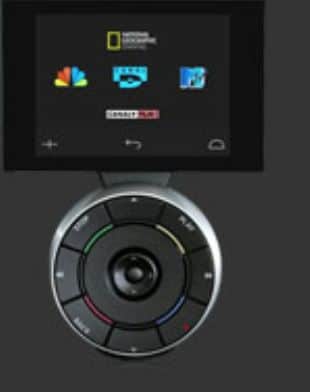
A backlit screen, which is able to be configured via a USB connection on the docking/charging station, sits on top of a very tactile metal control sphere. The interface is a modification of the well known Beo4 layout but with the addition of a click wheel and ring of control buttons. A numeric keyboard can be activated on the touch sensitive screen by pressing TEXT. Different set ups of screen can be customised by the user though this has to be set up by the dealer. Configuration is a dealer task.
One Way Traffic
The remote is not the hoped for return to two way remote control but does allow the screen to be customised to suit a user’s system. In particular it is thought that program logos could be able to be imported onto the screen. It would appear that these are B&O defined so may be somewhat limited.
Fully Compatible
As the Beo5 uses a derivative of the original Beolink 1000 codes, it is able to be used with many products dating right back to the eighties. It will replace the Beo4 in time and will be supplemented by a basic control for sets such as the Beovision 8.
The Beo6 replaces the Beo5 and adds a wide screen which is touch sensitive rather than the pressure sensitive screen of the Beo5. Initially, little will seem different but once the BeoSound 5 Encore is released and the BeoSound 5 is updated, two way control including tag information and cover art will be enabled.
The communication is wireless via the router the BS5 Encore is connected to.
A statement in sound and sight.
Beosound A9 makes every musical moment rich, detailed and immersive – all from a seamless circular shape that blends in beautifully or stands out confidently.
Crafted from premium anodised aluminium, fabric and real oak, it’s a timeless work of art that can be customised to match your space and taste. When it’s time to dial up the volume, simply slide your finger gently across the top surface – and with a simple tap you can skip to the next or previous track and play/pause your music.
New degrees of detail
A9 stands strong on real oak legs, and delivers your music through acoustically calibrated covers. Ringed with precision-milled aluminium and backed by high-quality polymers, it forms an endless loop of engineering and art.
Customisable design
The shape is timeless, but the shade is yours to choose. A9 is a customisable centrepiece that adapts to your taste and space. Want a striking colour? You’re covered. Different legs? Swap them out. Personalise your speaker to chime with any room, and sing in any home.
Sculptural design
Beosound A9’s iconic shape is designed to be displayed. From afar, it’s a minimalistic masterpiece. Up close, the details shine. Just like your favourite furniture, it stands apart in any room. And if you prefer it on the wall, it rises to the occasion. Enjoy beauty from every angle, whether you press play or not.
Active room compensation
A9 works out where it is in the room to give you perfect playback, every time. Ensuring bass, mids and highs are never too overpowering or weak. Wherever you place it, it gives a standout performance. No muddiness. No fuzziness. Just pure, clean sound. As the artist intended.
Room-filling sound
When A9 plays, the whole room takes notice. Boasting volume that rivals much bigger speaker setups, it’s perfect for large spaces and get-togethers. Want a more immersive experience? Seamlessly connect A9 with other speakers to let the music flow through your home.
Sound mode Set.
Time to entertain? Dial up the bass. A moment to relax? Level things out, like when it’s time for your favourite podcast. The B&O app gives you customisable sound, right in the palm of your hand.
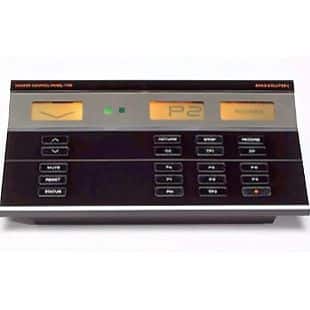
The first Master Control Panel and the first two way remote made by Bang & Olufsen, the MCP 7700 was designed to be used with the Beocenter 7700.
It can now be seen as the precursor to the Beosystem 5000 family though it was not as sophisticated as its descendants. It also had a back lit LCD display rather than the LED display used in the MCP 5000.
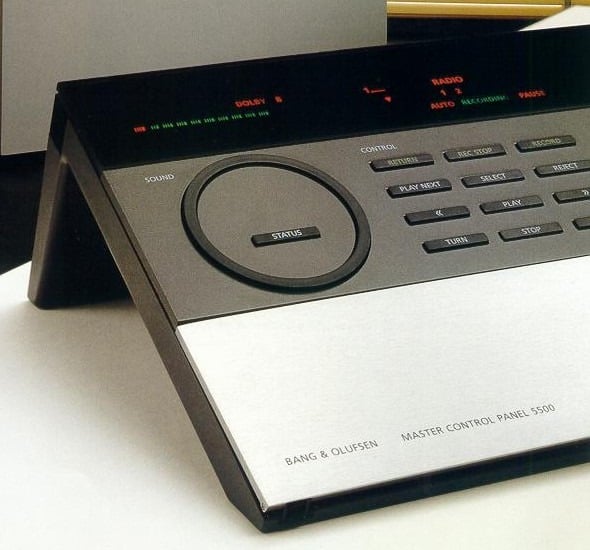
The MCP 5500 was the updated version of the MCP 5000 and was easily distinguished by the rotary controller which was used primarily for volume control but also had secondary functions enabled allowing treble, bass and balance to be controlled.
Unlike the MCP 5000, it used what were essentially Beolink 1000 codes but required an additional code to be sent by the Beomaster to allow two way control. Only the Beomaster 5500, 6500 and 7000 provided these signals so it was of limited value with other systems.
It was available in white to match the Whiteline 5500 system.