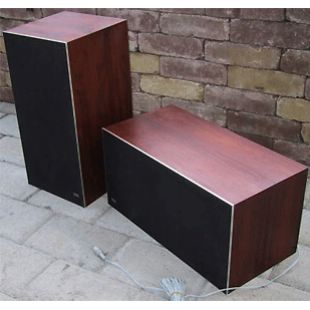
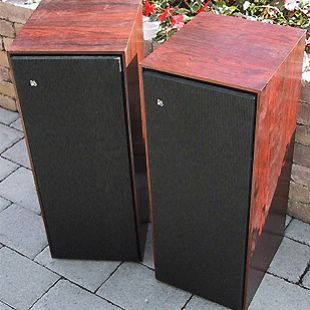
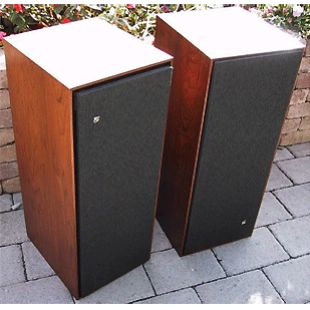
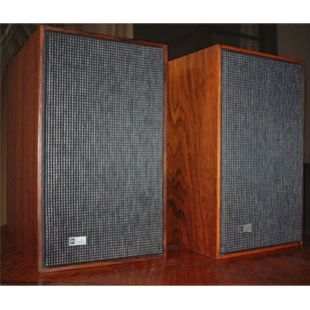
In 1972 the Museum of Modern Art in New York (MoMA) chose seven Bang & Olufsen products designed by Jacob Jensen to be included in their Design Collection as representing excellent examples of the Museum’s criteria for quality and historical importance; design, in fact, which had influenced the twentieth century. Beovox 2700 were one of those seven products. That same year Beovox 2700 won the iF Design Award.
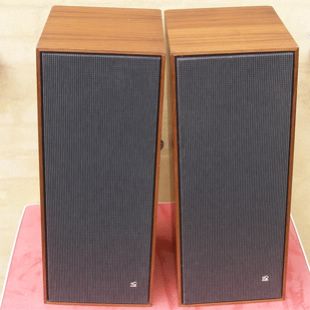
Rated at 30W, the Beovox 2600 was powerful enough to be used with the Beomaster 3000, though it was also recomended for use with the Beomaster 1000, 1200 and 1600.
Slightly larger than the Beovox 1200 of the same year, it was fitted with an 8” woofer with a rubber roll edge and a 1.5” dome tweeter. Befitting a loudspeaker to be used with the excellent Beomaster 3000, the Beovox 2600 met all the conditions of the DIN 45 500 “hi-fi” standard.
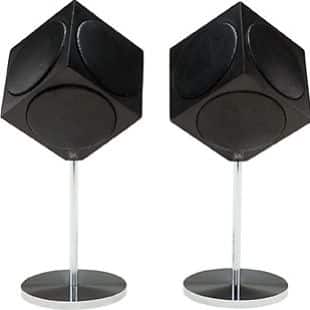
Beovox 2500 Type 6211 were ‘cube tweeter’ speakers, launched at the same time as the innovative BeoLab 5000. The Beovox 2500 Cube loudspeakers were developed to complement both the Beomaster 5000 and BeoLab 5000 in order to spread the high tones. For decades, controlling the directivity and dispersion of particularly the higher frequencies has been a key concern for loudspeaker designers worldwide.
The ability to control the higher frequencies is crucial, as they carry the majority of sonic information about what you are listening to, and where the sound is coming from. During the 1960s, Bang & Olufsen’s Acoustic Engineers were just as concerned with creating a “quality stereo” experience. Whereas it did not matter just how bass frequencies were distributed (as the human ear cannot differentiate the direction of low frequencies) the problem of ensuring good dispersion of midrange and treble frequencies has always persisted.
The problem back then was the same as today; whereas there is no directional problem with the bass, how to ensure dispersion of the midrange and treble? The focus was on the treble, as the higher the frequency range, the narrower the field of dispersion. Beovox 2500 Cube, released in 1967, was an attempt at an omni-directional treble loudspeaker, where the six driver units in the cube-shaped cabinet overlapped to cover all fields. The six driver units, one on each face of the cube, presented a rather special placement problem, which was solved by balancing the loudspeaker on one of the corners. It could therefore rest on a stand or hang from the ceiling.
Of course, with the overlapping fields and reflections from walls, floor and ceiling, the solution wasn’t perfect, but the Beovox 2500 Cube received universal acclaim from audiophile circles at the time for its ability to provide omnipresent sound. Its compact proportions and design, as well as the idea behind it have all contributed Beovox 2500 Cube’s current status as a cult product.
With its six high-frequency tweeters radiating in all directions, Beovox 2500 could be base- or wall-mounted, or even mounted from the ceiling. The compact speakers ensured complete spatial distribution of the highest notes, and its maximum power handling capacity in the range above 2000 Hz was 60W. The speaker was the ideal tweeter for a Beolab system. It could be connected to Beovox 5000 and Beovox 3000.
At the 1967 spring fair in Hanover, B&O and Jacob Jensen – the designer of the speakers – received the IF award for the Beomaster 5000, BeoLab 5000 and Beovox 2500 Cube loudspeakers for outstanding and user-friendly design.
“B&O loudspeakers will meet very exacting conditions as their specifications exceed international hi-fi standards. All B&O speakers are of the pressure-chamber type with an impedance of 4 ohms. They are available in matched pairs only in a choice of teak or Brazilian rosewood finish” – taken from the 1967 – 1968 Bang & Olufsen product catalogue
B&O loudspeakers will meet very exacting conditions as their specifications exceed international hi-fi standards. All B&O speakers are of the pressure-chamber type with an impedance of 4 ohms. They are available in matched pairs only in a choice of teak or Brazilian rosewood finish
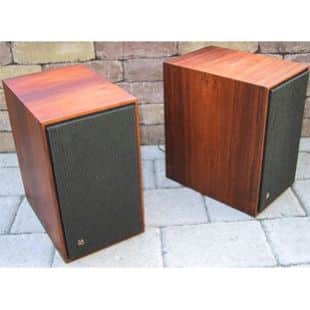
Only being available for two years, these small bookshelf speakers
are not that well known. With their old style cone tweeter but a modern small size, they can be considered a link between the 1960s and 70s. The small power handling capacity probably was to be blamed for their demise though, as most receivers introduced in the early ’70s already well exceeded the rated power.
These aren’t the speakers to use at a party, but at moderate volume they produce a very pleasing warm sound especially with acoustic music. The cone tweeter however makes them highly directional, so they are best used in set-ups where you can direct them straight at the preferred listening position.
Beovox 2200 bass drivers have rubber roll edges, so there is no need to worry about foam rot. If the speakers sound fine with all drivers working, they should be a safe buy even without further investigation. The frets, constructed on a wood/metal frame, are however easy to carefully pry off for inspection.
These speakers blend very well on a bookshelf, taking only a little bit more space than, say, a CX100 – and a small, golden old style B&O emblem on the fret accentuates the look. Highly recommended
to complete a vintage set-up with a contemporary Beomaster 900M, for example.
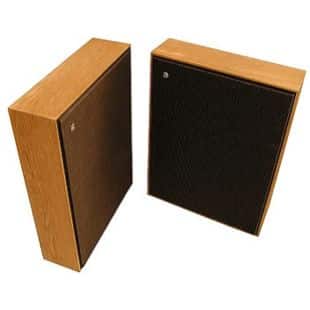
The plain exterior of the Beovox 1600 concealed an interesting design. Designed for wall mounting, either vertically or horizontally, the Beovox 1600 was the ideal for the mid range B&O models of the period such as the Beomaster 1200 or Beocord 2400.
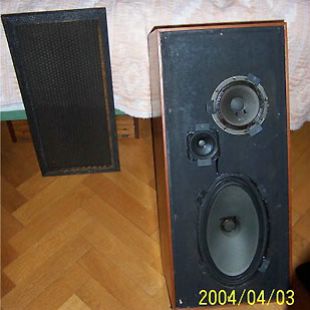
The Beovox 1600 was a three-way design. The units comprised a 12cm woofer, a 2.5cm dome midrange and a 4cm cone tweeter. These units were supplied by Wharfdale (England), Philips (Holland) and SEAS (Norway) respectively. An odd mix, though they were all of good quality and were well made, the woofer had a rot-resistant soft rubber roll edge and a pressure die-cast basket for example. Using a cone driver as the tweeter and a dome for the midrange was odd practice, though it has to be remembered that these were early days for dome loudspeakers in general.
The crossover network was of a fairly standard three-stage parallel design complete with a band pass section for the midrange. Unusually for B&O, a film capacitor was used as the pass element for the tweeter, normally a cheaper electrolytic capacitor would be found here.
The slim cabinets also had an unusual feature, they were braced from front to back to make the large front and rear panels more rigid. This may have been done to stiffen the rear panel in particular, to reduce the amount of acoustic energy that was transmitted into the wall. The cabinets were constructed on the pressure chamber principle and were fronted by a cloth grille that was supported on a pressed steel sheet.
B&O had clearly put a lot of work into the Beovox 1600. It was later replaced by the Beovox 1800.
The crowning glory of Beolab 20 is the Acoustic Lens that delivers smooth high-frequency sound in full 180 degrees. The results are uncompromising listening experiences across your room and much greater freedom in terms of where you place your speaker for optimal sound.
Review thanks to BeoWorld member Sajpratty – Thanks Steve.
Test environment…
BeoMaster 1000 (white key version, tone controls all at neutral)
BeoGram 1000 (SP 6-7)
Side-by-side comparison with BV1000 (all speakers still on original capacitors)
Correct period (for sound balance) sources:
Arthur Lyman “Taboo” (chosen for range of instruments and no remix “work”) – (a 1958 pressing recorded 16-20000 cps, mono)
The Beatles “Please Please Me” – (a 1964 pressing, mono)
Dvorak’s Symphony No. 9, Alexander Gibson and the LPO – (a 1967 pressing, stereo)
Bass response
Very deep, deeper than the BV1000 and better defined. Close to the lower limits of my ears but still easy to hear the different notes played.
The BV1000, in contrast, never gave the impression that the lower ranges of my hearing were being tested.
Treble response
Very similar in quality to the BV1000, but reached a bit higher without losing detail. Very sensitive to positioning, quite directional, possibly more so than the BV1000.
Midrange balance
Adjustable to taste (5-position switch at rear.)
General impressions
Double bass – low, defined, easy to hear the different notes played, very easy to tell the difference from electric bass.
Grand piano – I’ve stood next to real pianos being played, this sounded and felt exactly the same.
Flute – nice and “woody” sounding.
Sleigh bells – sounded clear and resonant.
Cymbals – bright and well defined.
Snare drum – I’ve had a go on one of these, this also sounded exactly the same.
Orchestral – sounded nice on the BV1000’s but the BV1500’s raised goosebumps.
In use – I prefer the BV1000’s for voice and the BV1500’s for music.
However, it was fitted with higher quality drive units (one 6” woofer and one 1.5” dome tweeter), which gave it a considerable performance advantage. The dome tweeter in particular was a great improvement over the cone type of the Beovox 600. The superior quality meant that the Beovox 1100 met the DIN 45 500 requirements for hi-fi. While it was still suitable for use with the same models as the Beovox 600, it could also be used with some of the better Beomasters, such as the 1000, 1200, 1400 and 1600.
“B&O loudspeakers will meet very exacting conditions as their specifications exceed international hi-fi standards. All B&O speakers are of the pressure-chamber type with an impedance of 4 ohms. They are available in matched pairs only in a choice of teak or Brazilian rosewood finish”
– taken from the 1967 – 1968 Bang & Olufsen product catalogue