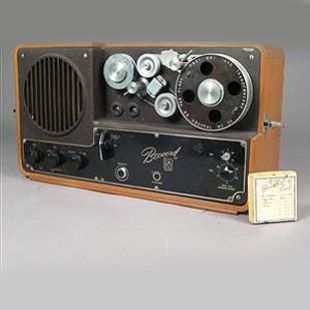
BeoCord V8804
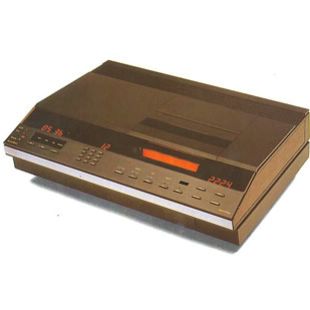
A further development of the Video 2000 video recorder.

A further development of the Video 2000 video recorder.
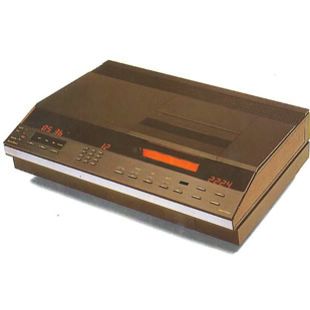
If your choice of TV viewing included video, the Beovision Video Terminal supplied with your Beovision 5100, 7100 or 8100 (or Beovision models 5500, 7700, 8800 and 9000 featured in the 1982 Autumn catalogue) could also be used to operate the Beocord V8802 video cassette recorder.
There were two types of video stand available, specially designed to accommodate any Bang & Olufsen VCR and combine them into a complete video system that was easy to install, easy to live with and a joy to use.
Beocord V8802 used the technical superiority of the V2000 format to guarantee top-quality recording and playback on economical flip-over cassettes. The 2×4 hour flip-over cassettes gave you 8 hours of recording time in one tape, which worked out cheaper in cost-per-minute terms than any other video format.
Microcomputer technology gave Beocord 8802-V a wide range of features and facilities and, at the same time, ensures that operation was fast, straightforward and fool-proof. Automatic track adjustment meant that even well-worn tapes recorded on another machine were reproduced accurately – that was important if you intended to hire feature film cassettes for home screening.
Sound quality was also of the highest quality with a technique called Dynamic Sound Suppression, reducing distortion and unwanted noise to negligible levels.
Freeze-frame and picture search are useful features, especially for sports fans, and both could be operated by remote control.
Another outstanding benefit was the ease with which Beocord’s computer-controlled timer could be programmed to make up to 5 automatic recordings from any 5 TV channels within a 16-day period. Of course, you could also record one programme while watching another. The Beovision Video Terminal kept you in control of the whole system without moving more than a finger.
The Terminal was supplied as part of the TV; if you purchased Beocord V8802 separately, or with a manual Beovision TV, the Terminal had to be purchased as an optional accessory in order for you to obtain the extra convenience of remotely controlled video.
Programming Beocord V8802 to make unattended recordings was quick and easy, thanks to logical control systems and microcomputers. Simply key in the channel, the day and the start and stop times of the programme you wanted recording. Each instruction was confirmed on the illuminated communications panel. The microcomputer’s memory could store 5 such sets of instructions covering the period of 16 days ahead. You could even check your programming for accuracy and correct mistakes by operating the ‘clear’ button. When all the programmed recordings had been completed the machine rewound the tape ready for instant replay.
The 8-hour flip-over cassette was more convenient and economical to use than any other type then on the market. The cassettes were tamper-proof: it was impossible to damage them by touching any moving parts or the tape itself. A safety switch built into the cassette casing prevented the inadvertent erasure of recordings you wanted to keep.
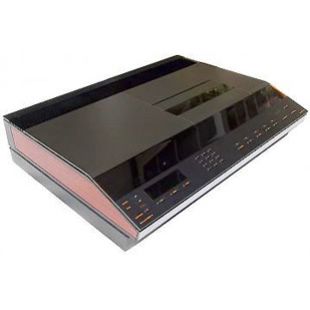
Beosystem 8800 Video was the only fully integrated home video system on the market in the early 1980’s. It comprised the Beocord 8800 video recorder, the Beovision 8800 colour TV, the Beovision Video Terminal and an elegant custom-built stand.
These individual components were designed to match and function harmoniously as one complete system, from a technical, functional, aesthetic and operational point of view. That is why you could operate all primary functions in the entire system from a distance using one infra-red remote control module. This gave you fast, easy, direct access to all facilities, whether these were ordinary TV programmes, recording or playback of video cassettes or Teletext home information services (when the Teletext circuitry is installed). Naturally, you could also make all important sound and video adjustments from the comfort of your chair.
The heart of Beocord 8800 Video was the 2 x 4-hour flip-over cassette – as part of the V2000 video system (similar to VHS and Betamax). It allowed you to make use of up to 8 hours recording time on one cassette, whereas most competing systems offered just 3,25 hours. Thus, the cassette was not only more convenient, it was also more economical to use than any other cassette on the market.
Another outstanding feature was that you could programme the Beocord to make 5 unattended recordings from 5 different TV channels at 5 different times up to 16 days in advance. You could have a relaxing holiday or travel on business, and be rest assured that you wouldn’t have to miss any of the programmes in your favourite TV series.
This creative use of machine intelligence (micro-computers) and the degree of flexibility and convenience afforded were unparalleled in competing video recorders. So too was the ease and speed with which you could operate the machine, thanks to its logical operation facilities and its large communication panel.
The optional stand for the Beosystem 8800 Video was both functional and attractive. It combined the TV receiver and recorder into one harmonious system, making the units even easier to install and convenient to live with at home. The positions of TV and VCR were reversible and the TV shelf had a rotating plate so you could alter its viewing angle at will. Beneath the shelf was a drawer for storing cassettes, headphones and other accessories. The stand was made of black anodised aluminium.
Programming the Beocord 8800 Video to make up to 5 unattended recordings during a 16-day period was both quick and easy, thanks to its logical operation facilities and microcomputers.
Illuminated symbols on the machine’s communication panel guided you through programming, step by step, confirming each step and keeping you informed at all times. You could even check your programming for accuracy and correct mistakes using the clear button. The 8-hour flip-over cassette allowed you to make high quality recordings at a lower cost per programme than ever before. The cassette had a tamper-proof design. Quite simply, it was impossible to damage it by accidentally touching the tape or any of its moving parts. A unique safety slider prevented you from inadvertently erasing a recorded cassette.
The Beovision Video Terminal was a remote control module which transmitted your instructions to the Beovision colour TV or the Beovision 8800 Video on a beam of infra-red light. It gave you immediate access to all primary functions on the Beosystem 8800 Video from anywhere in your room. You could select any of 16 TV channels on the Beovision. Or up to 26 if you made use of the Beocord’s TV tuning and storing facility. You could make video recordings or play a cassette. And if you had Teletext installed in your TV, you could operate this advanced home information service from a distance.
Naturally, you could also adjust volume levels, brilliance and colour without leaving your chair. Or mute the set but retain the picture, if the phone rang.
The Beovision Video Terminal was an integral part of Beovision 8800. Beocord 8800 Video could also be used with non-Bang & Olufsen TVs. If you chose to do so, you could still operate Beocord’s functions from a distance using the Beovision Video Terminal which was available separately (Type 3319).
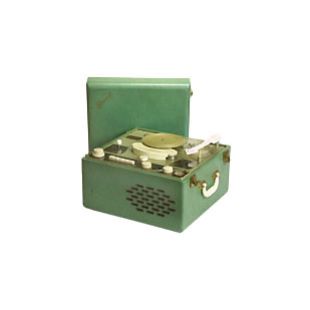

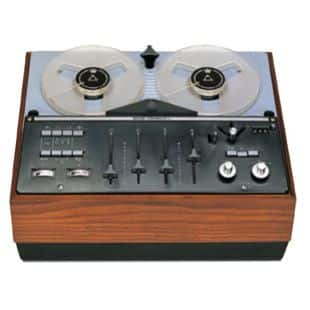
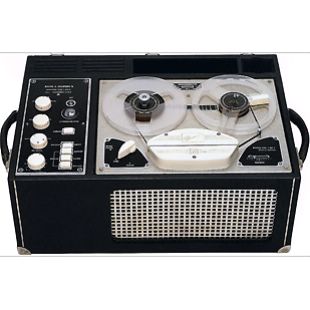
Beocord Stereomaster was a reel-to-reel tape recorder which was novel for its time in that it had an Automatic Stop Function for if the tape should break during play. There were two variations – Type T was designed to be transportable; Type K was designed for a more static position.
The tape recorder is ready just to plug in as the connections have been built in the bottom of the furniture cabinet.
The new B&O Beocord Stereomaster Tape Recorder is the ideal recorder for the discriminating tape amateur. For the first time in the world you can have an amateur tape recorder with a built-in mixing panel for simultaneous mixing of three input signals.
Here, for the first time, is an all-transistor Hi-Fi tape recorder comprehensive professional specifications, including:
Synchronous motor of the Pabst type
Separate recording and playback heads
Recording quality may be checked at any time, either before recording (at the recording amplifier output) or after (at the tape monitoring amplifier output)
Equipped with two V. U. meters.
Three dual-input channels with slide-potentiometer adjustment.
Professional standards for speed, wow and flutter.
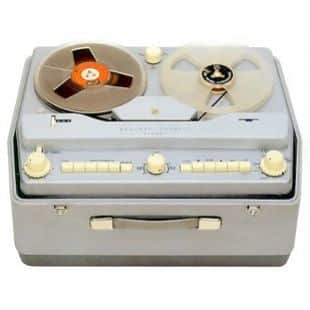
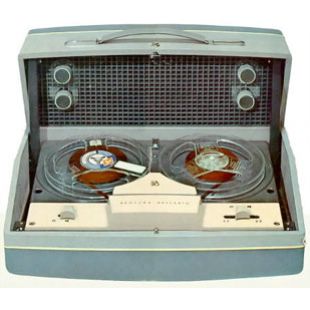
Beocord Belcanto 608 reel-to-reel tape recorder won the iF Design Award in 1962.