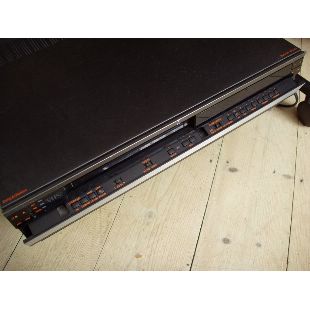
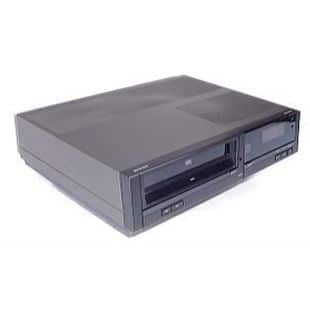
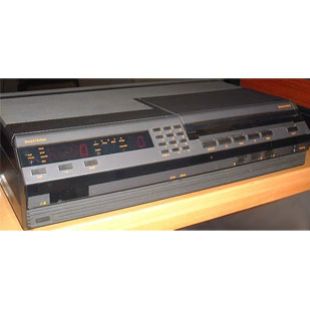
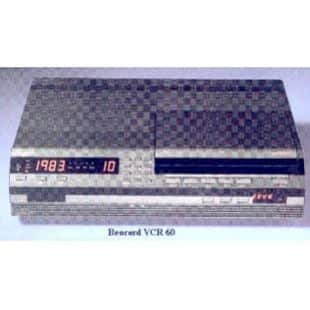
Beocord VHS 82 was Bang & Olufsen’s 1987 addition to the stereo video cassette recorder line-up with up to four hours of video playing time and eight hours of hi-fi quality stereo sound on just one video tape!
In terms of design, colours and uses, Beocord VHS 82 was created to harmonise with Beovision MX2000. And the same remote control Video Terminal could be used to control both units. Control was so integrated that the TV screen acted as an open instruction manual for the video cassette recorder.
All of the functions on Beocord VHS 82 were described and stored on ‘menus’ that were brought to the screen with the assistance of the Terminal. This step-by-step instruction ensured fast, faultless operation. So even things like presetting channels, time programming and picture search were as easy as was possible. And although the special menu operation was only possible in connection with the latest TV generations from Bang & Olufsen, Beocord VHS82 was an ideal video supplement for ant TV.
The fact that Beocord VHS 82 could take its place as a technically superior audio tape recorder in any music system emphasizes just how outstanding this stereo video recorder was.
Beocord VHS 80 was Bang & Olufsen’s entry into the VHS arena. Both Beocord VHS 90 and VHS 80 had stereo sound circuitry with Dolby B Noise Reduction. So when combined with a stereo Beovision they ensured the fullest enjoyment from stereo videotapes. You could also record stereo TV/FM Simulcasts if you used a stereo Beovision model.
One of the many plus points for owning a Bang & Olufsen VHS recorder from this period meant that for the first time, you could operate both the Beocord and the Beovision using the same remote Terminal. Whichever Beovision you chose, whether mono or stereo, Beocords VHS 80 or 90 would have been an ideal match for it. One touch on the TV’s remote Terminal allowed you to play a videotape, make recordings, fast wind or rewind the tape, scan the tape in either direction or freeze a single frame on-screen. If you wished to combine a Beocord VHS 80 or VHS 90 with a non-Bang & Olufsen TV, the remote Video Terminal could be purchased separately to provide chairside control of all primary playing and recording functions.
Beocord VHS 90 offered the best of both worlds – a high quality stereo sound recorder that, when connected to a hi-fi system, achieved performance characteristics that were close of compact discs; and a video recorder that combined superb picture quality with true hi-fi sound. When used as an audio recorder, up to 8 hours of music could be stored on one VHS tape and replayed non-stop. For hi-fi video recording, 4 hours was the maximum. With Beocord VHS 90, you could instruct the automatic timer to record up to five different programmes up to 14 days ahead. A repeat button enabled you to record the same show at a specific time every day of the week.
Unlike most most dual-purpose machines the Beocord VHS 90 records two versions of video track simultaneously: a hi-fi stereo track for replay on the same machine and an ‘ordinary’ stereo track which meant that your cassettes could be replayed on a non-hi-fi stereo video recorder.
Beocord VHS 80 also had stereo sound circuitry for video recording and playback. In fact, it offered the same video facilities as Beocord VHS 90, including an identical 39 channel search-and-store tuner and 5 programme/14 day timer.
Picture quality was of equally high standard too, but Beocord VHS 80 did not offer audio-only recording or hi-fi sound characteristics. However, it did incorporate a Dolby B Noise Reduction Circuit for maximising the recorded sound.
Placement of both VCRs: a practical stand from Bang & Olufsen organised your video system into a complete remote-controlled centre which could easily and discreetly be placed in your viewing room.
In the crucial quiet passages you heard only the sound of silence from the mono Beocord VHS66. The HX Professional recording system gave more ‘headroom’, enhancing the definition of high, delicate sounds, and Dolby B Noise Reduction cut down on hiss and noise.
Features:
Dimensions (WxHxD): 48 x 10,5 x 36cm
4 hours of recording/playback on E240
Mono sound recording, HX Professional recording system; Dolby B
Like Beocord VHS 91 and VHS 66, this video tape recorder was fully remote controlled through the Beovision keypad. A touch of the button activated record, playback, fast forward and rewind, single frame, freeze frame and picture search which operated at 4 times normal speed.
This a fairly basic Philips video recorder, little disguised for its role as a B&O machine.
To the unwary, this machine looked remarkably similar to the Video 2000 machines which preceded it. But as the name suggested, it was a VHS machine though supplied by Grundig again. Not sold in the UK.
The last Video 2000 made by B&O, this again was based on a Grundig machine. The format had however not managed to get a foothold in the rental market and therefore had lost out to the inferior VHS system. As a European format, it did last longer in the core market but gradually B&O realised that they had to serve all their markets and so introduced a VHS machine.