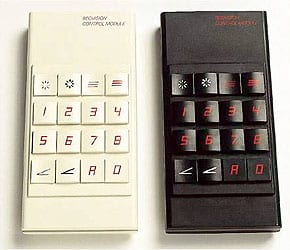
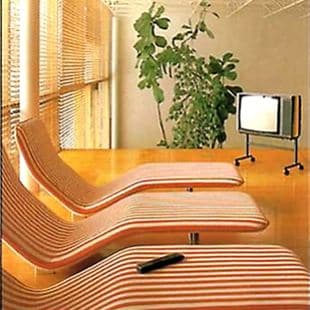
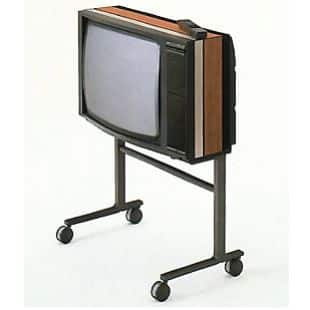
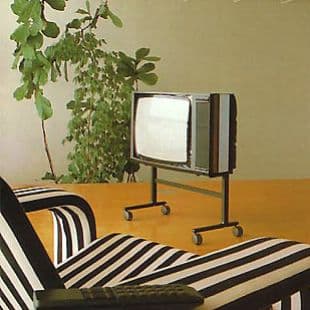
Very clever design allowed this remote to be used easily in the dark. The Hill and Dale effect of the control keys allowed one to navigate the remote with one’s thumb easily. Made not only for the top of the range 6002 but also for the 3802.
“As yet, none of us need 32 TV channels, let alone 100. But satellite re-broadcasting systems and cable TV, including regional and community networks, might soon change that” (1983 catalogue)
Therefore, Bang & Olufsen equipped all the luxury Beovision models with an advanced digital tuner that had the capacity for receiving 100 UHF channels, 32 of which could be stored in the set’s microcomputer memory for instant recall at the touch of a button.
The real boon for most viewers is that you could locate, store and recall any of these stations without leaving your armchair. All you had to do was touch a key on the Beovision Video terminal. So although B&O gave its “future-safe” luxury TV range more micro-electronics, more features and more connection possibilities than ever before, they made, at the same time, all the complex technology even more accessible – instantly. To borrow a phrase from the computer industry, Bang & Olufsen’s ’02-Series’ TVs were “user-friendly”.
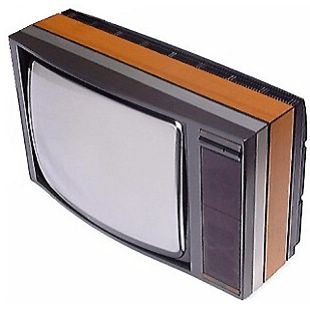
Beovisions 5502, 7702, 8802 and 9002 all shared the same advanced chassis design and offered the same user-benefits. They were true “luxury” sets because many ‘extras’ offered by other companies, were given as standard by Bang & Olufsen.
The Beovision Video terminal supplied with Beovisions 5502, 7702, 8802 and 9002 offered a plethora of operational benefits. In addition there was also an advanced ‘tune and store’ function that allowed you to operate the automatic tuning system from the comfort of your chair.
One touch of the ‘tune’ button started the digital tuner scanning the wavelengths of the UHF band. When it found a station, it stopped – giving you the opportunity to either reject or accept it. If it was an unsatisfactory reception from a distant transmitter (or simply a station you don’t like!), you just pressed ‘tune’ again to continue the search. When you found a station you enjoy, on a channel giving a good, clear reception, you could instruct the set’s microcomputer to remember that transmission frequency by pressing ‘store’ followed by your own choice of pre-set programme number (e.g. for BBC2 you might designate pre-set number 2). Thereafter, whenever you wanted to watch BBC2, you simply touch button ‘2’ on your remote Terminal.
Up to 32 different TV stations could be located and stored in this way, so your Beovision really is ‘future-safe’ because it has plenty of spare capacity to accommodate new programme sources as and when they come ‘on stream’.
The latest type of Beovision Video terminal also had a button marked ‘sound’. This was only effective with Bang & Olufsen stereo TVs – Beovision 7802 and Beovision 8902.
Beovision 5502 had a 50cm screen and measured 62cm wide, 40cm high (71.5cm including stand) and 39cm deep.
Beovision 7702 had a 22″ screen. Dimensions were 67.5cm wide, 43.5cm high ( 76cm including stand) and 41.5cm deep.
Beovision 8802 had a 26″ screen and measured 77cm wide, 49cm high (80cm including stand) and 45.5cm deep.
All three models had slim cabinets finished in a choice of natural teak or rosewood. White finish was available to special order.
Beovision 5500 had a 50cm High Bright tube with automatic contrast regulation, so the picture always looked bright and clear, with true-to-life colour even in daylight viewing.
Quality was not compromised simply because it was physically a small set. Picture and sound reproduction used the same high technology as that featured on the 26″ Beovision 8800. The remote control system wa also identical, with up to 16 channels available for instant selection.
Beovision 5500 – like the other Beovisions in this family – was exceptionally cool running, with maximum power consumption under 75 watts – less than an ordinary light bulb! Because less heat was generated inside the set, vital components were exposed to less physical stress and therefore had a longer working life. High reliability was, and still is, an important factor when choosing a new TV.
If remote control or access to Teletext was not required, then Beovision 5000 was a suitable alternative offering manual selection of up to 12 stations. The rest of the facilities offered by this television set were the same as its more luxurious brother, the Beovision 5500.
In the days before widescreen, active speakers and Dolby Digital modules, the catalogue of 1985 stated that: “it would be foolish to spend more money that you needed. Why pay for multiple features and facilities when all you wanted was the best possible picture quality, good sound and instant remote access to all available UHF TV channels?”. Unfortunately, those days have long since gone!
The most sensible and economic answer to such a modest set of demands was right there, it stated, in the ‘traditional’ Beovision 5102, 7102 and 8102. All three sets were identical; it was only the size of the tubes that differed. You obtained the same type of picture tube as in the luxury sets (the Beovision 5502, 7702 and 8802 range, for example): automatic colour balance, high reliability… and a bright, clear, natural-looking picture. Sound quality was 6 watts RMS.
The remote control was identical too – the Beovision Video Terminal was used on all of the sets. You could tune across the entire UHF band and store up to 32 station frequencies in the set’s microcomputer memory for instant recall. The Beovision Video Terminal made it easy to control.
Sound output was 6 watts. Connections were provided for an extension speaker and a tape recorder; the tape socket had an alternative function – you could use it to feed the TV sound through a hi-fi system. And connecting a Loop Amplifier would allow a person with a hearing aid to enjoy TV sound more fully.
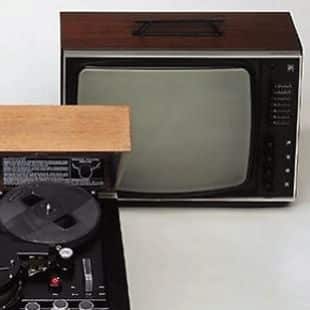
All three models could be supplied with or without Teletext facilities. The slim-line cabinets were identical in design but offered an alternative in materials and finish: a furniture-crafted wood cabinet finished in rich-grained natural teak or rosewood; Beovision 5102 was also finished in natural grey.
These high quality remote control colour TVs had 8 channels which could be pre-tuned for instant access via the infra-red Video Terminal. Volume level and picture adjustments could also be made without moving more than a finger. Bass and treble tone and picture contrast adjustments were made via the controls sited behind the set’s front fascia.
All models used the 30AX in-line self-converging picture tube with its High Bright characteristics. Bang & Olufsen’s unique Permanent Colour Truth circuitry ensured that the balance between colours was always correct. Together, these features guaranteed a top quality picture that would not deteriorate as the set got older.
Teletext was available as an optional feature on all three models. When fitted, Teletext was accessible via the same Video Terminal used for ordinary entertainment viewing.
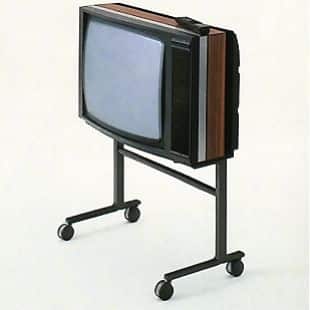
Beovisions 5100, 7100 and 8100 came complete with a smooth gliding undercarriage. Apart from screen size and cabinet options, they were technically identical in all respects.
Sound output was 6 watts RMS. Connections were provided for an extension speaker and tape recorder; the tape socket had an alternative function – you could use it to feed the TV sound through your hi-fi system. (From B&O Catalogue Supplement Winter 1982/83)
Beovision 5500 had a 50cm High Bright tube with automatic contrast regulation, so the picture always looked bright and clear, with true-to-life colour even in daylight viewing. Quality was not compromised simply because it was physically a small set. Picture and sound reproduction used the same high technology as that featured on the 26″ Beovision 8800. The remote control system wa also identical, with up to 16 channels available for instant selection.
Beovision 5500 – like the other Beovisions in this family – was exceptionally cool running, with maximum power consumption under 75 watts – less than an ordinary light bulb! Because less heat was generated inside the set, vital components were exposed to less physical stress and therefore had a longer working life. High reliability was, and still is, an important factor when choosing a new TV.
If remote control or access to Teletext was not required, then Beovision 5000 was a suitable alternative offering manual selection of up to 12 stations. The rest of the facilities offered by this television set were the same as its more luxurious brother, the Beovision 5500.
BeoVision 5 was Bang & Olufsen’s first home cinema plasma screen.
With its big screen, advanced sound system, original positioning options and sophisticated remote control, the BeoVision 5 sets the standard for plasma solutions, especially when it comes to integration in the home. Until the discovery of plasma technology, the idea of having a TV screen hanging on the wall was restricted to the realm of science fiction films. Now the dream has become a reality, and Bang & Olufsen has brought it one step closer by offering a plasma solution that is more than just a “picture on the wall”.
BeoVision 5 is the natural choice for people wanting to combine large-scale audio-visual experiences with a high degree of flexibility in the positioning of the TV screen. All of Bang & Olufsen’s expertise in picture handling and screen technology has been deployed in order to improve the already sharp picture from the big 42-inch screen of BeoVision 4. Brushed aluminium encases both the screen and a special integrated active loudspeaker reproducing high-quality stereo sound.
As a result, BeoVision 5 does not require any additional equipment to fulfil the standards that Bang & Olufsen is renowned for. BeoVision 5 can also function as a centre for distributing sounds and pictures throughout the house via Bang & Olufsen’s unique distribution system: ‘Beolink®’.
BeoVision 5 works with the entire range of Beolink® products and can also connect with the Bang & Olufsen DVD 1 and the Beocord V8000 video recorder. All products can be operated with the Beo4 remote control.
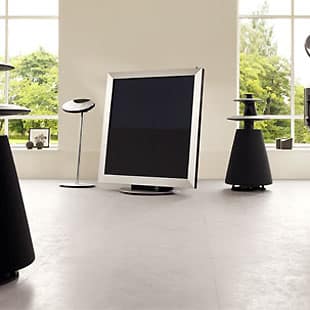
The positioning is quite something, too. Imagine brushed aluminium, gathered at 45-degree angles at the corners, surrounding both the plasma screen and the sound system. Inspired by classical art, it can be hung on the wall in its entirety as a single object -just like a picture in a gallery. However, a TV that hangs on the wall is not intended to represent the ultimate in mobility for some users who prefer greater freedom in their options for their personal home décor. Should it be positioned in the middle of the room on a base? Should the base be motorised so that you can rotate the television from your armchair using the remote control? What about a drawer system in the same design to conceal the DVD player, satellite receiver or video recorder? Or what about leaning the television against the wall, if you don’t want to hang it up? Everything has been thought of!
BeoVision 5 is a unique 108cm (42 “) plasma home cinema concept from Bang & Olufsen. With its obvious associations to the art-of-painting, this plasma master is truly a work of art in itself. This is reflected in its outstanding design affording the user many different placement and colour options. The design of BeoVision 5 was orchestrated by David Lewis, Bang & Olufsen’s chief designer.
The combination of a a high quality plasma display and Bang & Olufsen’s competences in video signal processing means that the picture on BeoVision 5 is the best in the industry. Its advanced sound system, using B&O’s active loudspeaker technology, provides a sonic experience that perfectly matches the outstanding quality of the picture. The built- in loudspeakers, placed below the screen, function as both a centre channel when used in a surround sound set up or as a superb stereo sound system when the BeoVision 5 is used as a stand alone TV.
Operationally, BeoVision 5 has much in common with the BeoVision Avant which means that it can be a system master, together with an audio system to distribute picture and sound around the house.
Picture and Sound Quality merge exquisitely in the new BeoVision 5 from Bang & Olufsen. Containing a striking 108cm 16:9 plasma screen and a pair of powerful built-in active loudspeakers, BeoVision 5 is framed elegantly in your choice of five shades of brushed anodised aluminium. Years of Bang & Olufsen expertise unite these fields to prove that the beauty also has brains.
The screen
With its large screen, advanced sound system, original placement possibilities and multifaceted Bang & Olufsen virtues within operation, BeoVision 5 sets new standards for plasma solutions, not least regarding integration into the home environment
Until the advent of plasma technologies, the idea of hanging a television set on the wall has been confined to the realm of science fiction films. Now that the dream has become reality, Bang & Olufsen takes this possibility a step further by offering a plasma solution that encompasses much more than a simple ‘picture on the wall’. BeoVision 5 is therefore a natural choice for people wishing to combine great viewing and listening sessions with flexibility in placement.
The frame
All Bang & Olufsen picture competencies are utilised to enhance the already razor sharp image of the large plasma screen. The 16:9 picture tops a pair of integrated active loudspeakers offering an enveloping stereo sound built with all the acoustic competencies for which Bang & Olufsen is known. As a result, BeoVision 5 does not require additional equipment to measure up sound- and picture-wise to demanding Bang & Olufsen standards. Furthermore, BeoVision 5 can serve as a Beolink® master, distributing sound and picture throughout the home in Bang & Olufsen’s unique distribution system. Full compatibility with all Beolink®-enabled Bang & Olufsen products is included, as well as seamless connections with Bang & Olufsen’s DVD 1 and Beocord V8000 VCR. Operation of all Bang & Olufsen items is carried out using the Beo4 remote control.
The placement
Offering a selection of brackets and stands, Bang & Olufsen offers a multitude of placement possibilities for BeoVision 5.
The sound
Featuring a pair of active loudspeakers located directly below the plasma screen, BeoVision 5 can provide up to 96 dB of stereo sound on its own. A built-in Dolby Digital® surround sound decoder offers a wealth of sonic experiences – and even includes automatic detection of this 5.1 channel digital sound format.
Connect any active loudspeakers from Bang & Olufsen’s BeoLab range, and be moved by the deep bass and tingling highs found in today’s digital entertainment offerings. Let your home cinema experience be led by the BeoLab 2 subwoofer, a double balanced passive radiator system where an 850 W ICEpower® amplifier (Long Term Maximum Output Power), supplies the fuel for the single active 22cm woofer and two 22cm passive radiators..
The many facets of BeoVision 5 plasma TV
VisionClear elements shine through
Once again Bang & Olufsen has succeeded in combining the objective parameters of picture quality and the subjective elements of viewing comfort to provide an extensive and enveloping viewing experience.
An exceptionally high level of Picture Quality is achieved through the employment of elements including motion compensated progressive scan, Digital Adaptive Luminance Peaking, Digital Colour Transient Improvement (CTI) and adaptive black. Presenting all horizontal lines at once, the BeoVision 5 digital interpolation system eliminates disturbing motion artefacts caused by viewing an interlaced scan on a large screen. By calculating object movement in pixels per field, new pictures are interpolated according to object motion.
Further development of Bang & Olufsen’s own Digital Adaptive Luminance Peaking circuitry adds additionally to the Picture Quality by amplifying the peaking according to the level of luminance shifts present. This purely digital function peaks large luminance shifts proportionally less than small shifts, providing a uniform visual experience. Furthermore, the wideband Digital CTI employed in BeoVision 5 assures a high degree of dimensional precision thanks to a gentler amplification than compared to standard CTI circuits.
How black is black?
Maintaining a proper black level is ensured by the employment of advanced adaptive black circuitry. Correct colour saturation is assured as the brilliance level is automatically adjusted during viewing by BeoVision 5. Reading the content of the current on-screen image, BeoVision 5 automatically increases colour saturation on very light images on the one hand, whilst keeping black details from drifting into grey upon a content shift.
The screen, the user, the surroundings
The field of Viewing Comfort, which involves the interactions between the screen, the user and the surroundings receives great attention through a number of elements. Automatic Picture Control sensors found in the striking “magic eye” found on the top right-hand corner of the BeoVision 5 monitors the amount of ambient light in the room and ensures the best possible picture quality under all lighting situations.
A special dark coloured anti-reflection coated contrast screen also reduces amount of incoming light by more than 80%. The resulting increase in contrast provides a richer on-screen colour experience. Enticing elements such as Hollywood-like electronic curtains, which automatically open and close and Active Picture Format Optimisation, where the transmission signal is read and the optimal picture format is presented automatically additionally highlight the user experience.
Adaptive Bass Linearisation
Protection against low-frequency damage at a high volume level is provided for all Bang & Olufsen BeoLab speakers by Bang & Olufsen’s patented Adaptive Bass Linearisation (ABL) circuitry. ABL monitors the displacement of the loudspeaker units and reduces the output level if any risk of mechanical damage arises. The ABL circuit has very fast attack- and release times for optimum protection and sound performance.
Furthermore, both the BeoLab 2 and the BeoLab 1 loudspeaker feature patented thermal protection circuitry which guards against overheating and burn-out by monitoring the physical temperature of the woofer. An NTC resistor mounted on the rear of the magnet system in combination with a sophisticated simulation of the voice coil temperature triggers an automatic reduction of output if the temperature should exceed the critical level.
Standard features: MasterLink, Picture-in-Picture, Set top box controller, RF Modulator, Dolby Digital Surround Sound (which also supports Dolby Pro Logic Surround Sound) and DTS (Digital Theatre System).
Dimensions: The active speakers within BeoVision 5 are the same as the latest (2002) model of the BeoVision Avant. The unit is 17cm wide at the bottom and around 10cm at the top of its 1,10m frame. It leans 9 degrees back and rests (when placed on the floor) on three small metal feet.
Cabinet
BeoVision 5 Cabinet (part number 1417759) has two drawers side-by-side for BeoVision 5 to stand on.
BeoVision 5 can be shaped and coloured in such a way as to complement its surroundings. The aluminium frame and front loudspeaker cover are delivered in the same colour combinations as BeoLab 1 : Metallic black, silver, red, green and blue. It can be positioned in one of several ways. On a floor stand at a 9 degree angle, on a wall bracket at two different heights and either parallel to the wall or at a 9 degree angle to the wall, on the floor on a cabinet which can house two units such as DVD 1, Beocord V8000 or a Set-Top Box, and finally on a motorised floor stand.
Positioning
Ideally BeoVision 5 should be set up with BeoLab 1’s in aluminium in the front with BeoLab 2 and BeoLab 6000’s in the rear. DVD 1 and Beocord V8000 should both be housed in the purpose built silver cabinet.
The screen
With its large screen, advanced sound system, original placement possibilities and multifaceted Bang & Olufsen virtues within operation, BeoVision 5 sets new standards for plasma solutions, not least regarding integration into the home environment
Until the advent of plasma technologies, the idea of hanging a television set on the wall has been confined to the realm of science fiction films. Now that the dream has become reality, Bang & Olufsen takes this possibility a step further by offering a plasma solution that encompasses much more than a simple ‘picture on the wall’. BeoVision 5 is therefore a natural choice for people.
Dimensions:
The active speakers within BeoVision 5 are the same as the latest (2002) model of the BeoVision Avant. The unit is 17cm wide at the bottom and around 10cm at the top of its 1,10m frame. It leans 9 degrees back and rests (when placed on the floor) on three small feet.
Both BeoVision 5 and BeoLab loudspeakers are available in a variety of colours (to match the colours of BeoLab 1) including red, black, aluminium, blue and green, which together offer a solution to suit both you and your interior décor.
Standard features: MasterLink, Picture-in-Picture, Set top box controller, RF Modulator, Dolby Digital Surround Sound (which also supports Dolby Pro Logic Surround Sound) and DTS (Digital Theatre System).
At the top of BeoVision 5 is a little plastic translucent dome which electronically surveys its surroundings. Not in the way of Big Brother – but in keeping a watchful eye on the light conditions in the room in which it is placed. It looks out for instructions from the Beo4 remote control and signals by either a red or green light dot if the television is switched either on or off. It also adjusts the picture according to the lighting conditions of the room itself: brightening the picture in a very bright room, or lowering its intensity in a darkened room. However, BeoVision 5 is not the first television to introduce this little dome. Beosystem AV9000, which was the first integrated AV system from Bang & Olufsen, accommodated it as well, placed in a similar position outside of the frame.
Beosystem AV9000 created a lot of attention in its time and was a breakthrough in home entertainment. But the dome created ill-feeling in that it challenged the expectations as to the general design of Bang & Olufsen products. It stood out in an unusual way. At the time of AV9000’s introduction there was a resistance movement challenging the company’s stance towards so much innovative, aesthetical design.
Ten years later it is a case of déjà vu. However, its reintroduction was proposed by the development team as an answer to a simple engineering problem.
BeoVision 5 Press Release
BeoVision 5 – Bang & Olufsen’s first plasma home-cinema solution
With a 107cm screen, advanced sound system and flexible placement possibilities, BeoVision 5 sets new standards for plasma technology and its integration into the home.
• A visual masterpiece
A sleek brushed aluminium frame, in a choice of six eye catching colours frames both screen and sound system, offering an integrated sound and picture plasma solution. Inspired by the world of classical art, both sound and image may be hung as one single item on the wall, like a painting in a gallery. However, BeoVision 5 has been designed with flexibility in mind and with the use of customised brackets and stands can be placed in a number of ways to suit individual interior set-ups.
Whether it be in the middle of the room on a motorised floor stand, so it turns towards your sofa via the remote control, leaning against the wall with an integrated drawer system to hide the DVD player and satellite receiver, or simply hanging flat against the wall, BeoVision 5 provides an outstanding home cinema experience.
• Superior Sound Quality
BeoVision 5’s 16:9, 107cm plasma screen sits on top of a pair of integrated active loudspeakers offering an enveloping stereo sound built with all the acoustic quality Bang & Olufsen is known for. BeoVision 5 is a Beolink® master product so can be connected seamlessly with all compatible Bang & Olufsen systems to distribute sound and picture throughout the home via the Beo4 remote control.
For the complete home cinema set-up, a powerful multi-channel digital surround sound experience can be created by linking BeoVision 5 to five active speakers from Bang & Olufsen’s extensive range. Both BeoVision 5 and BeoLab loudspeakers are available in a variety of colours, including red, black, aluminium, blue and green, which together offer a solution to suit both you and your interior décor.
BeoVision 4 offers greater flexibility and modular convenience to Bang & Olufsen customers than has previously been possible. BeoVision 4 is available in different sizes and consists of the screen, BeoSystem 2 and a cabinet. BeoSystem 2 is the master unit having the same functionality as BeoVision 5.
The recommended centre channel loudspeakers are BeoLab 4000. This plasma TV set has been previously only available in the North American market including Canada, Mexico and the US. When combined with speakers and stands, BeoVision 4 becomes an integral part of BeoSystem 1. However, from Spring 2004 the system – known as Beosystem 2 – arrived in Europe.
This European system incorporates different-sized screens and may be mounted on a wall. Available in 50″ and 65″ screen sizes (37″ and 42″ screen sizes available only to March 2006) The screen surround is of brushed aluminium and is based upon much the same design as BeoVision 5. VisionClear and an anti-reflection coating is included. Controlled by Beo4, the system comprises:
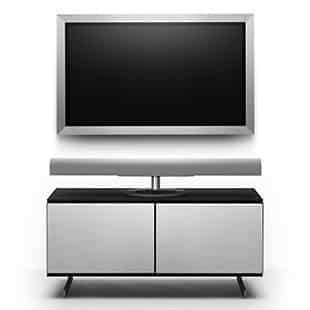
Cabinet 2168 is similar to cabinet type 2164 and has a shiny, aluminium-coloured front. Within it can be placed a satellite decoder, DVD 1 and/or Beocord V8000, if these are your required options.
Part:
Part Number:
BeoVision 4-37 silver – 1816608
BeoVision 4-37 black – 1816609
BeoVision 4-37 dark grey – 1816610
BeoVision 4 42 silver including wall bracket – 1816049
BeoVision 4 42 dark grey including wall bracket – 1816578
BeoVision 4 42 black including wall bracket – 1816577
BeoVision 4 50 black including wall bracket – 1816591
BeoVision 4 50 dark grey including wall bracket – 1816592
BeoVision 4 50 silver including wall bracket – 1816415
BeoSystem 2 – 1816403
Cabinet 2168 – 1216813
Cabinet BV4 – 1216813
BeoVision 4 65 silver – 1816632
BeoVision 4 65 black – 1816633
BeoVision 4 65 dark grey – 1816634
BeoSystem 2 (BV4 65) – 1816403
BeoVision 4 65 Wall Brackets – 1405866
Remote Control for BV4 stand alone – 8053460
BeoVision 4 Wall Bracket and Table Stands
A new wall bracket and table stand for the BeoVision 4 range will be available from December 2004. The new wall bracket is finished in black lacquered steel and with its reduced dimensions is suitable for use with the 37”, 42” and 50” screen options.
The table stands will be available in two options: one for BeoVision 4-37 and the other for either BeoVision 4-42 or BeoVision 4-50. The Table Stands will be finished in black, painted aluminium.
The only accessory for BV4-65 is the wall bracket. Introduced on BV4-65 will be a slightly darker Contrast Screen resulting in an improved perceived picture quality due to the lower black level.
Wall Bracket & Table Stand Part Numbers:
BV4 Wall Bracket 1407866
Table Stand BV4-37 1408566
Table Stand BV4-42/50 1407966
BeoVision 4 – 42 Newsletter April 2004
In view of the general expansion of flat screens in the market, Bang & Olufsen is now strengthening its flat screen portfolio by launching BeoVision 4 – 42. BeoVision 4 – 42 is a modular flat screen home-cinema system master consisting of:
A 107cm plasma monitor for wall mounting (wall bracket included)
BeoSystem 2 – a master unit offering the customer a genuine Bang & Olufsen system master
an elegantly designed cabinet for placement of BeoSystem 2 and a separate box solution, e.g. DVD 1.
In line with our vision of constantly questioning the ordinary in search of surprising and long-lasting experiences, it is crucial for Bang & Olufsen to stand out. The mere offering of a plasma solution with a separate master unit is far from unique in the market today. Still, we put great value in differentiating Bang & Olufsen products from our competitors.
BeoVision 4 – 42 is differentiated by:
A true Bang & Olufsen visual expression and craftsmanship to the last detail with the aluminium frame on the monitor, the design of the cabinet and the possible combination with BeoLab loudspeakers, BeoVision 4 – 42 has a true Bang & Olufsen visual expression. This is characterised by an elegant design, an exquisite choice of materials and craftsmanship to the last detail.
The aluminium frame is mounted on a handmade mainframe made of steel. There are no visible screws or welding notches – even the screws are handmade in order to ensure a smooth surface and not disturb the visual expression. By means of our special surface treatment competences, we have achieved a beautiful yet robust surface of the aluminium on the frame and the cabinet.
BeoVision 4 – 42: a system master that offers freedom of application.
The BeoVision 4 – 42 solution offers not only sublime experiences in a home-cinema setup. It also is fully compatible with the Beolink® system and can work as a system master that distributes sound and/or picture to up to 16 rooms. BeoVision 4 – 42 is a modular system, it has a built-in Dolby® Digital/DTS® module, and it can be integrated with the entire BeoLab loudspeaker range, as well as with Bang & Olufsen audio and video products. There is only one cable between the monitor and the master unit which increases the placement flexibility. All this maximises the freedom of application – only your imagination sets the limits for a true Bang & Olufsen experience.
Easy operation – One remote
Despite the possibility of integrating BeoVision 4 – 42 with many products and features, the operation is well-known and simple – based on one remote: Beo4. This is ensured via the IR-eye which is connected to BeoSystem 2. The built-in Set-top Box Controller is an example of the simplified operation principle of Bang & Olufsen; digital television can be received from a separate satellite box, but still operated with Beo4.
VisionClear – improved picture technologies
VisionClear is a concept developed by Bang & Olufsen that focuses on picture improvement technologies. Among the technologies is the peaking technology, which sharpens the picture by making a simulated contour around objects so that every detail stands out. There is a tendency in the market to overdo the peaking – so that the picture becomes unnaturally sharp. Bang & Olufsen focuses on creating a natural sharpness in the picture – therefore the picture is only peaked to a certain limit. The natural picture is moreover helped by noise reduction. As the peaking technology also makes noise more visible, a noise reduction circuit is incorporated in BeoVision 4 – 42 to compensate for the increased noise. This way BeoVision 4 – 42 offers sharp yet noiseless pictures.
Viewing Comfort – improved viewing experience
The Viewing Comfort concept focuses on the interface between the screen and the user, and between the screen and the room. It has been developed to improve the subjective viewing experience of the user. Viewing Comfort elements in BeoVision 4 – 42 include the anti-reflection coated contrast screen, which reduces reflections of incoming light and improves the black level. The black level of BeoVision 4 – 42 is better than what is generally seen in the market for plasma – meaning that what looks black is more black, rather than grey.
The result is deeper and richer colours. Other Viewing Comfort elements in BeoVision 4 – 42 are electronic curtains and automatic picture format optimisation. (Due to the separation of monitor and master in BeoVision 4 – 42, the Automatic Picture Control feature known from BeoVision 5 and other BeoVision products is not available in BeoVision 4 – 42).