Posted on

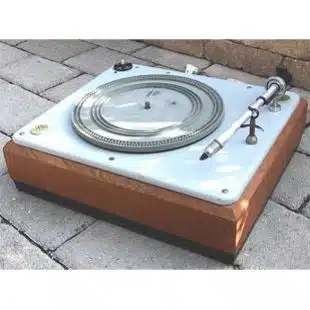
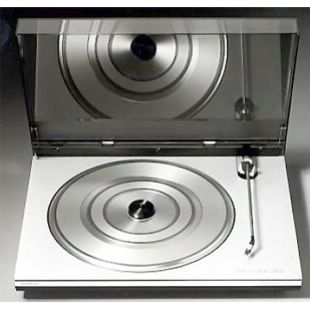
BeoGram 608

Bang & Olufsen BeoGram 608

Understanding the numbering of these Beograms is really quite easy: the ‘V’ in ‘608V’ means that it was powered with AC voltage and ‘F’ meant that it had a built-in preamplifier. The designation 608, 609 and so on, indicated the year the product was marketed.

Beogram 608 was a turntable without a built-in RIAA preamplifier and was produced for the 1962 season (internally many were date-stamped e.g. September 1961 would indicate the year it left the factory).

Beogram 42 was basically the same as Beograms 6xx but with a larger platter and longer tonearm. The longer tonearms could, like the preamplifier and platter, be refitted.

Posted on

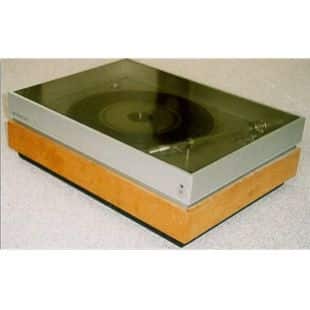
BeoGram 42V/VF

Bang & Olufsen BeoGram 42V_VF

The B&O 4-speed record player is an important step on the road to full musical enjoyment, being designed specially with a view to vibrationless and rumbleless operation. This feature is of great importance when playing stereo records as the pickup stylus must be sensitive to vibrations in all directions in order to be capable of “scanning” the record properly.

Understanding the numbering of these Beograms is really quite easy: the ‘V’ in ‘608V’ means that it is powered with AC voltage and ‘F’ means that it has a built-in preamplifier. The designation 608, 609 and so on, indicates the year the product was marketed. There was also a ‘U’ version for both AC and DC voltages. Beogram 608 for example, was a turntable without a built-in RIAA preamplifier and was produced for the 1962 season (internally many were date-stamped e.g. September 1961 would indicate the year it left the factory).

The difference between the models 41xx and 42xx was that the 41xx had a small turntable and the 42xx model had a larger turntable.

Posted on

BeoGram 41V/VF

Bang & Olufsen BeoGram 42V_VF

The B&O 4-speed record player is an important step on the road to full musical enjoyment, being designed specially with a view to vibrationless and rumbleless operation. This feature is of great importance when playing stereo records as the pickup stylus must be sensitive to vibrations in all directions in order to be capable of “scanning” the record properly.

Understanding the numbering of these Beograms is really quite easy: the ‘V’ in ‘608V’ means that it is powered with AC voltage and ‘F’ means that it has a built-in preamplifier. The designation 608, 609 and so on, indicates the year the product was marketed. There was also a ‘U’ version for both AC and DC voltages. Beogram 608 for example, was a turntable without a built-in RIAA preamplifier and was produced for the 1962 season (internally many were date-stamped e.g. September 1961 would indicate the year it left the factory).

The difference between the models 41xx and 42xx was that the 41xx had a small turntable and the 42xx model had a larger turntable.

Posted on

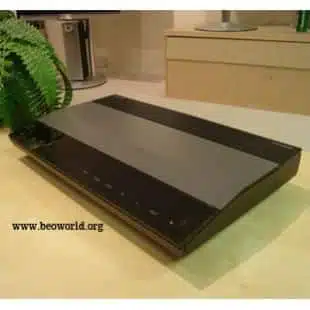
BeoGram 3300

Bang & Olufsen BeoGram 3300

It’s better both for your records and for sound quality to play a record the way the master was made – in a straight line from the edge to the centre. This tangential arm record player did just that, giving a far more precise reading of the signals in the groove. The MMC4 cartridge made a vital contribution too; it was feather-weight, with a stylus pressure of only 1,2 grams, giving outstanding sound quality but minimising wear and tear on your records.

There’s more protection too – invaluable for all-night parties. The electronically controlled tangential arm was suspended so that it isolated mechanical vibrations from the cartridge. The suspension chassis was also thoroughly engineered to neutralise vibrations. So keep on dancing – the record player can take it! Beogram 3300 was part of Beosystem 3300 although may be used as a stand-alone item.

One of many tangential decks all utilising the same basic design, the 3300 was noticeable mainly for its grey finish and slightly lurid graphics. Very much a child of the 80s, it was replaced by the 3500 and 4500.

Posted on

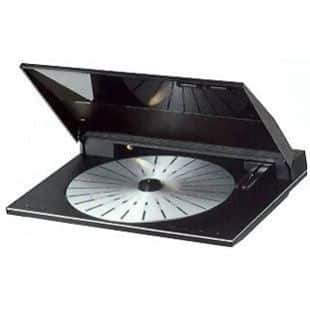
BeoGram 6000 (1981)

Bang & Olufsen BeoGram 6000 1981

Beogram 6000 – Type 5751 – was a fully automatic record player with one-touch operation.

Put a record on the turntable, touch START and let Bang & Olufsen technology do the rest. The lightweight, low inertia tone arm was fitted with the MMC 20EN pick-up cartridge. This had a naked elliptical diamond and a low Effective Tip Mass which, together with the lightweight arm, secured excellent tracking performance and minimum record wear.

The patented spring suspension system effectively prevented external knocks and vibration from affecting tracking and sound quality. This later radial 6000 model was fitted with Datalink and was really a Beogram 2402 with new electronics in the same design. It really did not match the Beomaster 6000 and was a short lived and frankly unpopular model but was offered as a cheaper alternative to the tangential tracking and tangential drive Beogram 6006. These decks were both replaced by the Beogram 6002. This deck had the newer MMC3 cartridge and was a strange amalgam of the two earlier decks in that it had a simplified tangential arm but belt drive for the platter

Posted on

BeoGram 2000 (1983)

Bang & Olufsen BeoGram 2000 1983

This radial-tracking record deck had a lightweight turntable (only 400g) to minimise torque at starting. The automatic cueing system was also very fast-acting, so it was only a matter of a few seconds between touching the PLAY control and hearing the music.

The tone arm had built-in anti-skating and carried the MMC 4 pickup, ensuring accurate tracking and excellent sound quality. Normal PLAY and STOP functions were entirely automatic and could be operated with the lid closed; manual buttons for playing non-standard discs were located on the deck plate. In addition to automating the setting of correct speed and cueing position for each record, the Beogram’s built-in microcomputer allowed a REPEAT function, which could be programmed for up to 7 plays of the same record.

Drive was provided by a tacho-controlled DC motor via a flat rubber belt, so turntable speed was always accurate and could not be affected by fluctuations in the mains supply.

When used with Beomaster 2000, an electronic data-link allowed Beogram 2000 to be operated by the Beomaster’s controls. Beogram 2000 could also be made up as part of the Beosystem 2000, when linked together with other compatible Bang & Olufsen products.

Posted on

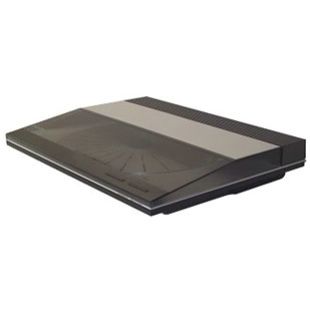
BeoGram 1800 (1968)

Bang & Olufsen BeoGram 1800 1968

This was a rare and interesting model. It boasted a new arm and motor compared to the Beogram 1000 but retained quite a lot of the design and the uninspired rubber mat.

It also had a most unusual dust cover with a metal surround with only the top panel being transparent. This design was to be seen also in the prototype Beogram 6000 but not in any production model.

Posted on

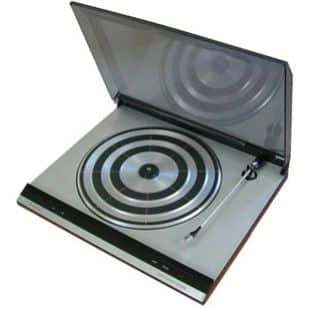
BeoGram 1500 (1978)

Bang & Olufsen BeoGram 1500 1978

Beogram 1500 combined ease of operation and advanced technology in a simple, straightforward way. All its operations were controlled via a single button.

Another advantage of this totally integrated design was its immunity to external shock and vibrations. The electronic servo drive system ensured correct turntable speed at all times. The low-mass arm had built-in bias compensation, and the MMC 20S pickup tracked at only 1,5 grams.

The unique pendulum spring suspension helped make the Beogram range of record players immune to the external shock and vibrations which would cause most other record decks to mistrack and damage the record groove.

Beogram 1500 could be made up as part of the Beosystem 1500, when linked together with other compatible Bang & Olufsen products.

This deck was the basic model of its time but the inherent design of this deck meant that the performance was extremely similar to the top of the range radial decks. Very easy to set up and simple to use, a true bargain buy in later years.