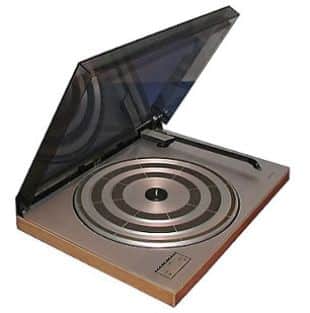
Beogram 1500 combined ease of operation and advanced technology in a simple, straightforward way. All its operations were controlled via a single button.
Another advantage of this totally integrated design was its immunity to external shock and vibrations. The electronic servo drive system ensured correct turntable speed at all times. The low-mass arm had built-in bias compensation, and the MMC 20S pickup tracked at only 1,5 grams.
The unique pendulum spring suspension helped make the Beogram range of record players immune to the external shock and vibrations which would cause most other record decks to mistrack and damage the record groove.
Beogram 1500 could be made up as part of the Beosystem 1500, when linked together with other compatible Bang & Olufsen products.
This deck was the basic model of its time but the inherent design of this deck meant that the performance was extremely similar to the top of the range radial decks. Very easy to set up and simple to use, a true bargain buy in later years.
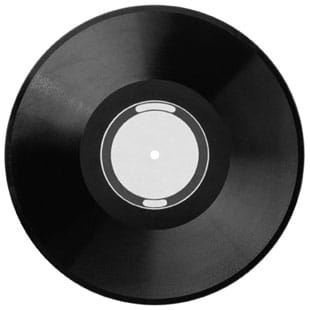
Vinyl records have three basic problems: it is physically impossible to press them with ridges that end up allowing low frequencies to come out at the same reproduction level as mid and high frequencies.
Bass compensation is therefore needed during playback. Secondly, records produce a certain amount of hiss which is covered up in post-production by boosting the gain of the high frequencies before pressing. Counter-EQing during playback compensates for this. Finally, magnetic cartridges produce a weak signal which must be boosted to match the rest of the amplification and this too is done during playback. In the mid-1950s, compensation standards were established by the Recording Industry Association of America.
The resulting RIAA preamp has been built into every hi-fi and stereo amplifier with phono or turntable inputs since then. A separate RIAA preamp is necessary when you are connecting a turntable to a mixer which does not have one built in.
The phono preamplifier is the key component needed to match the output of the turntable to the line input of the amplifier or audio mixer. If you’ve tried connecting a turntable to a modern amp or hi-fi unit and you’re not happy with the results, it’s probably because you don’t have a suitable turntable input.
Manufacturers tend not to include a turntable input anymore because the vast majority of customers don’t play vinyl. However, you can still obtain turntables and magnetic pick-up cartridges. The signal from these pick-ups is much smaller than from a CD, tape deck, radio tuner or auxiliary source – so if you connect to any of those inputs you’ll not have much volume. Also the tone will be totally wrong – all treble and no bass. What you need then is a phono preamplifier, it connects between turntable and amplifier or hi-fi unit. It lifts the signal to the required level and restores the tonal balance.
Pre-amplifiers explained
Retrieving the signal from a record groove takes carefully balanced engineering to restore the sound back to the original so it can be applied to the input of an amplifier or audio mixer.
All gramophone records are cut with falling bass (LF) and rising treble (HF) below and above some mid-range frequency (MF). It’s this trick that makes it possible to keep the groove a constant width.
It is a phono preamplifier’s job (otherwise known as gramophone amplifiers, turntable pre-amps or vinyl disc equalisers) to precisely perform the opposite effect to that of the record cutting machine. This is called equalisation (EQ for short) which boosts the bass and cuts the treble by just the right amount. It also has to amplify the tiny signal from the pick-up cartridge, with minimal noise and distortion, so it’s big enough to drive an amplifier.
The following list of B&O Beogram turntables shows those with built-in RIAA pre-amplifiers and those without
It is important to note that pre-amplifiers may have been installed by a 3rd party.
While we believe this list to be correct, we do recommend that you fact check with the relevant manuals.
RIAA Built-in
BeoGram 100VF
BeoGram 1200
BeoGram 3000
BeoGram 3400
BeoGram 3500
BeoGram 4500
BeoGram 6000 (Tangential)
BeoGram 6500
BeoGram 7000
RIAA option (CD4 demodulator)
There is a switch on the right hand side of the deck to identify them
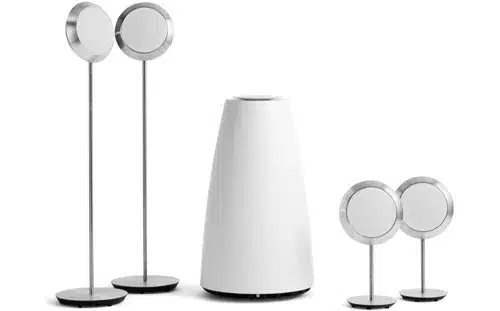
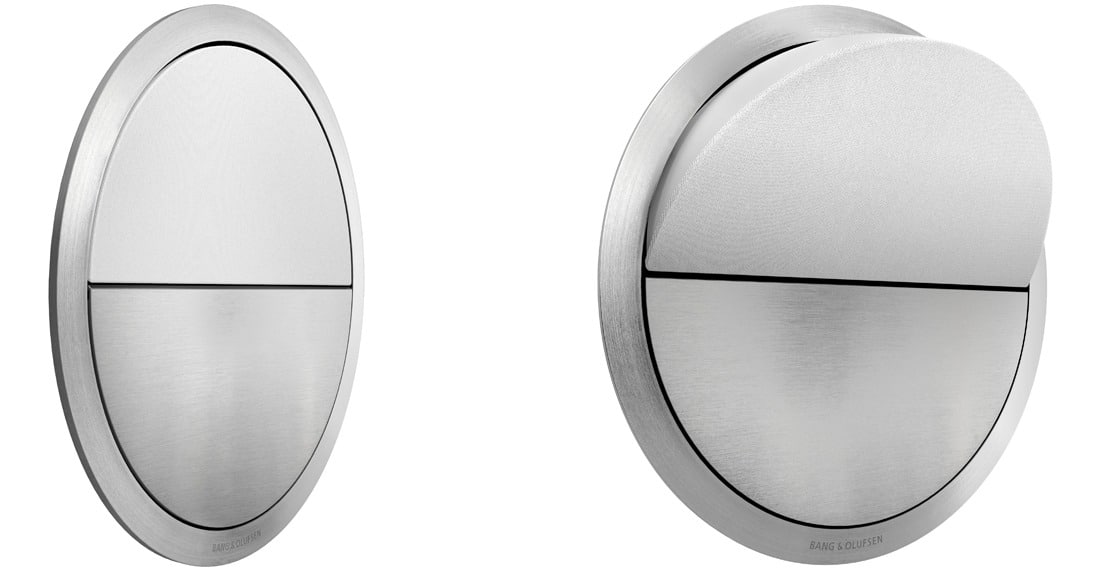
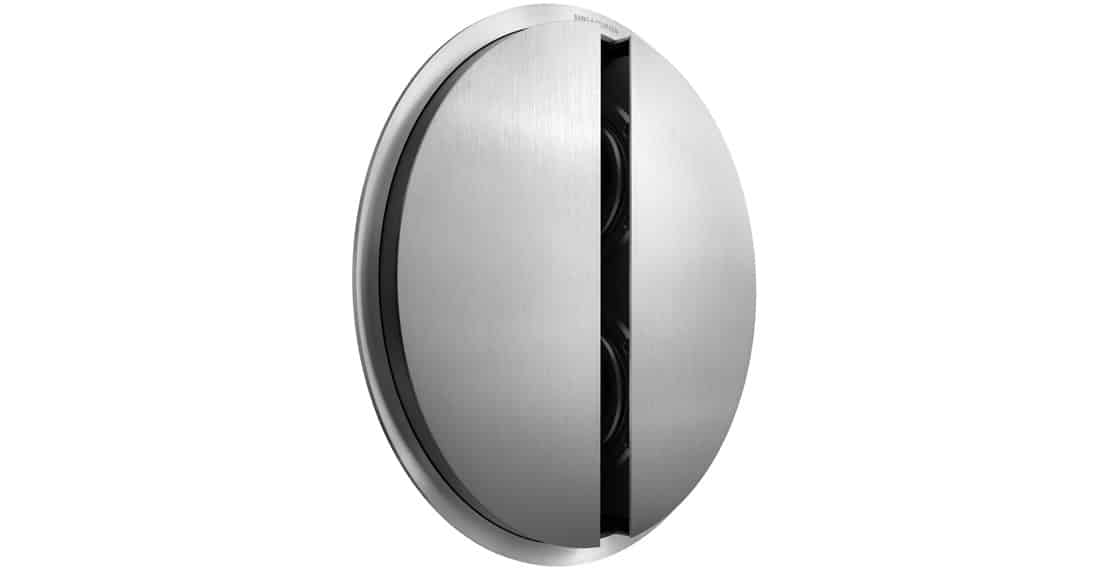
The BeoLab 15 unit houses treble, midrange and a motorised tilt mechanism, which activates when your music starts to play, that is, it has an inner speaker cabinet which pivots from its mounting so you can adjust the direction of sound to your precise needs.
A separate subwoofer with four 4-inch speaker units mounted in two closed box cabinets, applying the Acoustic Balance Principle designed to prevent any unwanted vibrations.
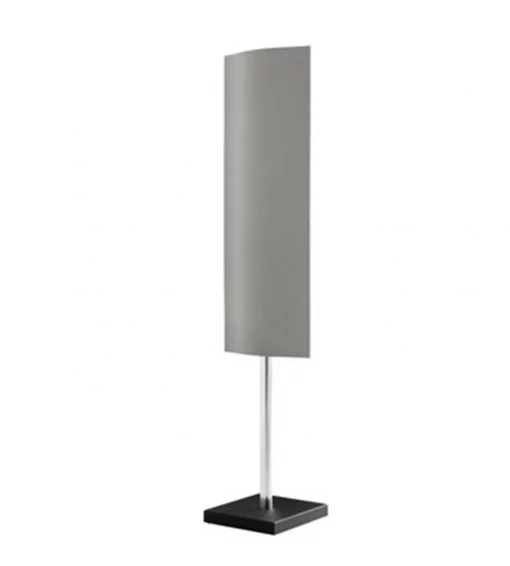
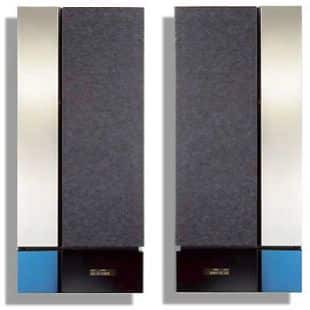
Bang & Olufsen’s BeoLab and Beovox 5000 / 3000 speakers had both the voice and the looks for a leading, acoustic role. And because of their looks, they were known as Bang & Olufsen’s range of panel loudspeakers. Panel loudspeakers were one of the most exciting and interesting examples of how Bang & Olufsen united advanced technology and stunning design to achieve totally new effects.
They may not have looked like high-specification loudspeakers – more like works of art – but their sound immediately gave them away. Even at full volume, they kept the total sound picture in perfect balance.
Design as a work of art
The elegant, flat panel loudspeakers were created to hang on the wall. And with their calm surfaces of blue or grey fabric coupled with polished steel, they could be taken for works of art. But the design was only partly for visual effect. The form of the panel speakers was founded on an advanced, acoustic principle that uses the wall as an active part of the sound reproduction process – without causing the wall itself to vibrate.
Optional display and amplifier
The panel loudspeakers were available in two sizes – each with or without amplifier and a display showing which source was playing and at what volume. Also it told you which track number on a CD or tape you were listening to. With display and amplifier the loudspeakers were called BeoLab. Without, they were called Beovox. The option depended upon which Bang & Olufsen sound system was connected. BeoLab speakers were designed to match Beosystem 6500, 4500, 3500 and Beocenter 9500 and 8500.
Why build amplifiers into the loudspeakers instead of keeping them separate?
Because you can reduce the size of the cabinet volume to one-third of the size of a conventional loudspeaker with the same sound capacity. The principle is called Active Loudspeakers, and what you get is a compact loudspeaker that can play at high volume without distortion or damage to its drive units. Furthermore, when amplifier, treble and bass units are paired for the same task, they can be tailored to compensate for each other’s shortcomings. What you hear is music that sounds exactly like the instrument it originally came from.
Mounting Options
Wall mounting brackets were supplied with this model. No other mounting solution wall offered.
PORTABLE POWER
The small but mighty Beolit 15 packs a powerful punch, featuring the innovative True360 omni-directional sound that lets everyone enjoy equally good sound no matter where they’re placed. With up to 24 hours of wireless playback, Bluetooth connectivity and premium, durable materials,
Beolit 15 is designed to fit the entire home