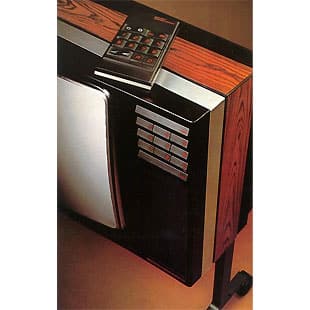
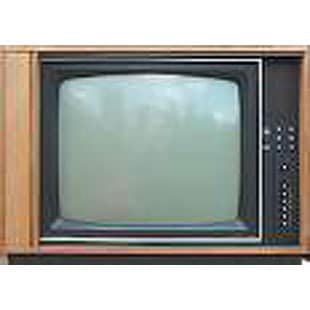
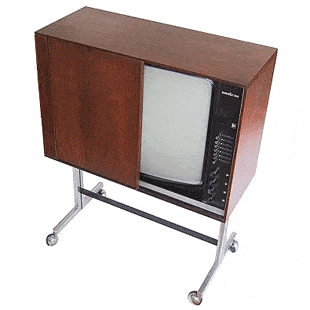
Beovision 3000 and 3300 had 50cm screens and were, at the time of the 1979 – 80 catalogue, Bang & Olufsen’s smallest colour TV sets. They were identical technically, except that Beovision 3300 had the ability to be controlled by remote control.
However, it was only the size of the screens and the outer dimensions of the sets that were small, according to the catalogue. Inside, the technology was on a par with B&O’s biggest models, with the same advanced circuits that made the bigger 26″ models renown for their reliability and high quality levels. In order to secure the best sound reproduction, Bang & Olufsen included a large, forward-facing pressure chamber loudspeaker and a 6,5 watts RMS hi-fi amplifier, similar to those in audio setups.
The sets’ cabinets were finished in genuine wood veneers and lived up to the tradition of excellent Danish furniture workmanship.
” Close your eyes and imagine your perfect TV. Should it have the latest digital surround sound decoder and a connection for extra loudspeakers? Integrated control of your satellite and DVD sources? And what about an anti-reflection contrast screen to improve your viewing comfort? Whatever you opt for, what you get as standard is Bang & Olufsen sound and picture quality – and a luxurious television experience that matches your own personal needs exactly.
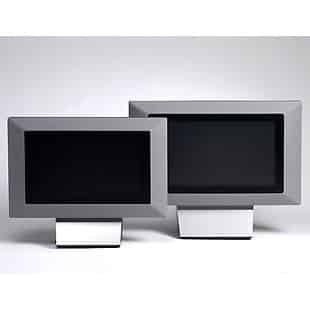
BeoVision 3 28 is a smaller version of the 77cm-screen . The TV set incorporates similar functions to that of its bigger brother but is just a 67cm viewable screen and is designed to allow for greater flexibility in respect of positioning.
This smaller-screened television is, design-wise, the same as BeoVision 3 32. The chassis (50Hz) is basically the same as in BeoVision 1 Update III (50Hz); operation and specification is therefore the same (including the tuner and speakers).
Design
When it comes to widescreen television, you may think that you’ve seen it all before. But take a look at the new BeoVision 3 28 and see what happens when intelligent design meets state-of the art technology. A perfect picture and truly great sound removes the distance between you and what’s happening on the screen.
Picture it for yourself: a wide screen elegantly framed in a colour of your choice. BeoVision 3 is designed to match your personal environment as well as your demands for a perfect viewing experience.
Clear Vision
What is it you’re watching on the screen? A true picture or poor image? The real-flat screen of BeoVision 3 offers the best viewing possible and the widescreen format ensures that it’s made for movie watching.
The more you can lose yourself in a film, the more enjoyable the experience becomes. That’s why anything that comes between the viewer and the picture is eliminated. Like reflections. A special contrast screen coating on the screen – fitted as standard * – reduces them to an absolute minimum and ensures a perfect viewing experience.
VisionClear is not something you’re meant to notice, but just enjoy. It starts already when you switch your BeoVision 3 on. Within a second it adjusts contrast levels, brilliance and colour to match the unique light conditions in the room – and will carry on doing so until you switch off again. (More on VisionClear)
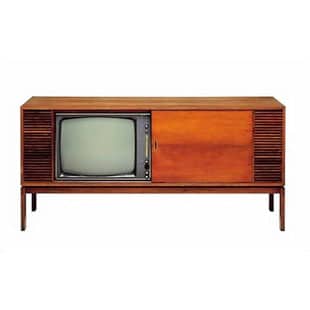
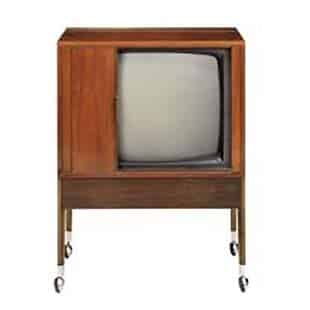
In 1965 came true combination of craftsmanship and advanced technology: Beovision 2000RG was a combined TV and radiogram. It had a sliding door to cover the monochrome TV screen when it was not being use and had stereo speakers mounted either side.
The optional tape recorder was available in two versions – Mono and Stereo.
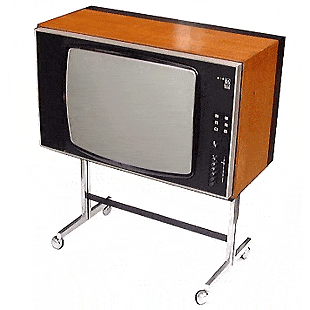
This “open screen” table model was one of B&O’s early attempts to produce a more compact colour receiver that was suitable for smaller rooms. Using the chassis from the Beovision 3200 and a 22” “push through” tube, the set was neat and elegant but still not exactly small, the two massive chassis were shared with the other models in the range and these, rather than the screen size, dictated the dimensions of the cabinet. An attempt to disguise the bulk was made by adding a black strip all around the back of the cabinet, breaking up the otherwise vast expanses of wood, though this can be said to be only partially successful.
The front of the Beovision 2600 was finished in matt black and trimmed around the outside with aluminium. The loudspeakers (two elliptical units made by Celestion in the UK) took up a new position to the left of the screen, displacing the convergence controls to a hatch on the underside. Access to these was easy if the set was mounted on the optional stand but impossible if it was placed on a (sturdy) table. This was not ideal, as a set of this design should not be moved once convergence is completed.
The Beovision 2600 was not replaced directly when the 3400 range was introduced as all these models came with 26” tubes. However, the table version of the Beovision 3400 was considerably smaller than the 2600 anyway, so in practice a problem did not arise. 22” sets were re-introduced with the new 39XX series models, for example the Beovision 3500.
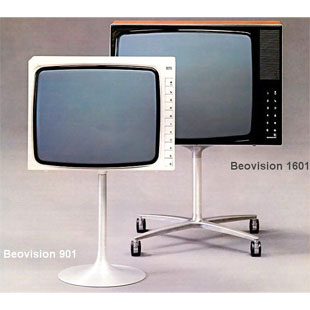
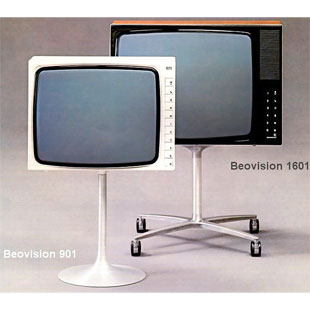
The Beovision 1600 replaced the Beovision 1400 range and included a new all-transistor chassis. As before, a 24” wide-angle tube was fitted, the largest monochrome tube that was available at the time. In contrast to the 1400 range, only one cabinet style was available, a table model, though this could be fitted with an optional pillar stand for free-standing use. The design was simple and elegant, with the minimum of cabinet work around the screen.
The controls were all of a new design, and concealed when not in use. Each one was mounted in a small latching drawer marked with a graphical symbol to represent its function. To adjust a setting (volume, brightness etc), one only had to touch the relevant drawer lightly and it would open, allowing access to an edgewise rotary control. The tuning worked in a similar manner, where the tuning controls were hidden inside the channel selector buttons. To adjust the tuning, one would press the button one wished to adjust, thus selecting the channel, then press again to slide out the drawer to reveal the tuning scale and control.
To make the most of the instant picture possibilities that the adoption of transistors (instead of the valves in previous models) offered, the heater of the picture tube of the Beovision 1600 was left energised at all times. In order to extend the life of the tube, when the set was switched “off”, the heater was run at a slightly lower level of power. Even despite this, the picture appeared truly instantly as soon as the “on” button was pressed, something that no other range of Beovision TV sets has been capable of since.
The rest of the design was quite conventional, with the exception of the voltage regulator which could tolerate a very wide range of mains voltages without picture disturbance.
The Beovision 1600 was the last large-screen monochrome Beovision model
The Beovision 1600 replaced the Beovision 1400 range and included a new all-transistor chassis. As before, a 24” wide-angle tube was fitted, the largest monochrome tube that was available at the time. In contrast to the 1400 range, only one cabinet style was available, a table model, though this could be fitted with an optional pillar stand for free-standing use. The design was simple and elegant, with the minimum of cabinet work around the screen.
The controls were all of a new design, and concealed when not in use. Each one was mounted in a small latching drawer marked with a graphical symbol to represent its function. To adjust a setting (volume, brightness etc), one only had to touch the relevant drawer lightly and it would open, allowing access to an edgewise rotary control. The tuning worked in a similar manner, where the tuning controls were hidden inside the channel selector buttons. To adjust the tuning, one would press the button one wished to adjust, thus selecting the channel, then press again to slide out the drawer to reveal the tuning scale and control.
To make the most of the instant picture possibilities that the adoption of transistors (instead of the valves in previous models) offered, the heater of the picture tube of the Beovision 1600 was left energised at all times. In order to extend the life of the tube, when the set was switched “off”, the heater was run at a slightly lower level of power. Even despite this, the picture appeared truly instantly as soon as the “on” button was pressed, something that no other range of Beovision TV sets has been capable of since.
The rest of the design was quite conventional, with the exception of the voltage regulator which could tolerate a very wide range of mains voltages without picture disturbance.
The Beovision 1600 was the last large-screen monochrome Beovision model