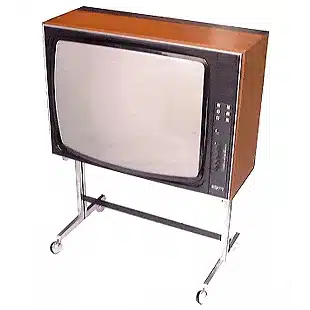
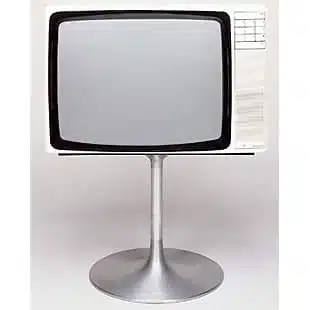
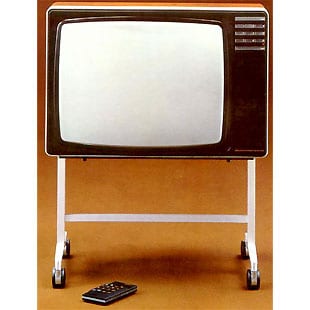
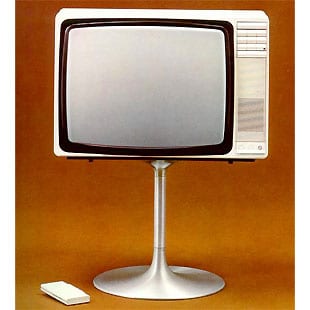
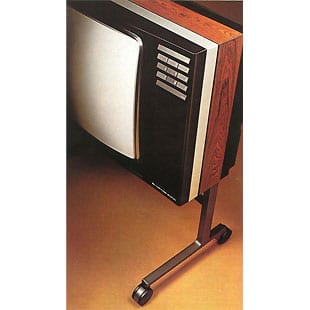
Beovision 3500 type number: 3907 was a 56cm colour television designed by David Lewis and Henning Moldenhawer. It could be placed on two types of stand – the trumpet stand (shown above) and the cross foot stand.
By 1975, colour television had become commonplace in homes throughout Western Europe. And a lot of those homes were furnished in white – the ‘in’ colour of the 1970s. Television, as a lot of home furnishings, followed this trend and Beovision 3500, with its trumpet base and cross-base on wheels, reflected what was happening in the world of interior design. The cabinet was made of moulded plastic and its appearance was markedly different from most other televisions of the era.
Beovision 3500 was Bang & Olufsen’s first fully transistorised television; this meant that very little warm up time was necessary for picture and sound. The choice of television channels had increased considerably over the previous years and the controls were adapted accordingly. “In everyday use, you select your TV programmes using the easy-touch push buttons at the top. Each of these can be set to one TV channel; this is done once only using the scaled potentiometer dials. These eight dials are only visible when the panel is opened; this is where you or your dealer can set the VHF and UHF channels that you are able to receive. Beovision 3500 has automatic frequency control, AFC, which locks the TV stations once they have been selected.” said the sales literature in 1975.
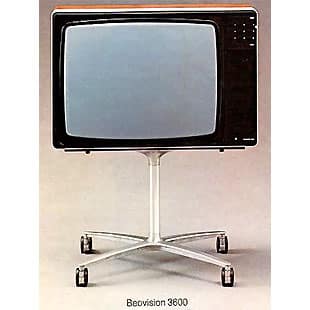
With Beovision 3500 it was clear that an icon had been created. The cabinet was made of moulded plastic and its appearance was markedly different from most other televisions of the time. However, the wooden cabinet was retained in the similarly-styled Beovision 3600 model. From 1975, Bang & Olufsen was also able to equip all its televisions with Automatic Cut-off Control.
An invention by the young engineer Erik Albert Jensen made waves internationally in the television sector. Cut-off Control ensures that the colour balance is maintained throughout the service life of the television. No fewer than 50 times each second the three electron beams are measured and corrected independently, thus avoiding any annoying deviations in colour.
Like other Bang & Olufsen colour TVs, Beovision 3602 had the automatic cut-off regulating circuit which ensured natural colours throughout the set’s useful lifetime. The in-line picture tube allowed for easier and better convergence in order to avoid the usual discoloured edges – not least when viewing a black & white transmission.
Internally the Beovision 3602 was identical to the Beovision 3502 so one obtained the same outstanding picture quality and equally good sound reproduction from the large, forward-facing loudspeaker.
On the easy-touch panel one could select programmes and turn on the set in the same action. Regulators that are not used often are hidden in tow touch-release compartments – one for sound and one for video adjustments. Power consumption was exceedingly low – only 110 watts and the low heat generation made this set suitable for placing in a shelving unit.
Optional accessories: Mobile X-shaped undercarriage or trumpet-shaped stand, both in polished alloy.
Beovision 3702 was a 56cm colour TV with small outer dimensions, a highly advanced construction throughout and the most logical operation facilities then on the market.
The ultrasonic remote control was designed to be operated with one hand and its most important regulators could be ‘read’ by the finger tips. These regulators – for brightness, colour saturation and sound are set in relief, so there was no need to look. The user could feel which position was which by the tactile buttons.
Any of eight pre-set stations could be called, and, by pressing the special reset facility, all adjustment levels including sound, would revert to their predetermined basic levels.
Beovision 3702 could be switched off at the main ‘off button on the set’s simple operation panel. Or one could switch it off with the remote control module in which case, the set goes into stand-by position. By pressing one of the programme selectors there is a picture on-screen within 5 seconds together with sound. The picture tube was of the in-line type which needed fewer adjustments and consumed less power – only 115 watts.
The chassis was modular and there was an automatic cut-off regulating circuit to maintain long-term colour purity. Beovision 3702 could accommodate a VCR without further technical adjustment and could be fitted with a special optional kit to reproduce sound through a hi-fi system. Two pre-stamped blanks on the set’s fascia allowed for the insertion of a headphone or extension speaker terminal and switch.
Beovision 3800 and 3900 were 22″ colour TV receivers finished in genuine wood veneers (teak or rosewood). They superceded models 3602 and 3702 in 1979. The sets were slim and elegant and their classic design suited any home décor according to the 1979 – 80 catalogue. High Bright picture tubes allowed for satisfactory daylight viewing since they permitted around 70% more light than from the screen than conventional picture tubes.
Beovision 3800 was for direct (set box) operation while Beovision 3900 permitted you to operate the set via an ultrasonic remote control handset. Beovision 3900 could also be supplied equipped for Teletext reception.
Automatic cut-off circuits guaranteed correct balance between the three basic colours (red, green blue) even after a long period of use. In fact, these sets incorporated every refinement which still makes Bang & Olufsen’s television sets among the market’s best. VCR programmes could be played without additional technical adjustment. There was an automatic synchronisation on all channels.
A choice of two mobile undercarriages were available. A tall undercarriage (42cm high, type 3057) depicted here, and a lower one (34cm, type 3058). Both were sold as optional accessories
Beovision 3502 and 3802 – designed by David Lewis – were two 22″ colour TV receivers whose cabinets were of a moulded synthetic material. They were elegant and practical, according to B&O’s catalogue of 1979 – 80; the material was shock- and shatter-proof and fire-retardant. Dirty marks could be wiped off easily with a damp cloth.
Operation was easy and problem-free via the large, logically designed operation panels. Additionally in the 3802 model, all functions could be operated from a distance via the remote control module. Both receivers could accommodate a VCR without further technical adjustment. Beovision 3802 could also be equipped for Teletext reception. Automatic cut-off circuitry ensured the correct balance between colours without the need for regular adjustment by an engineer. High-bright picture tubes allowed for satisfactory viewing in daylight conditions. Modular chassis and low power consumption (and therefore less heat) ensured greater reliability.
Beovision 3800 and 3900 were 22″ colour TV receivers finished in genuine wood veneers (teak or rosewood). They superceded models 3602 and 3702 in 1979. The sets were slim and elegant and their classic design suited any home décor according to the 1979 – 80 catalogue. High Bright picture tubes allowed for satisfactory daylight viewing since they permitted around 70% more light than from the screen than conventional picture tubes.
Beovision 3800 was for direct (set box) operation while Beovision 3900 permitted you to operate the set via an ultrasonic remote control handset. Beovision 3900 could also be supplied equipped for Teletext reception.
Automatic cut-off circuits guaranteed correct balance between the three basic colours (red, green blue) even after a long period of use. In fact, these sets incorporated every refinement which still makes Bang & Olufsen’s television sets among the market’s best. VCR programmes could be played without additional technical adjustment. There was an automatic synchronisation on all channels.
A choice of two mobile undercarriages were available. A tall undercarriage (42cm high, type 3057) depicted here, and a lower one (34cm, type 3058). Both were sold as optional accessories
Beoplay H100 delivers immersive sound and luxurious design built to last the test of time. Advanced Dolby Atmos headphones with titanium drivers and next-level noise cancellation. Perfect for music, work, and travel. Every purchase includes an exclusive leather pouch to protect and carry your headphones in style.
A headphone experience that reaches back into decades of history to redefine your listening future. The possibilities? Many. The moment? Immersive.
No pressure. No distraction. Lost in the moment. This is when we find ourselves. And to do it, we just have to listen. Beoplay H100 brings back the clarity, so wherever we move, we feel moved.
Unbelievable sound.
The quality? Like never before. With custom titanium drivers housed behind elegant aluminium grills, these headphones deliver Hi-Res sound, all tuned by our in-house tonmeisters. The introduction of EarSense™ delivers a personal and unrivalled listening experience by tailoring the sound to your unique fit in real time.
Chaos: off. The moment: on.
To appreciate great sound, you need silence. That’s why Beoplay H100 has ten carefully configured studio-grade microphones, delivering our most advanced noise cancellation and transparency mode yet. Beoplay H100 also offers crystal clear call quality and reduced wind and background noise. So no matter how busy your world gets, you can stay focused.
Switch things up with ease.
Move from the music to the outside world in a twist. Use the carefully crafted haptic dial to enable TrueTransparency™ – a silky-smooth transition to your surroundings.
Make it natural with spatial audio
Take your listening experience to the next level and unlock a new dimension of immersion. Optimised for Dolby Atmos, state-of-the-art spatial audio processing and headtracking, Beoplay H100 delivers a more natural listening experience on any mobile device, for any type of content. So hit play and enjoy a multidimensional soundscape that extends beyond stereo.
Modular at heart.
Elements can be swapped out or serviced. The battery. The headband. The cushions. Even the drivers. One day, we believe all headphones will be designed like this. Intuitive. Long-lasting. Modular. So you can care for and make them like new again. And again. Beneath the surface lies a brand-new technology platform built to evolve, bringing new features as time goes on, so your musical moments will only get better. H100 is not just a beautiful headphone – it’s a meaningful one.
Intelligent and adaptive.
Beoplay H100 delivers an experience that feels instinctive and effortlessly natural. It pauses music, tunes you into the surroundings when you need it to and intuitively moves audio between your devices.
Crafted for effortless control.
The new scratch-resistant, hardened glass touch interface is silky smooth, both in feel and function. Together with precision haptic dials and tactile buttons, you have all the essential controls where you need them – right and left.
Moving beyond comfort.
Slip these on and enter a world of serenity. Thanks to the multiple layers of cushion foam, finely wrapped in knitted textile, the inner headband provides all day breathability and comfort. The lambskin leather sits gently against the skin and contributes to an experience that feels as good as it sounds.
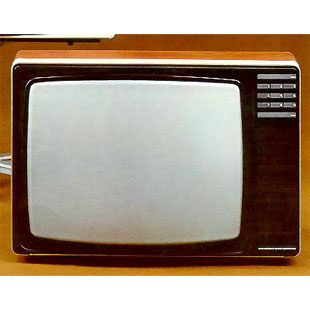
Beovision 3000 and 3300 had 50cm screens and were, at the time of the 1979 – 80 catalogue, Bang & Olufsen’s smallest colour TV sets. They were identical technically, except that Beovision 3300 had the ability to be controlled by remote control.
However, it was only the size of the screens and the outer dimensions of the sets that were small, according to the catalogue. Inside, the technology was on a par with B&O’s biggest models, with the same advanced circuits that made the bigger 26″ models renown for their reliability and high quality levels. In order to secure the best sound reproduction, Bang & Olufsen included a large, forward-facing pressure chamber loudspeaker and a 6,5 watts RMS hi-fi amplifier, similar to those in audio setups.
The sets’ cabinets were finished in genuine wood veneers and lived up to the tradition of excellent Danish furniture workmanship.