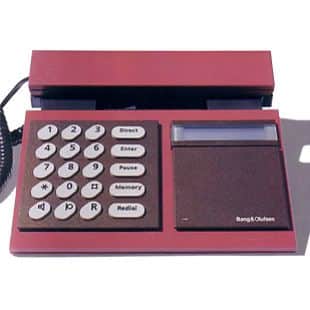
Beocom 2000, the classic telephone from Bang & Olufsen… what else is there to say?
Beocom 2000 was unlike anything which had been introduced by Bang & Olufsen before.
All the parts of the phone were made by the company itself and not imported from other manufacturers. A well-equipped telephone with extraordinary sound quality, a tradition carried on with all of the Beocom range of telephones.
The design is truly timeless. The display gave information on which number your were calling and the time connected. All standard functions were of course, also available, like volume control and numeric memories, and for the more advanced user there was a special headset available!
This phone was also available in a more simple version, Beocom 600, which didn’t have the display but had the same sound quality.
The memory bank of the Beocom 2000 enabled you to store your personal top twenty, and at the touch of just a few buttons you were connected. With display, bass reflex speaker in handset, 20 numbers of memory, quick call key for an often-use or ’emergency’ number, redial of last 3 numbers called, pause function, adjustable volume control, microphone mute (for secrecy), built-in speaker for listening, adjustable tone ringer with 8 settings plus off. There was even a hidden note pad which could be used by raising the lid on the right-hand side of the unit!
Up to 1993 Beocom 2000 was produced with different coloured keys. However, from this time a more mellow design was offered with all the keys complementing each other. On its bright display with large characters the Beocom 2000 could offer you the last three numbers for redialling
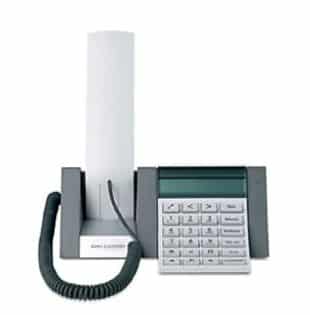
BeoCom 1600 was a tabletop telephone which combined a modern design with ease of use and was the same telephone as the BeoCom 2400 but without the alpha numeric memory functions. It however, did have the normal numeric memory functions. Using this phone was easy.
As with all other Bang & Olufsen telephones, BeoCom 1600 was equipped with a bass reflex speaker giving clear and easy recognisable voices. An infra-red module was available as an optional extra, giving the user the ability to control the volume on other Bang & Olufsen audio and video products. It was designed by the Swiss industrial designer Martin Iseli.
The vertical placement of the BeoCom 1600 handset made it easy to answer a call. Making a call was equally simple due to the position and curved surface of the keypad. The ultra light handset ensured that even long telephone conversations never seemed tiring.
Design
Reach out to towards BeoCom 1600 and enjoy a telephone that was simple to understand and easy to use. The ultra light handset weighed only 115g – which made it comfortable to hold even during the longest of conversations. The intelligent layout of the sloping keypad also ensured that your fingers moved intuitively and easily from button to button and from function to function.
Features
With BeoCom 1600’s built-in memory you could store the 10 telephone numbers you used the most and enjoy quick one-button access to them. As well as a volume control that allowed you to adjust the sound level during a call, BeoCom 1600 also offered a built-in loudspeaker function and the possibility to mute the microphone in the handset.
Colours
There was a choice between black, blue, red, yellow, green, terracotta, and grey.
A/V Control
With an optional A/V volume control incorporated into BeoCom 1600, you could adjust the sound on your Bang & Olufsen audio-video products directly from the telephone.
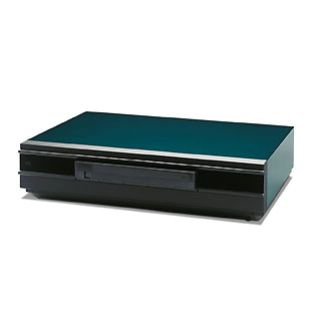
BeoCord V8000 video tape recorder matched the Beovision MX range of Bang & Olufsen televisions in looks as well as performance.
You could store a channel on the Beovision MX TV and it was automatically communicated to the V8000. Recording was a simple matter of selecting the programme directly from Teletext using the Beo4 remote control. It could be positioned by using one of the stands as part of a Beovision TV.
BeoCord V8000 rewound a three-hour tape in 95 seconds and it shifted from fast forward to play in a split second.
Other features included NTSC stereo playback. Looks-wise it embodied a black fascia with a choice of cabinets in pearlescent shades of blue, green, red, grey and black, plus glossy grey and glossy white.
Beocord V6000 was a hi-fi stereo video cassette recorder designed to work with Beovision models ME6000 and MS6000.
Together they formed an integrated unit in which TV and video cassette recorder automatically share all commands and can be operated by the same remote control. This combination was designed to be used as a standalone TV/VCR combination. The VCR had all playback facilities as any standard VCR. It also had VPS/PDC and NTSC playback. The video recorder was controlled via a Beolink 1000 handset through the Beovision television.
Bang & Olufsen’s new generation of TV and video systems at the time that the V6000 was released, made it simpler an more comfortable to watch TV. All data stored in the TV: time and programme channels, were automatically stored in the VCR as well. The same applied when you connected your TV and video recorder to a Beolink system – the clocks on the various units within the system were automatically synchronised.
Beocenter 2300 was dedicated to the CD enthusiast who, for example, like to store the titles of favourite CDs, or permanently skip unwanted tracks. It was known as Beosystem 2300 when connected to the BeoLab 2500 active speakers. It was eventually surpassed by BeoSound 3000 when it included more features and received a facelift in 2001.
Beocenter 2300 was developed from the idea of a flexible music system that could compete with the sound quality of heavy music systems. Thanks to the advent of active speakers, this was a possibility with both Beocenter 2300 and its similarly-equipped sibling (which also had cassette tape recording and playback) the Beocenter 2500. With active speakers, each of the powerful bass and treble units were equipped with their own separate amplifiers. In addition, the electronic cross-over network ensured full bass reproduction.
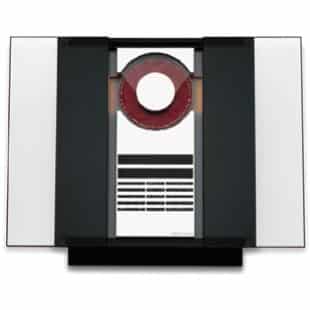
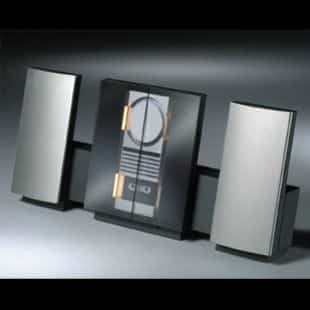
The loudspeakers were located on both sides of a centre console, where two clear glass covers automatically glided to the side when a hand was passed in front of them. Behind the glass covers there was access to the operating panel, receiver, CD player and a cassette recorder.
The receiver allowed the option of presetting 2 x 20 FM/AM radio stations. The cassette recorder featured Auto Reverse, Automatic Recording level, search function and Bang & Olufsen’s HX-PRO recording system, a system which ensures that the sensitive treble range is captured in recording. The memory in Beocenter 2300’s CD player allowed you to edit up to 100 CDs.
Both systems could be operated via their operating panel or a Beolink 1000 or Beolink 5000 remote control. There were sockets for headphones and connection to additional sound sources; extra loudspeakers can also be connected.
Beocenter 2300 was available with loudspeaker panels in cobalt grey, black, white, cerise or jade and could be made up to the Beosystem 2300 when incorporated with the BeoLab 2500 active loudspeakers.
Mounting Options
This classic design was reincarnated over a 21 year period with various mounts and stands. Floor stands were available with a pole stand or CD and tape storage, wall mount solutions allowed for the Hi-Fi only, or with BeoLab2500 speakers until these were discontinued
“BeoSound Ouverture: the design may be a Bang & Olufsen classic, but BeoSound Ouverture and BeoSound 3000 refuse to rest on their laurels. Access to new musical sources and fresh loudspeaker options ensure that the concept remains an open invitation to make something special out of your music” (B&O catalogue 2001 -2002)
This stereo has two different names: BeoSound Ouverture in Europe and BeoSound 4000 in the rest of the world. This is the only stereo system, so far, to support the new MasterLink system without any add-ons. It’s really a follow up to the Beocenter 2500 which was the first and original stereo with this somewhat different look. Along with the launch of this unit in 1991 (as the BeoSound 2500) Bang & Olufsen also started selling the new remote control – Beo4. The difference between the Ouverture and Beocenter 2500 is that the newer model doesn’t feature two-way communication and it has instead a completely new CD mechanism. It also holds some new features when it comes to the CD. But the most important difference is the MasterLink connection. With this system you can connect the unit to, for example, a BeoLab 2000 or BeoLab 3500 without any further electronics. Reach out and the doors glide quietly aside, while a gentle light spreads from within. It’s BeoSound Ouverture’s way of saying, “welcome” and part of the experience every time you put on a new tape or CD. CD player with programming, tape recorder with auto reverse, FM/AM radio with pre-set, timer function, optional Beo4 remote control operation, connections for Beolink® and headphones, optional wall bracket and floor stand. BeoSound Ouverture’s unassuming rubber key pad hides a contact foil, which, in turn, covers a matrix of vertical and horizontal cords. When a control is pressed, the cords connect and the microprocessor is activated.
Design
Music is more than just something you listen to, it’s an emotion you experience. So isn’t it time your favourite music was played on something that lets it express itself to the full? BeoSound Ouverture stands up and invites you to make something special out of your music – over and over again.
Features
Bring new life to old CDs by changing their track sequence with the Random Play function. Or programme it to skip over any unwanted tracks and to play the ones you want in the order you prefer. Transferring the music of a CD onto tape doesn’t have to mean poorer quality. The Ouverture constantly monitors and adjusts the signal during any recording to ensure a uniform sound level throughout – and will automatically stop recording when the CD finishes playing. There’s room for up to 30 pre-set stations on the Ouverture’s intelligent AM/FM radio.
So how do the sliding glass doors work?
The glass doors on the BeoSound 3000 and BeoSound Ouverture are opened and closed by steel wires driven by an electric motor via a gearbox. The motor is triggered by an infrared system that detects your approach… Why wake up to an annoying alarm clock when it could be your favourite piece of music instead? The timer function on the Ouverture can be programmed for the entire week and will automatically turn itself off again after playing for any length of time you choose.
Specials
Just raise a hand and watch as the glass doors glide silently aside. It’s the Ouverture’s way of saying “welcome” and reveals that a special experience is about to begin. Of course, a simple on/off button would do, but then what would be so special about that?
Easily Placed
It’s a dream come true – a music system that can fill your life with music without filling your home with equipment. The flat upright design of BeoSound Ouverture means that it’s slim enough to sit by itself upon the narrowest shelf or light enough to be hung directly on a wall with a pair of loudspeakers.
Use
With its mix of glass and aluminium, the Ouverture grabs the attention without shouting out loud. Its compact size and visual presence ensures that it enhances rather than dominates the surroundings in which it’s placed – which makes it the perfect audio system for the home and place of work. The stereo can also be controlled by the optional Beo4 remote control.
Mounting Options
This classic design was reincarnated over a 21 year period with various mounts and stands. Floor stands were available with a pole stand or CD and tape storage, wall mount solutions allowed for the Hi-Fi only, or with BeoLab2500 speakers until these were discontinued
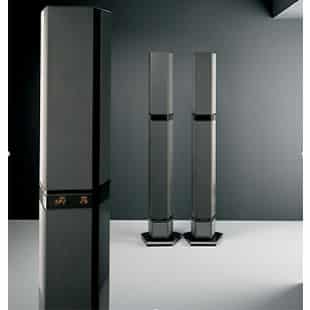
These tall and elegant speakers were developed according to a totally new acoustic principle. They sounded just as magnificent as they looked. Because there were no parallel surfaces in the pentagonal cabinet, the design reduced the internal standing waves and reflection; it was a simple and beautifully effective way of eliminating distortion. The cabinet provided the ideal conditions for the loudspeakers. It was an acoustically ‘dead’ construction, with a moulded inner cabinet surrounded by a stainless steel exterior. Whatever the dimensions of your room, and regardless of the furnishings, BeoLab Penta always sounded wonderful. It also needed very little floor space; head room was all that’s required!
BeoLab Penta was the top-of-the-line speaker from Bang & Olufsen. It was around from the late ‘eighties to the mid-1990s and was upgraded several times. The last version of the active Penta was the Penta 3. In the late 1980’s – when the Penta range was introduced – there was also a passive version, Beovox Penta. But since Bang & Olufsen decided in the 1990s just to concentrate on active speakers, these and some other models, such as the Beovox 4500 and most of the RedLine speakers, were discontinued.
Did you know that the display in Penta I and Penta II was orange and and on Penta III it turned green?
Why build amplifiers into the loudspeakers instead of keeping them separate?
Because you can reduce the size of the cabinet volume to one-third of the size of a conventional loudspeaker with the same sound capacity.
The principle is called Active Loudspeakers, and what you get is a compact loudspeaker that can play at high volume without distortion or damage to its drive units. Furthermore, when amplifier, treble and bass units are paired for the same task, they can be tailored to compensate for each other’s shortcomings. What you hear is music that sounds exactly like the instrument it originally came from.
BeoLab Penta had nine individual loudspeaker units that were accurately positioned in a vertical line to produce a sound dispersion which was so precise that reflections from the floor and ceiling were eliminated. Consequently, Penta speakers could be placed almost anywhere in a room, irrespective of its size or furnishings. The operating panel at the base of BeoLab Penta allowed for the fine tuning of the bass reproduction at three levels.
The speaker’s cross section was a pentagon. The benefit of this design was that it cannot house standing waves which normally are a problem in speakers. The choice of using polished stainless steel was made to help the speaker blend into its surroundings by reflecting them. This gave the speaker the same colour as the surroundings which helped to make the speaker more of a subtle fixture,
Sound with as many facets as a diamond
The location of the speakers within the column was carefully planned to control the sound waves so that they weren’t reflected by the floor and ceiling. The resulting sound quality simply beggared description.
BeoLab 150: Controlled overdrive
At the base of BeoLab Penta was the BeoLab 150 amplifier with a power output of 175 watts DIN/IEC. This could give your music a tremendous boost, both to the quality and the actual power output. It was ideal if you love partying but had a relatively small music system. Big power needs careful control – so the amplifier was equipped with Dynamic Soft Clipping system. When there was any overloading, the system softly rounded off the sound; distortion becoming a thing of the past.
Speakers that more than measure up
Top quality music systems need the best speakers available – or you’re missing out. BeoLab Penta was the natural partner for Bang & Olufsen’s Beosystem 5000 and Beocenter 9000, with their built in CD players. The laser-pure quality of compact disc makes heavy demands on speakers, and both these systems had extremely fine amplifiers. Using BeoLab Penta with these systems and you’d enjoy some of the best sounds in the world. You’d also appreciate handy features such as the light display at the base of the column, which indicated which music source was being used. Of course this was even more useful if you installed Beolink® to give you music all over the house.
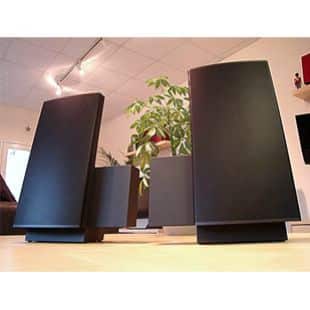
Quality loudspeakers provide well-modulated sound expression, and at the same time a visual personality that also commands attention. Bang & Olufsen’s BeoLab 3000 and Beovox 3000 loudspeakers had both the voice and the looks for a leading, acoustic role. Because of their thin shape, they became known as Panel loudspeakers.
Panel loudspeakers were one of the most exciting examples of how Bang & Olufsen united advanced technology and stunning design to achieve totally new effects. They didn’t look like high specification loudspeakers,, but their sound gave them away. Even at full volume they kept the total sound picture in perfect balance.
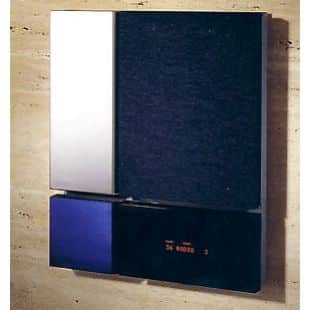
The elegant, flat loudspeakers were designed to be hung on the wall. And with their calm surfaces of blue or grey fabric coupled with beautiful, polished steel they looked like works of art presented in their own right. The idea of the panel speakers was based upon an advanced, acoustic principle that uses the wall as an active part of the sound reproduction, without causing the wall itself to vibrate.
They were available with or without amplifier and display showing which source was playing, at what volume, and which track number on a CD or tape you were listening to.
With display and amplifier the panel, speakers were called BeoLab 3000. Without, they were known as Beovox 3000.
The options depended on which Bang & Olufsen sound system was connected. You obtained maximum utilisation from Beosystems 6500, 4500, 3500 and Beocenters 9500 and 8500.
Why build amplifiers into the loudspeakers instead of keeping them separate?
Because you can reduce the size of the cabinet volume to one-third of the size of a conventional loudspeaker with the same sound capacity.
The principle is called Active Loudspeakers, and what you get is a compact loudspeaker that can play at high volume without distortion or damage to its drive units. Furthermore, when amplifier, treble and bass units are paired for the same task, they can be tailored to compensate for each other’s shortcomings. What you hear is music that sounds exactly like the instrument it originally came from.
Mounting Options
Wall mounting brackets were supplied with this model. No other mounting solution wall offered.
Bang & Olufsen’s preferred supplier for brackets and stands, STBbrackets, have made a range of solutions specifically for this model. Distributed throughout the World by the Bang & Olufsen store network, the STB options add to the diversity of mounting options and positions available.
»Wall Mounting Brackets
Wall Bracket for BeoVox & BeoLab flat panel speaker range
WB3000 has been introduced to meet a growing demand to mount Bang & Olufsen flat panel speakers to the wall. The bracket (sold as a pair) is a faithful reproduction of the original which was supplied with the speakers. These beautiful speakers can now be installed on to the wall, where they are a genuine and authentic Bang & Olufsen statement.
BeoLab 2500 are active loudspeakers designed to match the BeoSound Ouverture and the BeoSound 3000. With their built-in amplifiers, they sound as if they’re three times their size. Hang them on the wall or place them on bookshelves.
They match both the Beocenter Ouverture and 3000 (previous to this they were used with both the BeoSound 2300 and 2500 music systems) with perspective and clarity, despite their modest dimensions. The explanation of the wide sound lies in the built-in amplifiers in each cabinet: one for bass and one for treble, so that they never have to compete for the same amplifier.
Features:
BeoLab 2500 are active loudspeakers with 2 built-in power amplifier modules to combine with the current (2002) BeoSound 3000 and BeoSound Ouverture. As speakers for the BeoSound 2300 and 2500 music systems, they were available in Blue Lapis, Black Granite, Red Garnet, Green Malachite, Yellow Dolomite and Silver Galena. However, new metal frets were introduced at the end of 2001. From the previous replaceable cloth fronts, they are now manufactured in pearlescent aluminium (see below). These new perforated metal frets presently come in 5 different colours – natural aluminium, black, blue, green and russet to match those of BeoSound 1.
“When it comes to sound reproduction we believe there’s only one relevant parameter: How close can we come to the originally recorded sound. We feel an obligation not to disturb the intentions of the artist by adding unnatural elements to the acoustic image. Therefore all Bang & Olufsen loudspeakers share the same goal. They differ in size and shape and in terms of sound pressure level. But they are all developed to reproduce the natural, unaltered sound as closely as possible ” – Bang & Olufsen catalogue 2001 – 2002
Adaptive Bass Linearisation
Adaptive Bass Linearisation (ABL) is a process patented by B&O and is incorporated in BeoLab loudspeakers. The idea is to use the surplus capacity in amplifiers and driver units, arising by normal listening levels, for a bass extension – a sound reproduction with more bass, than the loudspeaker otherwise would be able to produce.
The function is adaptive. This means that the loudspeaker adapts to the signal it receives. Loudspeaker drivers are therefore fully exploited, without suffering mechanical or electronic abuse, and the built in amplifiers are not subjected to signals would otherwise create an overload situation.
ABL gives stunning bass reproduction considering the size of the loudspeaker in which it is incorporated, under normal listening levels.
Mounting Options
BeoLab2500 were originally mounted to the HiFi with wall bracket 2087 or physically separated and mounted onto furniture as a bookshelf option.
Beocenter 9300 really defined the word ‘classic’. It was for those who preferred to enjoy the music rather than to pore over the product manual. The design of the 9300 was around for many years before production ceased in the late 1990’s. It was available in many different versions; for example 8000, 9000, 9500 and the this last version: Beocenter 9300.
The differences between the 9500 and the 9300 was that the 9300 had a new and improved CD mechanism fitted which was faster than the previous versions. Some minor differences were that the 9300 lacked two-way remote communication and an equalizer loop-through. However, the 9300 still is still among the Bang & Olufsen greats!
BeoCenter 9300 could operate with active as well as passive loudspeakers. A mere touch activated BeoCenter 9300 and a line of sensi-touch options glowed on the lower glass display. The 9300 was a complete music system for people who prefer to enjoy music rather than poring over a product manual.
Features:
2 x 80 watt amplifier, CD player with programming, tape recorder with auto reverse, FM/AM radio with 30 preset stations, finger touch control, optional Beo4 remote control operation, connections for Beolink® and headphones, Master Control Link. There was also the option of using the BeoCenter with or without active speakers, such as BeoLab 4000 (shown above). A stand could also be bought as a separate item