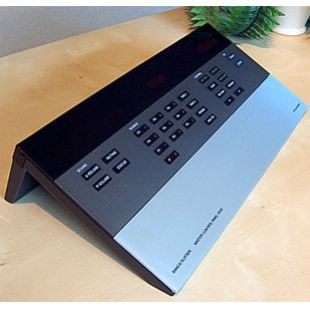
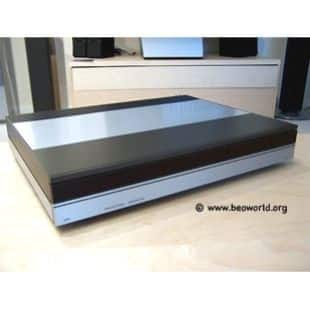
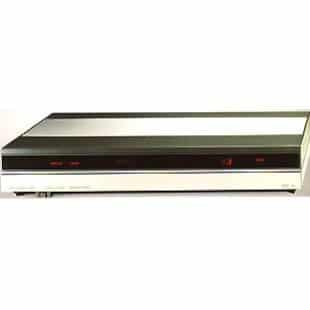
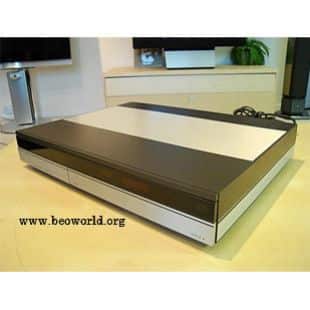
The main remote control for the Beosystem 5000, the MCP 5000 allowed full control of your Beosystem from your armchair.
Two way control allowed the status of the system to be ascertained easily and complex timer programming was possible using the controls under the flip down panel.
The MCP 5000 could only be used with the Beomaster 5000 and could be part of a multi-room system allowing full control in a link room. MCP5000 will not operate any of the other systems such as the Beosystem 5500, 6500 and 7000.
As part of Beosystem 5500, this advanced tape recorder was as close to professional standard as could be made at the time, bristling with features you just loved to use!
There was Auto Reverse, letting you play or record both sides of a cassette as one continuous tape. And automatic adjustment of sound levels avoided annoying volume changes from one recording to the next. Then there was Bang & Olufsen’s famous HX-Pro recording system which gave vastly superior sound quality on the higher frequencies, creating a richer, more detailed sound image.
Beocord 5500 automatically adjusted itself to match standard, chrome or metal tapes. You had the option of Dolby B or C during recording. During playback, the recorder automatically switched itself to the noise reduction system you recorded with. Automatic track search was also included – just key in the track number and the recorder did the rest.
The cassette recorder could be controlled via the two-way Master Control Panel 5500 as part of the Beosystem 5500.
Auto Record level
One of the less-pleasant chores in making a recording is setting level control to its optimum position. Setting it too low raises the level of background noise on the recording. Setting it too high makes the recording distorted at high music levels. With this in mind, Bang and Olufsen introduced an automatic record mode which was called ‘Auto Record’.
Auto Record worked in two steps: when the record button was pressed for the first time, the cassette recorder went into a record pause mode, where the incoming signal was monitored. Under microprocessor control, the highest level was monitored and the record level was set at the optimum level for that music. On pressing the record button the second time, the tape was set in motion and the recording started, but continuing to make minor adjustments. If at any time during the recording, the level of music rose above the monitored level, the level control was lowered by exactly the amount required for the new optimum recording level.
This method of setting the level control closely imitated the action of a highly skilled recording engineer, if asked to set the level for a recording. It was the best that could be done when the full recording could not be monitored before recording started.
This feature incorporated a new method of monitoring the signal, which proved to be a more effective method over conventional methods. It was patented by the company with the patent number 158702.
On the amplifier itself were buttons for adjusting bass and the level of sensitivity. This meant that you could arrive at a permanent adjustment that matched the room exactly.
BeoLab 150: Controlled overdrive
At the base of the BeoLab Penta column was the BeoLab 150 amplifier with a power output of 175 watts DIN/IEC. This could give your music a tremendous boost, both to the quality and the actual power output. It was ideal if you loved to party but had a relatively small music system. Big power needs careful control – so the amplifier was equipped with Bang & Olufsen’s Dynamic Soft Clipping system. This was a circuit that prevented both distortion and damage to the speaker units by softly rounding off signals that were too powerful. Another circuit prevented damage due to prolonged overloading.
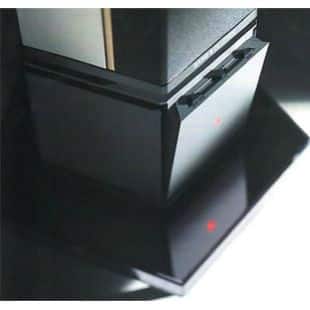
BeoLab Penta turned on automatically when it received a signal and also turned itself off three minutes after receiving the last signal. BeoLab Penta had a light display that indicated the volume level and which sound source the music was coming from. This was especially useful with Beosystem 5500 and Beocenter 9500.
BeoLab 150 and 200 were used as part of the BeoLab Penta active loudspeakers range.
Connections:
At the bottom of BeoLab 150 were two clip-sockets and a four pole DIN socket for connecting speakers, a line input phono socket and a mains cable.
Beomaster 5500 was the brains and heart of the system which it made up.
Connected by Datalink to the record player, tape recorder and CD player it allowed the user to remote-control the whole system via the Master Control Panel. The 2 x 60 watt/8 ohm tuner/amplifier gave true hi-fi quality. Bang & Olufsen’s Automatic Power Handling Control system prevented overloading and distortion, regardless of how many speakers were connected. Up to 20 stations on the tuner could be preset and the frequency synthesizer took care of automatic search and fine tuning of stations. The result – superb reception of LW, MW and FM wavebands and impressive ease of use.
Beomaster 5500 was aesthetically balanced to match the rest of the components within Beosystem 5500
These days, these receivers are the cheapest of the Beolink 1000 controlled stackable systems. They do have the huge advantage of having not only DIN connectors but also a full complement of RCA plugs. This actually makes them ideal for present day use as the extra connections allow computer and digital music connections in addition to usual sources.
For rooms where you didn’t need so much power, Beovox Penta was the little brother which suited you down to the ground. It didn’t have the built-in amplifier or the light display, but it was identical to BeoLab in all other respects.
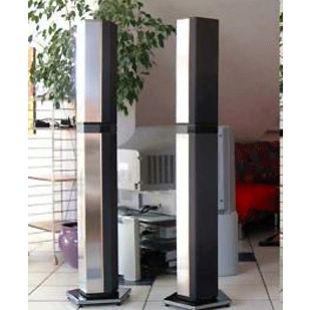
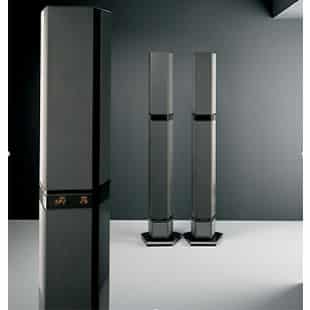
These tall and elegant speakers were developed according to a totally new acoustic principle. They sounded just as magnificent as they looked. Because there were no parallel surfaces in the pentagonal cabinet, the design reduced the internal standing waves and reflection; it was a simple and beautifully effective way of eliminating distortion. The cabinet provided the ideal conditions for the loudspeakers. It was an acoustically ‘dead’ construction, with a moulded inner cabinet surrounded by a stainless steel exterior. Whatever the dimensions of your room, and regardless of the furnishings, BeoLab Penta always sounded wonderful. It also needed very little floor space; head room was all that’s required!
BeoLab Penta was the top-of-the-line speaker from Bang & Olufsen. It was around from the late ‘eighties to the mid-1990s and was upgraded several times. The last version of the active Penta was the Penta 3. In the late 1980’s – when the Penta range was introduced – there was also a passive version, Beovox Penta. But since Bang & Olufsen decided in the 1990s just to concentrate on active speakers, these and some other models, such as the Beovox 4500 and most of the RedLine speakers, were discontinued.
Did you know that the display in Penta I and Penta II was orange and and on Penta III it turned green?
Why build amplifiers into the loudspeakers instead of keeping them separate?
Because you can reduce the size of the cabinet volume to one-third of the size of a conventional loudspeaker with the same sound capacity.
The principle is called Active Loudspeakers, and what you get is a compact loudspeaker that can play at high volume without distortion or damage to its drive units. Furthermore, when amplifier, treble and bass units are paired for the same task, they can be tailored to compensate for each other’s shortcomings. What you hear is music that sounds exactly like the instrument it originally came from.
BeoLab Penta had nine individual loudspeaker units that were accurately positioned in a vertical line to produce a sound dispersion which was so precise that reflections from the floor and ceiling were eliminated. Consequently, Penta speakers could be placed almost anywhere in a room, irrespective of its size or furnishings. The operating panel at the base of BeoLab Penta allowed for the fine tuning of the bass reproduction at three levels.
The speaker’s cross section was a pentagon. The benefit of this design was that it cannot house standing waves which normally are a problem in speakers. The choice of using polished stainless steel was made to help the speaker blend into its surroundings by reflecting them. This gave the speaker the same colour as the surroundings which helped to make the speaker more of a subtle fixture,
Sound with as many facets as a diamond
The location of the speakers within the column was carefully planned to control the sound waves so that they weren’t reflected by the floor and ceiling. The resulting sound quality simply beggared description.
BeoLab 150: Controlled overdrive
At the base of BeoLab Penta was the BeoLab 150 amplifier with a power output of 175 watts DIN/IEC. This could give your music a tremendous boost, both to the quality and the actual power output. It was ideal if you love partying but had a relatively small music system. Big power needs careful control – so the amplifier was equipped with Dynamic Soft Clipping system. When there was any overloading, the system softly rounded off the sound; distortion becoming a thing of the past.
Speakers that more than measure up
Top quality music systems need the best speakers available – or you’re missing out. BeoLab Penta was the natural partner for Bang & Olufsen’s Beosystem 5000 and Beocenter 9000, with their built in CD players. The laser-pure quality of compact disc makes heavy demands on speakers, and both these systems had extremely fine amplifiers. Using BeoLab Penta with these systems and you’d enjoy some of the best sounds in the world. You’d also appreciate handy features such as the light display at the base of the column, which indicated which music source was being used. Of course this was even more useful if you installed Beolink® to give you music all over the house.
At the base of the BeoLab Penta column was the BeoLab 150 amplifier with a power output of 175 watts DIN/IEC. This could give your music a tremendous boost, both to the quality and the actual power output. It was ideal if you loved to party but had a relatively small music system. Big power needs careful control – so the amplifier was equipped with Bang & Olufsen’s Dynamic Soft Clipping system. This was a circuit that prevented both distortion and damage to the speaker units by softly rounding off signals that were too powerful. Another circuit prevented damage due to prolonged overloading.
BeoLab 150: Controlled overdrive
On the amplifier itself were buttons for adjusting bass and the level of sensitivity. This meant that you could arrive at a permanent adjustment that matched the room exactly.
BeoLab Penta turned on automatically when it received a signal and also turned itself off three minutes after receiving the last signal. BeoLab Penta had a light display that indicated the volume level and which sound source the music was coming from. This was especially useful with Beosystem 5500 and Beocenter 9500.
BeoLab 150 and 200 were used as part of the BeoLab Penta active loudspeakers range.
Connections:
At the bottom of BeoLab 150 were two clip-sockets and a four pole DIN socket for connecting speakers, a line input phono socket and a mains cable.
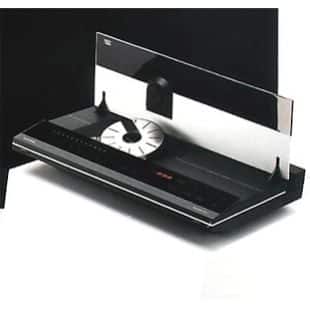
A featherlight touch on the glass control panel brought up an illuminated display of numbers which corresponded to the tracks on the disc. You could select tracks in any order; you could see how long a track lasted and a motorised dust cover and automatic light were among the features that this stand-alone CD player possessed.
The CD player was based around the Philips CD104, built in Belgium.
As a standalone player, it lacked the Datalink and remote control facilities that its predecessor, the Beogram CD50, possessed. A good-looking CD player which performed well, it was later superceded by the Beogram CDX-2 in 1987.
Bang & Olufsen Sales Training System
Beogram CDX
Beogram CDX is a Compact Disc player in a classical Bang & Olufsen design
Features:
Top operation
Motor driven dust cover
Sensi-touch operation
ADVANCE and RETURN functions
Replay up to 4 times
Display with indication of playing time of individual tracks, elapsed time and index
Analogue and digital filter (176.4 KHz over sampling)
Connection with Phono plugs
Operation
If Beogram CDX is in standby position and there is a compact disc on the platter, one push at the PLAY button will start the playback.
If there isn’t a compact disc inserted, you push the EJECT button and the motor driven dust cover will open, the platter will lift and the compact disc can be inserted.
Apart from the above-mentioned PLAY and EJECT buttons, all operations are sensi-touch fields, which are operated with a slight touch.
When pushing the field PLAY, the dust cover closes automatically and playback starts.
The display indicates the individual tracks on the inserted Compact Disc. If it has more than 20 tracks, the two first digits in the time display will show the total.
The time display has 3 main functions, which can be ordered by pressing DISPLAY, namely the time of the individual tracks, the elapsed playing time and index, which is a sub-division of the time of the individual tracks.
ADVANCE and RETURN are used for jumping to the next or the previous track and are indicated with a flashing of the selected track on the display.
With the digits 1 to 0, a track can be selected at random and the jump is marked on the display.
With STORE and CLEAR you can select or leave out up to 40 tracks on the Disc.
REPEAT replays the Disc up to 4 times.
One push at STOP gives pause, and by keeping the finger on the field till the Disc stops, you get actual STOP. << and >> are used for fast search within the individual tracks.
When activating it once, you search in jumps of 1 second
By keeping the finger on the field you search in jumps of 10 seconds and after 10 seconds the jumps are 1 minute
Connection
Beogram CDX is provided with a fixed signal cable with Phono plugs and can be connected to all LINE inputs. For amplifiers with TAPE inputs which are already being used, we can deliver a CD/TAPE adaptor, type 8950060 (accessory at additional price)
1985 Magazine Review
” The CDX is one of two ‘Beograms’ which have been promised by B & O for some considerable time. It would seem that to a large extent B & O have edged, their bets, for the CDX is a Philips-based machine while the alternative model uses Sony-sourced assemblies. The CDX is an extraordinarily beautiful machine yet, as we shall learn, is based entirely upon the ever so humble Philips CD?101 (the same player as used by Meridian for the MCD conversion). The styling is obviously intended as match the other B & O units and so the company has an untapped market of existing owners who have been patiently waiting for a CD player. But it is a player well worth considering in its own right as a separate purchase.
Unusually the CDX is a top loader but the lid assembly is powered and in response to the eject button the lid assembly smoothly folds back to allow the disc to be loaded. With the exception of the Eject and Power switches, all the controls are touch sensitive (using a type of capacitive sensing) a choice which I found far from reassuring since I kept wanting to use extra finger pressure to ensure a good contact! My overall lack of confidence was further encouraged by the all black control panel which reveals nothing until the power is applied. Perhaps it’s too much like computer screen ‘soft keys’ for me for I kept wondering if the Play switch would be still in the same place every time I went back to this player!
Two types of display are provided; a digital readout to show track time, total elapsed play time, and track numbers up to 99; and a bar scale of 20 LEDs to show the status of the first 20 tracks. A reasonable range of facilities is offered with both track skipping and fast searching (both backwards and forwards). Tracks can be pre-selected for playback and programming is possible for combinations of up to 40 tracks stored in the memory. Finally a Repeat mode allows continuous playback of the whole disc or of individual tracks.
Once the CDX is opened some idea of B & O’s inventiveness can be gained. Into the plastic casing has been dropped a Philips CD101 player complete down to the signal and mains supply cables but less the Switch/Display board. Instead B & O plug in wires from their own front panel and wire connections to their Eject and Power switches. The whole conversion is very neat and since the Philips player is left unmodified all the standard parts fit thus ensuring ease of service.
It has to be said that providing the last word in performance is not needed; the Philips CD?101 is an excellent choice with the CDM mechanism being recognised for its good build quality and reliable operation (it is also to be found in the expensive Revox B225 player). The electronics design largely follows the familiar Philips circuit with 4 times oversampling conversion using a separate 14-bit DAC for each channel.
In the laboratory the performance was much as expected with a generally flat frequency response except for a mild dip of 0.25dB around 7kHz; very low noise (?104dB); low crosstalk between channels and quite reasonable linearity. No problems were experienced when using the error testing discs and this player did very well in playing back some of my badly scratched discs with very few garbled passages.
Auditioning was conducted through my usual system of passive control unit and Krell power amplifier with LC connecting cables. Essentially in terms of sound quality this was very much a case of re-reviewing a Philips CD101 (or Marantz CD63) and the expected high standards were
achieved. The sound can be characterised as open, exciting with a fine sensation of space and depth, and good stereo focus. The weaknesses were primarily at the extremes of the audio band with a warm, stodgy bass and a degree of harshness at high frequencies. However within the context of the B & O system the sound quality of this player would be considered quite excellent.
VERDICT: A beautiful model which will appeal to a wider market than just the traditional
B & O owner. The overall performance of the CDX is excellent and this player can be considered as good value
PROS: Good sound quality. Very good value for money. Beautiful looks
CONS: Rather fiddly to use. Old fashioned top loading ”
The quality of the Beogram CD 5500 CD player took time to fully appreciate. For example, the elegant disc tray with its completely smooth and silent drive. Or the way that the disc drive system was mounted to isolate it from vibrations. Perhaps you were most impressed by the way that a built-in circuit in the player compensated for the tiniest faults on the disc itself (contrary to popular belief they’re not always perfect!). Finding tracks was both fast and easy – it was necessary to just ask the Master Control Panel for the track number you wanted. You could programme tracks to be played in any order, or sample each track briefly. There was a light display which showed you the length of the track you were playing and the remaining time on the disc – invaluable for recording.
Though very similar to look at to Beogram CD 50, this all-new Philips-based machine was a radical departure, both in manufacturing and technical terms. Beogram CD 5500 was the first CD player to be entirely designed by Bang & Olufsen and with the exception of the optical deck, it was entirely made by the company too. The performance and reliability of the Beogram CDX models probably influenced the choice of the Philips radial single beam pickup system and brushless DC spindle motor.
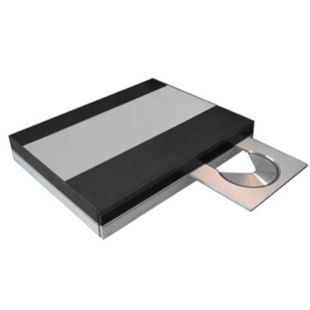
Externally, a slim aluminium plate machined out to the size of a compact disc replaced the Beogram CD 50 door and drawer loading system and it moved quickly and silently, again in marked contrast to its predecessor. The deck was on the right-hand side side of the fascia as opposed to Beogram CD 50 left-hand side arrangement, so that the loading of a cassette into the new Beocord 5500 tape recorder, which you had the option of placing below, was not obstructed. Later versions had a concentric 8cm circular recess machined into the loading plate, to accept CD singles.
With the Beogram CD 5500 there was no infra-red sensor option, and the front panel controls were even more basic, so at very least a Beomaster 5500 and Beolink 1000 terminal were needed to use it properly. On the back panel, there was a 7-pin Datalink socket for Beomaster 5500, and a single phono digital output connection, for which there was never a use within the B&O range.
The performance of this outstanding machine was never bettered, and with the exception of minor styling and software revisions, it remained virtually unchanged until the end of the separates system range with the Beogram CD 7000.
Beogram CD 5500 could be controlled via the two-way Master Control Panel MCP 5500 as part of Beosystem 5500.
Beogram CD 50 was Bang & Olufsen’s very first CD player designed to be part of a stacking system and first featured in the 1983/84 product catalogue and allowed Beosystem 5000 owners to use all the buttons on the Master Control Panel 5000. Beogram CD 50 was a front-loading CD player.
The disc was placed in the motorised drawer which opened at a touch and closed either by light finger-tip pressure or by operating the PLAY control. If the disc was inserted incorrectly (upside down as compared to most other CD players of the time) the drawer opened automatically to allow the user to replace it.
Although the CD50 is quite limited in operation from the front panel as a stand-alone unit, it is a very nice sounding and very functional machine utilising Burr-Brown decoders and a large array of RAM buffering. RCA outputs are available as well as the traditional DIN connection.
Since Beogram CD 50 was designed as a component of Beosystem 5000, it had a Datalink connection to allow remote control of all functions via the Beomaster’s Master Control Panel. Two phono output sockets and a 7-pin Datalink connection were provided for this purpose. However, since it was the only CD player in the B&O range in 1984, it was chosen for use with other Beosystems. An optional remote keypad – Terminal CD 50 – that could transmit commands to an infra-red sensor on the Beogram’s display fascia was provided to allow remote control of the unit when not used with Beosystem 5000. The optional Terminal was also recommended for those wishing to combine Beogram CD 50 with non-Bang & Olufsen hi-fi systems.
Strengths: the laser device is very beefy with plenty of heat sinking. Lots of shielding and grounding. Burr-Brown IC decoders utilised.
Weaknesses: without the remote control the unit will only carry out a few operations from the front panel: Open, Close, Display options, Play, Skip to selection, and Standby/Off. The CD must be inserted upside down as in some older Pioneer-type CD players.
The SCAN function was a feature unique to Beogram CD 50. You could sample the first 12 seconds of each track and either reject it from your programme or STORE its location for inclusion in a later playing sequence. A comprehensive display capability meant that you always knew what was happening, what CD track was playing or due to be played, elapsed and remaining time of each track, and so on.
Bang & Olufsen CD50 review
” This review was approached with more than the usual interest. B&O announced the fact that they were to introduce a CD player to match their 5000 system in the region of two years ago. For a long time however the promised player was not forthcoming, the main reason according to B&O being that they didn’t think the medium sounded good enough.
A few months back, B&O released first player, the CDX, and just before this went to press the CD50 designed to match the 5000 system was finally announced. The sample sent was a prototype and guaranteed to be ‘in accordance with specifications’. The usual warnings apply with such products and detail findings should be treated as tentative.
The CD?50 is one of the most impressively finished players in group; arguably the most impressive with its acres of brushed aluminium and immaculately moulded plastic parts The machine operates with utmost decorum, but allows the user plenty of thumb twiddling time whilst it laboriously retracts the drawer, reads the contents and initiates play. Tracking performance was good through to exceptional and immunity from shocks even better.
Description
A physically large player, the CD50 is an aesthetic match for B&O’s 5000 system and can be operated by the system remote control, which allows access to the play and programming features – the latter accepting sequences up to 36 tracks long. But it an also be used in foreign, non-B&O systems, either as is, or with an optional remote control. This is the £34 Terminal CD50, which is also advantageous even for 5000 system owners as many functions are not available without its help. System 5000 owners will therefore find themselves in the uncomfortable position of requiring two remote controls. I spoke to the company about this, who tell me that this will be taken into account (whatever that means) in a revamp due probably late 1986.
As a standalone item, the only facilities available to the user (unless I’ve missed something – there are no instructions) are play from the beginning or any other track, but the search is strictly sequential and in the forward direction only. The controls are micro switches behind the front panel: hit the right-hand edge and play starts, hit it again and the track count increases by one, though this can only be done with the disc loaded and table of contents in memory. The middle section toggles the excellent display between various time and track/index indications. The remote control, which was not ready in time for the review, adds the following: intro scan (which plays the first few seconds of each track), cueing (presumably with an audible output), index search, programming controls and a numeric keypad for direct track selection.
The Technical Bit
The CD?50 is based on an Aiwa transport, a fact betrayed by the upside down disc loading requirement. Even for a prototype the insides are a bit of a mess, the unit being crowded with wires everywhere and modifications by the bucket load. Decoding is 16 with 2x oversampling using a Yamaha chip and steep L-C aliasing filters. Component quality is just average. Measured performance is about average too. The frequency response is a bit wayward: there’s a small dip between above 1kHz, recovering to peak at 16kHz before slowly rolling away. Other figures were about average, but the low level waveform was better than usual.
Listening
B&O have accomplished in the CD-50 something which they may not have set out to do: to make a player that emulates much of the euphony and openness of good analogue sources e.g. records and combines it with typical digital strengths – low noise, convenience and the rest. There is a certain consistency, despite the 16KHz output peak, and the overall impression is one of pleasantness and clarity. However, the bass end is not ideally controlled and there was also some masking of fine detail.
Verdict
An excellent but costly player, sound quality is better than average and facilities pretty comprehensive if purchased with the remote control.
Pros…
A very pleasant sounding player that clearly benefits from the change that Bang & Olufsen have wrought to the off-the-shelf components used inside. Styling is excellent if you like this kind of thing – the player will suit those allergic to the knob-bedecked run of the mill.
… and Cons
Good as the B&O sounds, it’s a doubtful proposition in value for money terms ? the price is definitely on the high side. B&O also seem to have got their knickers in a twist with the control system and the 5000 system remote control, which controls every other part of the system, only accesses the most basic of facilities on the CD player. ”