Posted on

BeoVox 1600

Bang & Olufsen BeoVox 1600

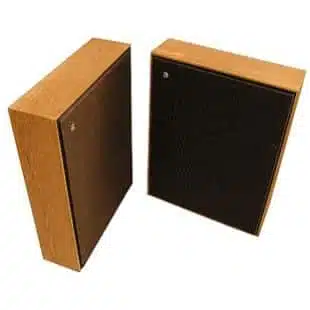
The plain exterior of the Beovox 1600 concealed an interesting design. Designed for wall mounting, either vertically or horizontally, the Beovox 1600 was the ideal for the mid range B&O models of the period such as the Beomaster 1200 or Beocord 2400.

The Beovox 1600 was a three-way design. The units comprised a 12cm woofer, a 2.5cm dome midrange and a 4cm cone tweeter. These units were supplied by Wharfdale (England), Philips (Holland) and SEAS (Norway) respectively. An odd mix, though they were all of good quality and were well made, the woofer had a rot-resistant soft rubber roll edge and a pressure die-cast basket for example. Using a cone driver as the tweeter and a dome for the midrange was odd practice, though it has to be remembered that these were early days for dome loudspeakers in general.

The crossover network was of a fairly standard three-stage parallel design complete with a band pass section for the midrange. Unusually for B&O, a film capacitor was used as the pass element for the tweeter, normally a cheaper electrolytic capacitor would be found here.

The slim cabinets also had an unusual feature, they were braced from front to back to make the large front and rear panels more rigid. This may have been done to stiffen the rear panel in particular, to reduce the amount of acoustic energy that was transmitted into the wall. The cabinets were constructed on the pressure chamber principle and were fronted by a cloth grille that was supported on a pressed steel sheet.

B&O had clearly put a lot of work into the Beovox 1600. It was later replaced by the Beovox 1800.
Posted on

BeoVox 1100

Bang & Olufsen BeoVox 1100

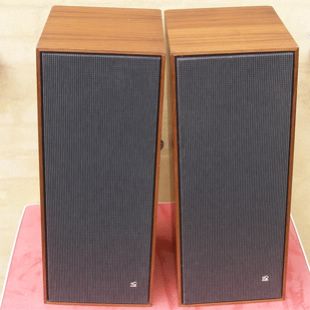
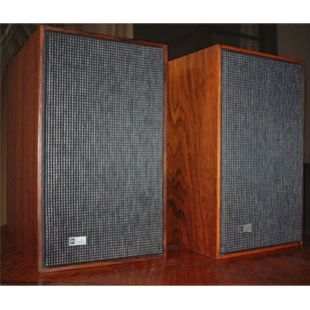
However, it was fitted with higher quality drive units (one 6” woofer and one 1.5” dome tweeter), which gave it a considerable performance advantage. The dome tweeter in particular was a great improvement over the cone type of the Beovox 600. The superior quality meant that the Beovox 1100 met the DIN 45 500 requirements for hi-fi. While it was still suitable for use with the same models as the Beovox 600, it could also be used with some of the better Beomasters, such as the 1000, 1200, 1400 and 1600.

Posted on

BeoVox 1000

Bang & Olufsen BeoVox 1000

“B&O loudspeakers will meet very exacting conditions as their specifications exceed international hi-fi standards. All B&O speakers are of the pressure-chamber type with an impedance of 4 ohms. They are available in matched pairs only in a choice of teak or Brazilian rosewood finish”

– taken from the 1967 – 1968 Bang & Olufsen product catalogue

Posted on

BeoCord 1500 De Luxe

Bang & Olufsen BeoCord 1500 De Luxe

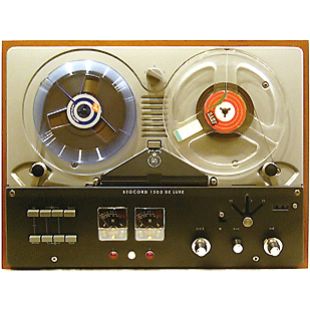
“If you already own a hi-fi music system or a good radio set with a tape socket – in other words, if you have an amplifier system capable of replacing that provided in a tape recorder you may prefer this 2-track recording machine. Technical specifications are equal to those of the Beocord 2000de Luxe K, but there is no mixer section or output amplifier.

The Beocord 1500 de Luxe has built-in playback pre-amplifiers and is sold complete with gramophone/radio record pre-amplifier. This recording pre-amplifier may be exchanged for a microphone pre-amplifier if direct microphone recordings are required.

Dimensions: 205mm high, 450mm wide, 335mm deep. Choice of teak or Brazilian rosewood finish” – taken from the 1967 – 1968 Bang & Olufsen product catalogue.

Beocord 1500 DL was a stereo tape recorder which you could use with an existing stereo system. There was no built-in amplifier or microphone – the unit’s raison d’être was a means to make really good recordings from records or the radio. A single stereo input channel of standard DIN level was the only source, but two outputs were provided: one of a fixed DIN level, and the other (Line) of a variable level controlled by a concentric (L,R) knob on the control panel. With a special lead and the correct Beomaster, it was possible to do off-tape monitoring during recordings (although by using standard DIN connection through the ‘radio’ socket this function was not available).

Accessories for the 1967 range of Beocord Tape Recorders:

An elegant steel undercarriage on smooth-running castors was separately available for the Beocord models at that time. It was available in two versions: for Beocord 1100/Beocord 2000 de Luxe T, and Beocord 1500 de Luxe/Beocord 2000 de Luxe K, respectively.

Beocord 1500 DL was replaced by Beocord 1800 in 1970, which looked very similar but included several detail improvements, such as a die-cast chassis and optical automatic stop. Mechanically, Beocord 1500 DL was the same as Beocord 2000 DL and was offered in the same way in either 2 track + 4 track replay and 4 track only models. The Beomaster 900 RG Compact radiogram featured a recess of the exact size to fit Beocord 1500 DL which made it into a complete audio system.

Posted on

BeoLit 1000

Bang & Olufsen Beolit 1000

This portable radio has a specification superior to those of most mains table models and is elegantly styled, with all the controls placed on the top panel.

The Beolit 1000 offers outstandingly fine reception: on all its five bands, distant stations tune in without noise and interference even when located on adjacent frequencies. The FM section features a separate dial drive and additional push-button selection of up to three pre-tunable FM stations. The extended Long Wave band includes the navigation bands, and on the SWII band (the ‘Europe’ band) you can find all the popular European entertainment stations. The built-in Short Wave expander permits you to spread stations for supreme ease of tuning. There are sockets for connection of an external aerial, extension speaker and external power supply.

The Beolit 1000 brings you external tonal quality. Audio output is 2.5 watts on the internal dry cells. Via a suitable mains converter the Beolit 1000 will deliver no less than 7.5 watts of audio output, making it ideally suited to use as a home radio set. It has individual bass and treble controls and gramophone and tape-recorder jacks.

You can use the Beolit 1000 in a car, with the specially designed lockable car-mounting bracket which operates on 6 or 12 volts and negative and positive earthing, and incorporates filters to suppress ignition interference. The bracket automatically cuts out the built-in power supply of the Beolit 1000 and cuts in the car battery, the car aerial and an extension speaker. When powered from the car battery the set will deliver 7.5 watts of audio output.

Available in teak, Brazilian rosewood and black goatskin finish. Dimensions: 201 mm high, 359 mm wide and 70 mm deep

In 1972 the Museum of Modern Art in New York (MoMA) chose seven Bang & Olufsen products designed by Jacob Jensen to be included in their Design Collection as representing excellent examples of the Museum’s criteria for quality and historical importance; design, in fact, which had influenced the twentieth century. Beolit 1000 was one of those seven products.

In 1968 Beolit 1000 won the prestigious iF Design award.

Posted on

BeoCord 1600 (1969)

Bang & Olufsen BeoCord 1600 1969

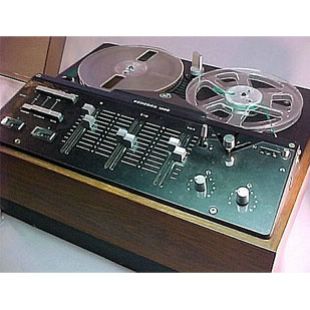
Beocord 1600 Type 4205 was a reel-to-reel tape recorder. Among its special features it had sound on sound, automatic recording level control and mixing controls The PA Amplifier could be operated without the motor running.

Bang & Olufsen’s Beocord 1600 tape recorder was designed by Jacob Jensen and was the second product to receive the iF Award in 1971.

Posted on

BeoCord 2400 (1969)

Bang & Olufsen BeoCord 2400 1969

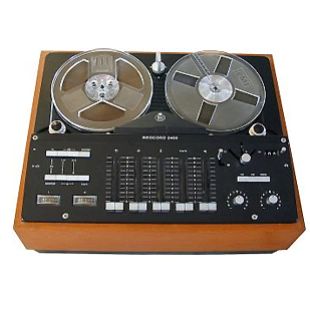
“What Advantages does your Beocord 2400 give you in the Form of Facilities, Performance and Reliability? Pressure diecast chassis for the mechanical section – provides a high degree of mechanical stability, assuring you that your Beocord 2400 is transport-proof. Silicon transistors in the fully transistorized amplifiers – a guarantee of highly stable operation, good signal-to-noise ratio, minimum distortion, and low power consumption.

Separate tape heads for record and playback – permit you to monitor the tape while a recording is in progress. 4-track record and playback – permits maximum playing time for your tapes, both mono and stereo. Two-hand operating of record function – protects you against accidental erasure of tapes.

High degree of channel separation – in mono recordings, too, you will have good separation between the two channels. Twin-faders – make it easy for you to adjust for stereo balance on both record and playback.

Besides, the dual amplifier of your Beocord 2400 gives you the following interesting facilities: Sound on sound (part-song) recordings; adding echo to recordings; synchronous recordings such as pilot signals for slide projectors synchronized with sound reproduction; language laboratory: recording a foreign-language text on one track and conversation exercises synchronously on the other track.

Photo-stop feature – permits you to stop tape during programme scanning, if tape breaks, and at end of tape. Line jack – facilitates tape-copying from or to another Beocord; also permits connection to a large hi-fi system such as the BEOLAB 5000.

Your Beocord 2400 will operate as a hi-fi amplifier – the amplifier may be used without the motor running. It has separate inputs for microphone, gramophone, radio or FM/AM tuner and provision for connection of two pairs of stereo speakers. And your Beocord 2400 meets the minimum specifications for the DIN 45 500 Standards”

Posted on

BeoCord 1200

Bang & Olufsen BeoCord 1200

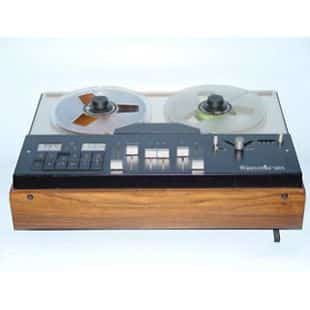
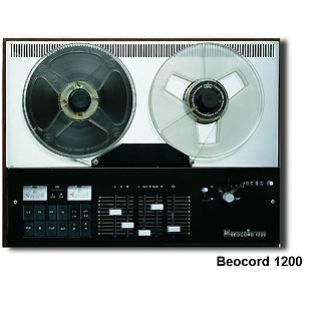
Beocord 1200 Type 4207 was a reel-to-reel tape recorder. Among its features it had sound-on-sound, automatic recording level control and mixing. The in-built PA amplifier could be operated without the motor running.

Beosystem 1200 – made up of Beomaster 1200, Beocord 1200 and Beogram 1200 was Bang & Olufsen’s B&O’s first designed system. The design ‘kinship’, which emphasised the interdependence between B&O’s various products, became a characteristic of B&O for many years. Beosystem 1200 was one of the first products selected by New York’s Museum of Modern Art for the museum’s permanent collection (not exhibition) in 1972.

In 1969 the Danish Society of Industrial Design awarded Bang & Olufsen and Jacob Jensen the ID prize for the Beomaster 1200 radio/amplifier, Beogram 1200 turntable and Beocord 1200 tape recorder for unusually beautiful and user friendly design. The jury emphasised in particular the Beomaster 1200 receiver which pointed in a new direction for the design of radios.

The 1200 series represented the logical continuation of the line of development and design which put B&O at the forefront of manufacturers of entertainment electronics.