Posted on

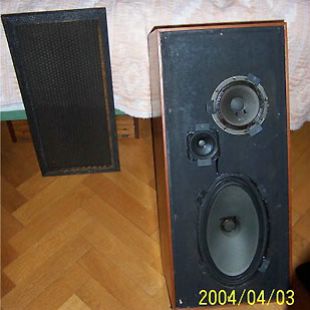
BeoVox 1500

Bang & Olufsen BeoVox 1500

The crowning glory of Beolab 20 is the Acoustic Lens that delivers smooth high-frequency sound in full 180 degrees. The results are uncompromising listening experiences across your room and much greater freedom in terms of where you place your speaker for optimal sound.

Review thanks to BeoWorld member Sajpratty – Thanks Steve.

Test environment…

BeoMaster 1000 (white key version, tone controls all at neutral)
BeoGram 1000 (SP 6-7)
Side-by-side comparison with BV1000 (all speakers still on original capacitors)
Correct period (for sound balance) sources:

Arthur Lyman “Taboo” (chosen for range of instruments and no remix “work”) – (a 1958 pressing recorded 16-20000 cps, mono)
The Beatles “Please Please Me” – (a 1964 pressing, mono)
Dvorak’s Symphony No. 9, Alexander Gibson and the LPO – (a 1967 pressing, stereo)
Bass response

Very deep, deeper than the BV1000 and better defined. Close to the lower limits of my ears but still easy to hear the different notes played.
The BV1000, in contrast, never gave the impression that the lower ranges of my hearing were being tested.
Treble response

Very similar in quality to the BV1000, but reached a bit higher without losing detail. Very sensitive to positioning, quite directional, possibly more so than the BV1000.
Midrange balance

Adjustable to taste (5-position switch at rear.)
General impressions

Double bass – low, defined, easy to hear the different notes played, very easy to tell the difference from electric bass.
Grand piano – I’ve stood next to real pianos being played, this sounded and felt exactly the same.
Flute – nice and “woody” sounding.
Sleigh bells – sounded clear and resonant.
Cymbals – bright and well defined.
Snare drum – I’ve had a go on one of these, this also sounded exactly the same.
Orchestral – sounded nice on the BV1000’s but the BV1500’s raised goosebumps.
In use – I prefer the BV1000’s for voice and the BV1500’s for music.
Posted on

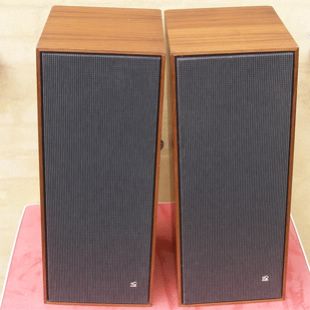
BeoVox 1000

Bang & Olufsen BeoVox 1000

“B&O loudspeakers will meet very exacting conditions as their specifications exceed international hi-fi standards. All B&O speakers are of the pressure-chamber type with an impedance of 4 ohms. They are available in matched pairs only in a choice of teak or Brazilian rosewood finish”

– taken from the 1967 – 1968 Bang & Olufsen product catalogue

Posted on

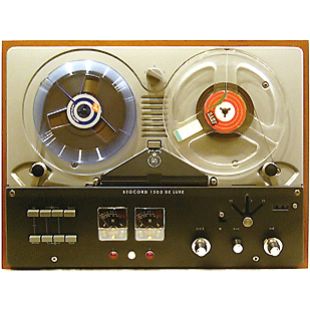
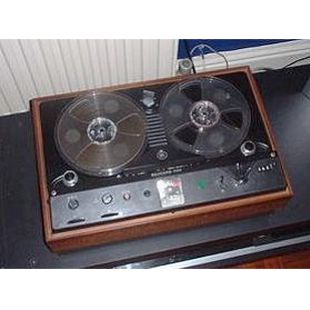
BeoCord 1500 De Luxe

Bang & Olufsen BeoCord 1500 De Luxe

“If you already own a hi-fi music system or a good radio set with a tape socket – in other words, if you have an amplifier system capable of replacing that provided in a tape recorder you may prefer this 2-track recording machine. Technical specifications are equal to those of the Beocord 2000de Luxe K, but there is no mixer section or output amplifier.

The Beocord 1500 de Luxe has built-in playback pre-amplifiers and is sold complete with gramophone/radio record pre-amplifier. This recording pre-amplifier may be exchanged for a microphone pre-amplifier if direct microphone recordings are required.

Dimensions: 205mm high, 450mm wide, 335mm deep. Choice of teak or Brazilian rosewood finish” – taken from the 1967 – 1968 Bang & Olufsen product catalogue.

Beocord 1500 DL was a stereo tape recorder which you could use with an existing stereo system. There was no built-in amplifier or microphone – the unit’s raison d’être was a means to make really good recordings from records or the radio. A single stereo input channel of standard DIN level was the only source, but two outputs were provided: one of a fixed DIN level, and the other (Line) of a variable level controlled by a concentric (L,R) knob on the control panel. With a special lead and the correct Beomaster, it was possible to do off-tape monitoring during recordings (although by using standard DIN connection through the ‘radio’ socket this function was not available).

Accessories for the 1967 range of Beocord Tape Recorders:

An elegant steel undercarriage on smooth-running castors was separately available for the Beocord models at that time. It was available in two versions: for Beocord 1100/Beocord 2000 de Luxe T, and Beocord 1500 de Luxe/Beocord 2000 de Luxe K, respectively.

Beocord 1500 DL was replaced by Beocord 1800 in 1970, which looked very similar but included several detail improvements, such as a die-cast chassis and optical automatic stop. Mechanically, Beocord 1500 DL was the same as Beocord 2000 DL and was offered in the same way in either 2 track + 4 track replay and 4 track only models. The Beomaster 900 RG Compact radiogram featured a recess of the exact size to fit Beocord 1500 DL which made it into a complete audio system.

Posted on

BeoCord 1100 (1967)

Bang & Olufsen BeoCord 1100 1967

Beocord 1100 – an all-transistor 2-track hi-fi mono recorder possessing a maximum of technical features: 3 tape speeds: 4.75cm/sec (recording of speech), 9.5cm/sec (recording of gramophone and AM radio), 19cm/se (recording of FM radio and direct recordings of music).

All reel sizes – including the 18cm reels. The amplifier, built on a printed integrated circuit principle, delivers no less than 10 watts of undistorted power output (built-in speaker 3 watts; extension speaker 10 watts). Automatic recording level control which may be switched on and off as desired. Two smooth-running specially engineered slack absorbers take up slack, ensuring absolutely smooth starting and stopping at all tape speeds. Electronic overload protection. Variable monitoring of the recorded signal. Top-quality low-noise tape drive motor built on rugged anti-torsion steel chassis. May be used as a separate microphone, radio, gramophone or guitar amplifier. Smooth-operating tape control lever. Large V.U. meter for visual recording level monitoring, input selector for gramophone, radio and microphone.

Separate bass and treble controls. Pause control lever with editing position. Automatic tape stop at end of tape and if tape breaks, also with metal foil. Tape counter. Speed selector with built-in on/off switch. Fast forward and reverse rewind. Output jacks for external speaker and low-impedance headphones. All jack plugs are international DIN standard types. Built-in splicing device. Permits recording from one tape recorder to another. Pilot lamp indicating that the instrument is switched on.

The Beocord 1100 is a convenient portable model (weighs 13,2kg) with built-in speaker and carrying handle, and its slim design makes it well-suited for placing on book shelves etc.

Space for radio cable, microphone with cable and stand, and recording cable.” – taken from the 1967 – 1968 Bang & Olufsen product catalogue.

Posted on

BeoLit 1000

Bang & Olufsen Beolit 1000

This portable radio has a specification superior to those of most mains table models and is elegantly styled, with all the controls placed on the top panel.

The Beolit 1000 offers outstandingly fine reception: on all its five bands, distant stations tune in without noise and interference even when located on adjacent frequencies. The FM section features a separate dial drive and additional push-button selection of up to three pre-tunable FM stations. The extended Long Wave band includes the navigation bands, and on the SWII band (the ‘Europe’ band) you can find all the popular European entertainment stations. The built-in Short Wave expander permits you to spread stations for supreme ease of tuning. There are sockets for connection of an external aerial, extension speaker and external power supply.

The Beolit 1000 brings you external tonal quality. Audio output is 2.5 watts on the internal dry cells. Via a suitable mains converter the Beolit 1000 will deliver no less than 7.5 watts of audio output, making it ideally suited to use as a home radio set. It has individual bass and treble controls and gramophone and tape-recorder jacks.

You can use the Beolit 1000 in a car, with the specially designed lockable car-mounting bracket which operates on 6 or 12 volts and negative and positive earthing, and incorporates filters to suppress ignition interference. The bracket automatically cuts out the built-in power supply of the Beolit 1000 and cuts in the car battery, the car aerial and an extension speaker. When powered from the car battery the set will deliver 7.5 watts of audio output.

Available in teak, Brazilian rosewood and black goatskin finish. Dimensions: 201 mm high, 359 mm wide and 70 mm deep

In 1972 the Museum of Modern Art in New York (MoMA) chose seven Bang & Olufsen products designed by Jacob Jensen to be included in their Design Collection as representing excellent examples of the Museum’s criteria for quality and historical importance; design, in fact, which had influenced the twentieth century. Beolit 1000 was one of those seven products.

In 1968 Beolit 1000 won the prestigious iF Design award.

Posted on

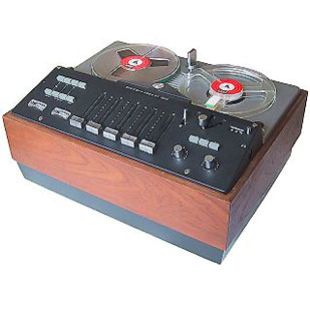
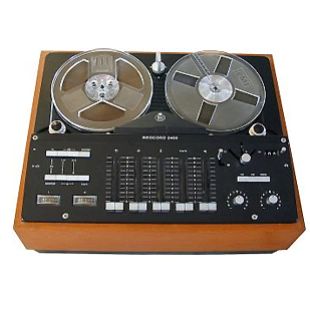
BeoCord 2000 Deluxe K (1965)

Bang & Olufsen BeoCord 2000 Deluxe K

“One of the best semi-professional fully transistorised hi-fi stereo tape recorders. It has professional data for speed, wow and flutter that meet international standards for studio tape recorders. New modern design concepts distinguish the Beocord 2000 de Luxe K from conventional tape reorders. Here are some of them: 4-track recording/2-track and 4-track playback; built-in 4-channel mixer section with twin faders for both mono and stereo recordings provides individual control and mixing of microphone, gramophone, radio and line signal inputs.

These faders make it possible to balance channels during recording. An aurally compensated twin fader makes it possible to balance playback volume levels, too. These features permit recordings of every kind, such as Multi-playback, or sound-on sound; that is, rerecording from one track to another whilst making another recording on the other track.

Synchro-playback – this feature consists of synchronising two recordings on separate tracks which you do wish to mix by recording, and may be used for language laboratory purposes and for automatic control of lantern slides. Echo – adding echo to both mono and stereo recordings. The amplifier equipment is an outstanding new system consisting of no less than seven fully transistorised easily replaceable amplifier units.

Monitoring: separate records and playback heads with individual amplifiers permit both before-the-tape and off-the-tape monitoring. Power output is 2 x 8 watts undistorted.

Frequency response: 7.5″/sec 30-20 000 Hz (+/- 2 dB: 40 – 16 000Hz), 3.75″/sec 30 – 16 000 Hz (+/- 2dB: 40 – 12 000Hz), 1.7/8”: 50 – 8 000Hz (+/- 2 dB: 50 – 6 000Hz)

Recording level is indicated by two illuminated V.U. meters which indicate the sum of signals in each of the two tracks that can be recorded simultaneously.

Slack absorbers: Two smooth-running specially engineered slack absorbers take up slack, ensuring absolutely smooth starting and stopping at all tape speeds.

Electronic protection circuit prevents damage due to electrical overloads. No other tape recorder in this price bracket has these professional standards for electrical and mechanical specifications. Fine low-noise tape drive motor mounted on rugged non-torsion steel chassis. Four tape heads, 4-track recording but – a remarkable feature – the instrument plays back both 2-track and 4-track tapes.

The erase head (long-life dual-gap ferrite erases “right to the bottom” (70dB). The 2000 de Luxe permits recording from one tape recorder to another, parallel recording on a number of tape recorders, and simultaneous copying of both tracks. The Beocord may also be used as: public address system, permanently installed hi-fi control centre, and orchestra and guitar amplifier.” – taken from the 1967 – 1968 Bang & Olufsen product catalogue .

Posted on

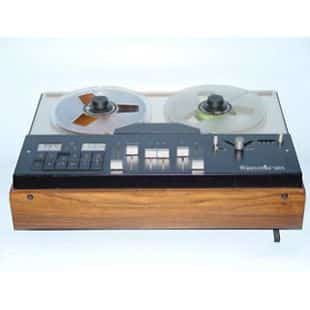
BeoCord 1600 (1969)

Bang & Olufsen BeoCord 1600 1969

Beocord 1600 Type 4205 was a reel-to-reel tape recorder. Among its special features it had sound on sound, automatic recording level control and mixing controls The PA Amplifier could be operated without the motor running.

Bang & Olufsen’s Beocord 1600 tape recorder was designed by Jacob Jensen and was the second product to receive the iF Award in 1971.

Posted on

BeoCord 2400 (1969)

Bang & Olufsen BeoCord 2400 1969

“What Advantages does your Beocord 2400 give you in the Form of Facilities, Performance and Reliability? Pressure diecast chassis for the mechanical section – provides a high degree of mechanical stability, assuring you that your Beocord 2400 is transport-proof. Silicon transistors in the fully transistorized amplifiers – a guarantee of highly stable operation, good signal-to-noise ratio, minimum distortion, and low power consumption.

Separate tape heads for record and playback – permit you to monitor the tape while a recording is in progress. 4-track record and playback – permits maximum playing time for your tapes, both mono and stereo. Two-hand operating of record function – protects you against accidental erasure of tapes.

High degree of channel separation – in mono recordings, too, you will have good separation between the two channels. Twin-faders – make it easy for you to adjust for stereo balance on both record and playback.

Besides, the dual amplifier of your Beocord 2400 gives you the following interesting facilities: Sound on sound (part-song) recordings; adding echo to recordings; synchronous recordings such as pilot signals for slide projectors synchronized with sound reproduction; language laboratory: recording a foreign-language text on one track and conversation exercises synchronously on the other track.

Photo-stop feature – permits you to stop tape during programme scanning, if tape breaks, and at end of tape. Line jack – facilitates tape-copying from or to another Beocord; also permits connection to a large hi-fi system such as the BEOLAB 5000.

Your Beocord 2400 will operate as a hi-fi amplifier – the amplifier may be used without the motor running. It has separate inputs for microphone, gramophone, radio or FM/AM tuner and provision for connection of two pairs of stereo speakers. And your Beocord 2400 meets the minimum specifications for the DIN 45 500 Standards”

Posted on

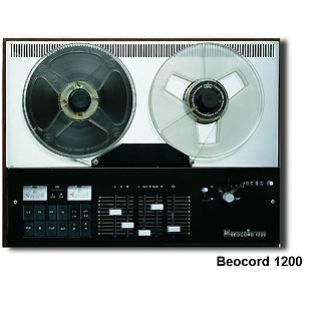
BeoCord 1200

Bang & Olufsen BeoCord 1200

Beocord 1200 Type 4207 was a reel-to-reel tape recorder. Among its features it had sound-on-sound, automatic recording level control and mixing. The in-built PA amplifier could be operated without the motor running.

Beosystem 1200 – made up of Beomaster 1200, Beocord 1200 and Beogram 1200 was Bang & Olufsen’s B&O’s first designed system. The design ‘kinship’, which emphasised the interdependence between B&O’s various products, became a characteristic of B&O for many years. Beosystem 1200 was one of the first products selected by New York’s Museum of Modern Art for the museum’s permanent collection (not exhibition) in 1972.

In 1969 the Danish Society of Industrial Design awarded Bang & Olufsen and Jacob Jensen the ID prize for the Beomaster 1200 radio/amplifier, Beogram 1200 turntable and Beocord 1200 tape recorder for unusually beautiful and user friendly design. The jury emphasised in particular the Beomaster 1200 receiver which pointed in a new direction for the design of radios.

The 1200 series represented the logical continuation of the line of development and design which put B&O at the forefront of manufacturers of entertainment electronics.