Beovox S50
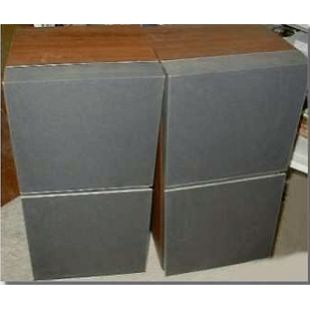
Uncommon in the UK, the smallest of the range at the time and a two way speaker. Replaced by the S45 which was also downgraded in comparison with a captive lead.

Uncommon in the UK, the smallest of the range at the time and a two way speaker. Replaced by the S45 which was also downgraded in comparison with a captive lead.
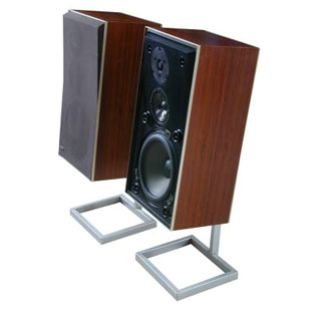
An exceptional little bookshelf speaker of hi-fi quality with a frequency range of 38 – 20000 Hz and less than 1% harmonic distortion.
You will find these speakers regularly recommended on BeoWorld. They have the same height and width as the lesser S35 speakers but are 3cm deeper and 1kg heavier. This small size difference makes an immense difference to the sound though. The extra filler drive unit adds hugely to the all important midrange sound and this is, to many users’ ears, the best balanced bookshelf speaker made by B&O. What it lacks in ultimate bass, it repays in accuracy and tone. The optional floor stand is elegant and effective and worth hunting out. A capacitor change may be needed to make an old pair sing but you are very unlikely to be disappointed by purchasing a pair of these.
For those in search of more bass, S75s are the bigger brother but lack the sonic purity found in the S45.2. To beat these in this range, you need M100s and a bigger house!
Linear phase sound reproduction. Speaker units include a 20cm woofer, a special 8cm Phase Link unit, and a 2,5cm dome tweeter. Volume 25 litres; weight 7kg.
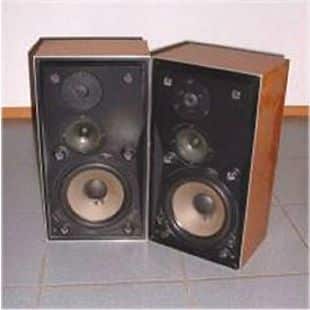
Beovox S4500 type 6318 were 4-8 Ohm speakers delivering 45W (RMS) and 75W (Music Power) These were a late derivation of the S45-2 and co-existed with the later Uniphase range for a year.
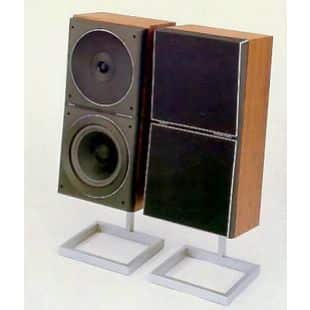
These medium-sized loudspeakers could be placed within a multiple shelving system, on an open shelf or table, mounted on the wall using the optional wall brackets or used as free-standing units by fitting the optional pedestal stands.
The two-unit configuration, with separate drivers for bass/midrange and treble reproduction, offered excellent frequency response and power-handling of 45 watts RMS.
The pressure chamber enclosures were finished in a choice of natural teak, rosewood, oak or white
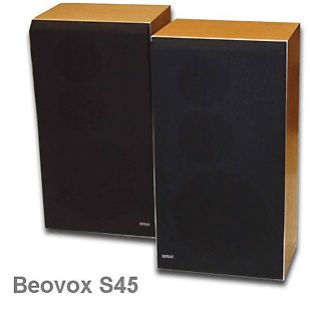
First model to carry this name, these were three way speakers and are easily differentiated from the S45-2 as they have a protruding resin rear and no metal trim on the rear of the cabinet. Otherwise very similar.
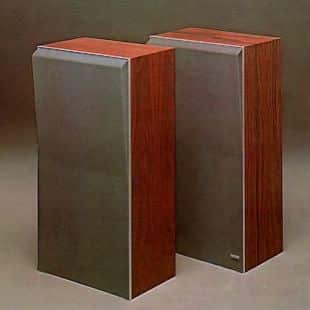
Beovox S30 and S40 both used a two-unit configuration and pressure chamber design to reproduce music faithfully and clearly.
They handled up to 30 watts and 40 watts respectively and were ideal for mounting within a shelving system. Beovox S40 worked in conjunction with Beosystem 2300 if that is how you wished to use them. They featured a 20cm bass driver (woofer) and a 2,5cm dome treble unit (tweeter) offering wide frequency response and clean, clear sound reproduction.
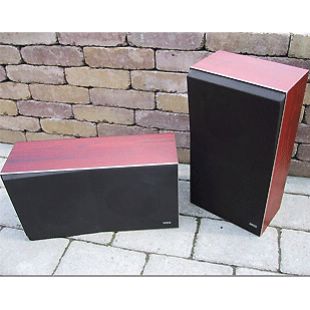
The smallest of the Uniphase range. These speakers were designed for use with the small music centres and less highly powered receivers in the B&O range.
They were the same external design as the bigger models in the range but in a very compact box. Obviously they had limited bass reproduction but when placed correctly could deliver excellent results.
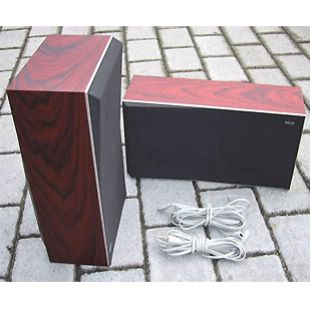
Beovox S25 were compact speakers produced between 1977 and 1983 with linear phase reproduction, suitable for placement in a small bookshelf. Fitted with a 17cm woofer and a 5cm dome tweeter. Frequency range 65 – 18000 Hz. Volume 12,4 litres, Weight 4kg.
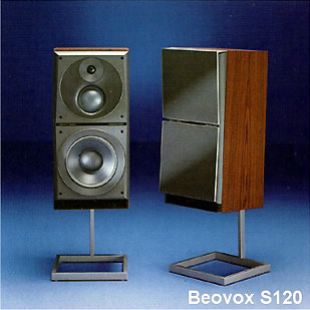
Beovox S120 is designed to handle 120 watts continuous load and can handle temporary loud passages throughout the entire audio range.
The speaker has a built-in protection circuit continuous overload. If the speaker output significantly exceeded 120 watts sinus, the speaker is cut out and the OVERLOAD indicator on the front lights up. The speaker is cut in again by pressing the button to the right of the indicator light. This protection circuit does not react to temporary signals and does not cause clipping or distortion.
Beovox MC 120.2 would handle up to 120 watts RMS power. The 20cm woofer, 7,5 mid/phase-link unit and 2,5cm dome tweeter were protected from overload by an automatic circuit. The port reflex cabinet allowed for full bass performance despite modest size. This model could be placed in a shelf system. Alternatively, optional wall-mounting brackets and floor pedestals were available.
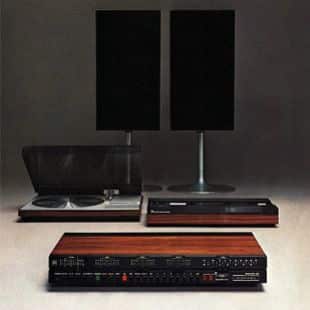
The amplifier section of this receiver had outstanding technical data: harmonic distortion was less than 0.1% at maximum power output and 0.06% at 50 mW. Frequency range was 20-30.000 Hz and effective bandwidth 10-35.000 Hz.
Frequency correction facilities were the LOW filter which reduced rumble on records (12 dB per octave at 80 Hz) and the HI filter which damped hiss (12 dB per octave at 4000 Hz). With the LOUDNESS control you could switch between objective and subjective linear reproductions. Beomaster 4000 had facilities for stereo and ambio reproduction. There were sockets for a record player and two tape-recorders, one allowing A\B monitoring. The headphone connection was placed on the receiver’s front. All inputs could be adjusted to give equal volume from all programme sources. The FM section had six pre-set stations. A light indicator assisted accurate tuning and an illuminated meter indicated the strength of a station. Field effect transistors, ceramic filters and integrated circuits were used.
When combined with a built-in record deck, the music centre was known as Beocenter 3500.
Receivers and amplifiers with the ambio function were products which, apart from stereo, could also reproduce the ambience or sound information of a room. Ambient information was included on most stereo vinyl recordings but could not be reproduced by a sound system with two loudspeakers or an ordinary stereo amplifier. Bang & Olufsen systems with the ambio function had facilities which electronically subtracted the difference signal (i.e. the difference between left and right channels) which contained ambient information. This information was fed into two extra loudspeakers which were placed as side speakers in a room. Ambiophony was an extension of stereo reproduction and enhanced the sense of realism. It could be used with nearly all stereo programme materials.
“Ambio is an extension of the type of sound reproduction known today as stereo.
Ambio is reproduced through four loudspeakers – two more than required for stereo.
Ambio is sensed as being more spatial and acoustically more life-like than conventional stereo. The sound picture has greater depth because you get the added feeling of being present of the concert hall, listening to the actual performance. Ambio is based on the principle that in the concert hall you not only receive sound impressions directly from the performing group, you also get reflections from the wall and ceiling. The spatial sensation is instrumental in providing the auditory experience and even a two-speaker stereo system will not bring it out fully. And you cannot accomplish the effect by connecting additional speakers to a conventional stereo amplifier because you still have the same left and right front signals merely distributed to more speakers.
In the Beomaster 4000 the left and right channels are subtracted from each other electronically and the resulting difference signal contains a certain amount of spatial information which is fed to the two new side speakers.
Many existing stereo records, FM broadcasts and tape recordings contain this spatial effect to a greater or lesser extent. In a concert hall, room acoustics will be recorded together with the actual programme material, appearing as time-delayed signals in both left and right channels. Recordings made in a strongly damped studio contain few time-delayed signals and the spatial sensation will therefore depend on how the producer mixed the sounds from the various instruments, perhaps adding acoustical effects by electronic means.
Multi-channel records such as SQ records, which are intended for use in a four-channel matrix system in order to bring out the sound effects , can be played successfully through the Beomaster 4000.
A good quality stereo turntable will provide ambio reproduction of both stereo and SQ records through your Beomaster 4000″