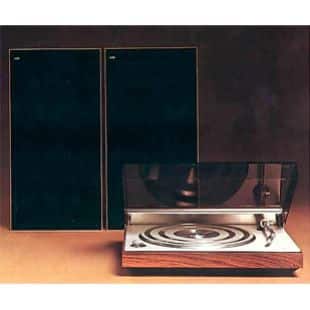
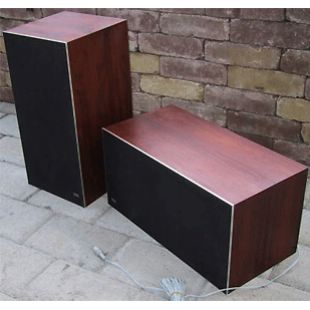
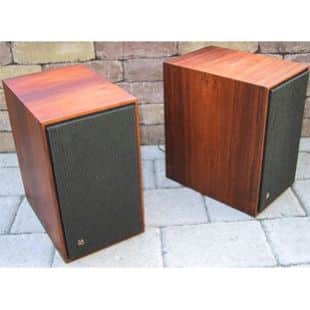
“B&O loudspeakers will meet very exacting conditions as their specifications exceed international hi-fi standards. All B&O speakers are of the pressure-chamber type with an impedance of 4 ohms. They are available in matched pairs only in a choice of teak or Brazilian rosewood finish”
A British Institution
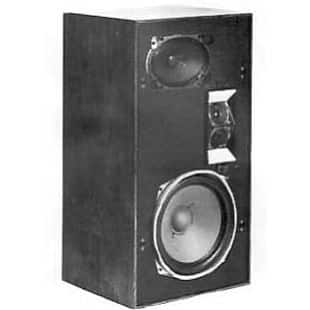
Were it not for the arcane British Tax system, this speaker would never have existed. As it was , the presence of a 12″ Goodmans woofer signified that this was a professional class loudspeaker, and hence one paid reduced purchase tax. It replaced the Beovox 4700 in the range in the UK for this reason.
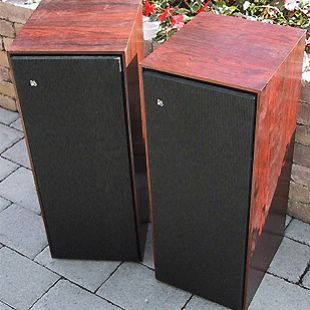
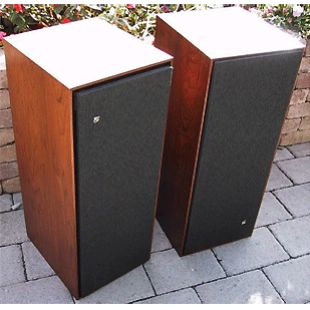
Beovox 3800 loudspeakers were recommended to the listener who liked his/her music to sound really natural and uncoloured. These high-fidelity pressure chamber enclosures contained a 30,5cm bass unit, an 8,5cm mid-range unit and a 2,5cm dome tweeter or treble unit. Beovox 3800 gave a finely balanced reproduction of all types of music. It had a power handling capacity of 40 watts RMS or 90 watts music power. Frequency range was 35~20.000 Hz. It was a full-size, floor-standing model, or it could be mounted on the trumpet-shaped pedestal which was available as an elegant accessory. Beovox 3800 exceeded the DIN 45500 norm by a wide margin.
Trumpet stand
Nearly all Beovox loudspeakers of this period were designed for either wall mounting or placing on a shelf. This included Beovox 3800. However, owing to its size, it could also be used as a floor-mounted speaker. For this reason, Bang & Olufsen produced the trumpet stand, type 8906007. The stand had a top on which the loudspeaker could be placed, not only elegantly but also practically in order to achieve a good sound dispersion.
In 1972 the Museum of Modern Art in New York (MoMA) chose seven Bang & Olufsen products designed by Jacob Jensen to be included in their Design Collection as representing excellent examples of the Museum’s criteria for quality and historical importance; design, in fact, which had influenced the twentieth century. Beovox 2700 were one of those seven products. That same year Beovox 2700 won the iF Design Award.
Rated at 30W, the Beovox 2600 was powerful enough to be used with the Beomaster 3000, though it was also recomended for use with the Beomaster 1000, 1200 and 1600.
Slightly larger than the Beovox 1200 of the same year, it was fitted with an 8” woofer with a rubber roll edge and a 1.5” dome tweeter. Befitting a loudspeaker to be used with the excellent Beomaster 3000, the Beovox 2600 met all the conditions of the DIN 45 500 “hi-fi” standard.
“B&O loudspeakers will meet very exacting conditions as their specifications exceed international hi-fi standards. All B&O speakers are of the pressure-chamber type with an impedance of 4 ohms. They are available in matched pairs only in a choice of teak or Brazilian rosewood finish” – taken from the 1967 – 1968 Bang & Olufsen product catalogue
B&O loudspeakers will meet very exacting conditions as their specifications exceed international hi-fi standards. All B&O speakers are of the pressure-chamber type with an impedance of 4 ohms. They are available in matched pairs only in a choice of teak or Brazilian rosewood finish
Only being available for two years, these small bookshelf speakers
are not that well known. With their old style cone tweeter but a modern small size, they can be considered a link between the 1960s and 70s. The small power handling capacity probably was to be blamed for their demise though, as most receivers introduced in the early ’70s already well exceeded the rated power.
These aren’t the speakers to use at a party, but at moderate volume they produce a very pleasing warm sound especially with acoustic music. The cone tweeter however makes them highly directional, so they are best used in set-ups where you can direct them straight at the preferred listening position.
Beovox 2200 bass drivers have rubber roll edges, so there is no need to worry about foam rot. If the speakers sound fine with all drivers working, they should be a safe buy even without further investigation. The frets, constructed on a wood/metal frame, are however easy to carefully pry off for inspection.
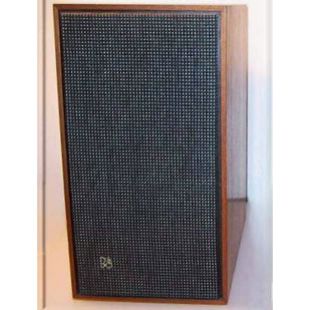
These speakers blend very well on a bookshelf, taking only a little bit more space than, say, a CX100 – and a small, golden old style B&O emblem on the fret accentuates the look. Highly recommended
to complete a vintage set-up with a contemporary Beomaster 900M, for example.
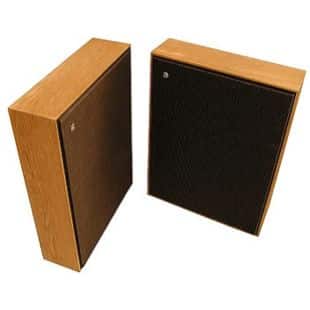
The plain exterior of the Beovox 1600 concealed an interesting design. Designed for wall mounting, either vertically or horizontally, the Beovox 1600 was the ideal for the mid range B&O models of the period such as the Beomaster 1200 or Beocord 2400.
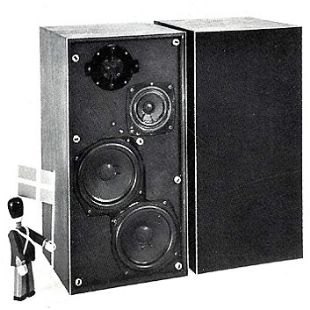
The Beovox 1600 was a three-way design. The units comprised a 12cm woofer, a 2.5cm dome midrange and a 4cm cone tweeter. These units were supplied by Wharfdale (England), Philips (Holland) and SEAS (Norway) respectively. An odd mix, though they were all of good quality and were well made, the woofer had a rot-resistant soft rubber roll edge and a pressure die-cast basket for example. Using a cone driver as the tweeter and a dome for the midrange was odd practice, though it has to be remembered that these were early days for dome loudspeakers in general.
The crossover network was of a fairly standard three-stage parallel design complete with a band pass section for the midrange. Unusually for B&O, a film capacitor was used as the pass element for the tweeter, normally a cheaper electrolytic capacitor would be found here.
The slim cabinets also had an unusual feature, they were braced from front to back to make the large front and rear panels more rigid. This may have been done to stiffen the rear panel in particular, to reduce the amount of acoustic energy that was transmitted into the wall. The cabinets were constructed on the pressure chamber principle and were fronted by a cloth grille that was supported on a pressed steel sheet.
B&O had clearly put a lot of work into the Beovox 1600. It was later replaced by the Beovox 1800.