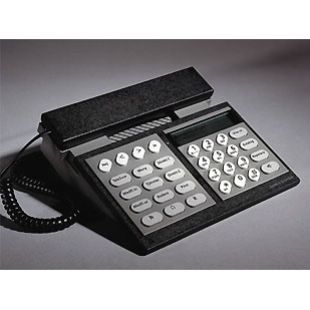
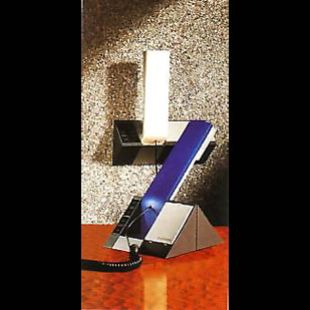
Good business is also about good communication. The telephone and the computer are important work tools for any business. As they sit side-by-side on your desk anyway, it makes sense to connect them and extend the capabilities of both. With BeoCom 2100, when a customer calls your business, his file on your computer’s database is automatically displayed. (The phone was not available in the UK).
BeoCom 2100 has a capacity for up to 250 individual entries, dependent upon the length of the telephone number and name. These can also be accessed and edited directly via the computer screen. The Caller ID function requires connection to a direct line
A matter of choice
BeoCom 2100 is a telephone for the home office, the small business or anything in between. It’s the first telephone to be built specifically around the services offered by the telephone companies and gives you one-button access to the services and functions you use the most
Functions and options
But it’s not only the improved access to external services that makes BeoCom 2100 a special telephone; it contains its own 250 name and number electronic telephone book and includes a headset connection and the opportunity for hands free operation
ISDN enhanced by Beoline 1200
The role of BeoCom 2100 in an office setting is further enhanced when it’s combined with a Beoline 1200 adapter. This makes it possible for traditional analogue equipment to communicate digitally via an ISDN connection Available in: Denmark, Netherlands and Sweden (2001) – Not available in the UK
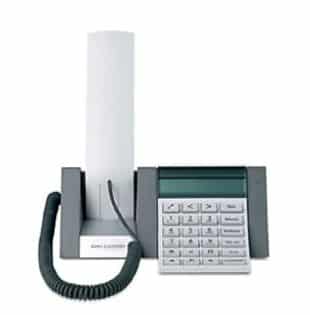
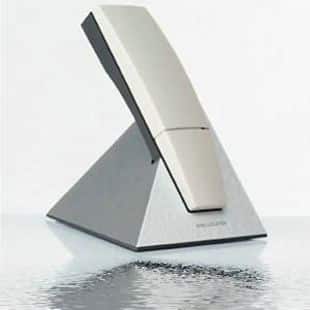
BeoCom 2 is a visually provocative response to everything looking alike in today’s telephone market. Its curved shape is very reminiscent of telephones used in the 1960’s, particularly in ‘The Prisoner’ TV series on the UK’s ITV network.
The release of BeoCom 2 in March 2002 was undertaken in its basic form. It was not a ‘system’ telephone in the first instance in that only one BeoCom 2 base could support one BeoCom 2 handset. This means there was no data exchange with other BeoCom2 handsets or BeoCom 6000 handsets or bases.
However, October 2002 saw BeoCom 2 become a full system DECT telephone, becoming part of the same 3-component solution that BeoCom 6000 uses. With this software update, customers can now ‘mix and match’ up to six BeoCom 6000 or BeoCom 2 handsets and chargers, using either the PSTN or ISDN base. This free software upgrade – to be carried out in dealers’ showrooms – will be necessary on existing BeoCom 2 phones in order to make them fully functional as a system phone.
Ringing the changes
The unique ringing tone of BeoCom 2 was created by musical composer, Kenneth Knudsen. Born in 1946, Knudsen is a self-taught musician and since graduating from the School of Architecture at the Royal Danish Academy of Fine Arts in 1974, he has chosen music as his profession. Over the years he has appeared on more than one hundred records with groups and soloists including Svend Asmussen, Miles Davis, Shubidua and the Indian violinist L. Subramaniam. He has been a member of, and recorded with groups like Secret Oyster, Coronaria Dans, ANIMA, Entrance, Bombay Hotel and Heart To Heart Trio. His list of compositions includes music for ballet, film, TV productions and jingles, as well as works for string quartet, solo guitar, solo cello, cello and piano, and choir.
In recent years Kenneth Knudsen has composed and recorded music for sound installations in various architectural and artistic contexts. As a soloist Kenneth Knudsen has released a number of CDs in his own name, most recently Sounds and Silence (dacapo DCCD 9419) and Music for Eyes (dacapo DCCD 9433).
Ringing the tune
The old-fashioned bell is nowadays rarely used in modern telephones. Like other bells, the sound from it contains a lot of overtones.
This is why you can both hear it at the bottom of the garden as well as close-by, and still experience the ringing of the bell as a pleasant sound. However the bell takes up too much room and it is too expensive for modern telephones. The technology that replaces it is both cheaper and more compact, but quite different to listen to. The design group found that this development was not exactly a positive one for the user. Therefore Bang & Olufsen turned to the Danish composer Kenneth Knudsen and asked him to compose a different ringing tune.
The Beocom 2 ring sounding like like cow bells is apocryphal! As visitors to Bang & Olufsen’s Struer headquarters know, there are no cows outside the Farm… only sheep! The ring of the BeoCom 2 was based on the sound of a piece of tubing falling on the floor. David Lewis was carrying a piece of metal tubing which he accidentally dropped to the ground. He thought the sound so interesting that a composer was called in to sample the sound and make a ring tone!
Knudsen chose to compose his tune as part of the design for a special telephone – the BeoCom 2 – rather than choosing an isolated, general tone, applied to all telephones. He therefore asked David Lewis, the chief designer of BeoCom 2 to make the final choice to ensure that the ringing tune was in harmony with the rest of the telephone. In this way the qualities of the ring became a harmonic part of the entire aesthetical experience of the new telephone.
To give the new ringing tune full justice the company’s acoustic department developed a small loudspeaker system in its own sealed enclosure within the handset of BeoCom 2 playing through a well defined slim opening within the phone’s aluminium tube.
Calling for attention
During the development of ideas for BeoCom 2, the design group expressed a wish that the ringing tune should call for attention in a polite way: a polite offer to make contact with the user, rather than a dominating, insisting demand.
But what is polite and what is not? How is this determined?
Bang & Olufsen asked the composer Kenneth Knudsen to solve this problem. Kenneth Knudsen came up with a number of solutions, from which designer David Lewis could choose.
Nearly each week of every year David Lewis drives in his car from Copenhagen to the B&O factory in Struer – a trip of 750km. During these long hours he would listen to Kenneth Knudsen’s pre-recorded tunes and discovered that in heavy traffic situations, where he was under pressure, he could clearly distinguish the pleasant call for attention, from other more annoying, ‘insisting’ tunes. He had therefore found the right tune for his new phone!
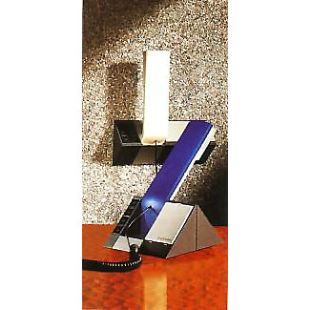
BeoCom 1600 was a tabletop telephone which combined a modern design with ease of use and was the same telephone as the BeoCom 2400 but without the alpha numeric memory functions. It however, did have the normal numeric memory functions. Using this phone was easy.
As with all other Bang & Olufsen telephones, BeoCom 1600 was equipped with a bass reflex speaker giving clear and easy recognisable voices. An infra-red module was available as an optional extra, giving the user the ability to control the volume on other Bang & Olufsen audio and video products. It was designed by the Swiss industrial designer Martin Iseli.
The vertical placement of the BeoCom 1600 handset made it easy to answer a call. Making a call was equally simple due to the position and curved surface of the keypad. The ultra light handset ensured that even long telephone conversations never seemed tiring.
Design
Reach out to towards BeoCom 1600 and enjoy a telephone that was simple to understand and easy to use. The ultra light handset weighed only 115g – which made it comfortable to hold even during the longest of conversations. The intelligent layout of the sloping keypad also ensured that your fingers moved intuitively and easily from button to button and from function to function.
Features
With BeoCom 1600’s built-in memory you could store the 10 telephone numbers you used the most and enjoy quick one-button access to them. As well as a volume control that allowed you to adjust the sound level during a call, BeoCom 1600 also offered a built-in loudspeaker function and the possibility to mute the microphone in the handset.
Colours
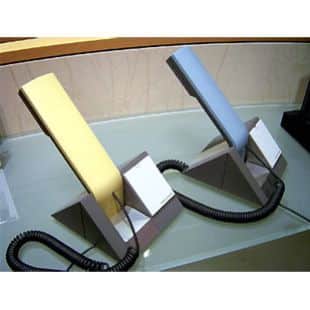
There was a choice between black, blue, red, yellow, green, terracotta, and grey.
A/V Control
With an optional A/V volume control incorporated into BeoCom 1600, you could adjust the sound on your Bang & Olufsen audio-video products directly from the telephone.
BeoCom 1400 and BeoCom 1500 were the first in the ‘new’ series of Bang & Olufsen telephones after the classic BeoCom 2000. The 1400 and 1500 series had a keypad integrated into the handset and not within the base like BeoCom 1600 and 2400.
This made the phone very compact. However, the sound quality was just as high as the more expensive phones because the two phones featured the same type of bass reflex speaker. Since everything is integrated in the handset, Bang & Olufsen offered no less than five different holders. Three different holders for wall mounting, one simple, and one with a built-in notebook.
There was also a version with an infra-red module to control the volume on main Bang & Olufsen equipment. Two table bases were also available, with and without the above-mentioned infra-red module. The main difference between BeoCom 1400 and 1500 is that the 1400 didn’t have memory capabilities or volume control.
BeoCom 1401 is an easy-to-use telephone with simple functionality. Choose between a wall-mounted version and a table top model offering optional volume control for recent B&O products and from a wide array of strong colours. It’s also a no-nonsense telephone. The range is simple, straightforward and functional and at the same time offering incredible flexibility. It’s possible to combine different colours with both a wall and table holder and to incorporate a volume control for Bang & Olufsen’s audio-video products.
Features
Memory for 10 numbers, redial function for the last number, adjustable volume control, microphone mute and optional AV volume control
Flexible
With its wide range of colours and unlimited placement options, BeoCom 1401 offers a level of flexibility that makes it just as easy to live with as it is to use
Colours
Do you want your telephone to match with the surroundings or to stand out from the crowd? Take a look at the different colours you can choose for your BeoCom telephone and decide for yourself. Choose between black, blue, yellow, red, terracotta, green and grey
A/V Control
Have you ever tried to hold a telephone conversation while the television or loud music is blaring away in the background? With the optional AV volume control in the tabletop version of BeoCom 1401 you can adjust the volume on your Bang & Olufsen audio-video products directly from your telephone
General keypad
The keypad is built directly into the handset of BeoCom 1401 offering easy access to all functions.
BeoCom 1400 and BeoCom 1500 were the first in the ‘new’ series of Bang & Olufsen telephones after the classic BeoCom 2000. The 1400 and 1500 series had a keypad integrated into the handset and not within the base like BeoCom 1600 and 2400.
This made the phone very compact. However, the sound quality was just as high as the more expensive phones because the two phones featured the same type of bass reflex speaker. Since everything is integrated in the handset, Bang & Olufsen offered no less than five different holders. Three different holders for wall mounting, one simple, and one with a built-in notebook.
There was also a version with an infra-red module to control the volume on main Bang & Olufsen equipment. Two table bases were also available, with and without the above-mentioned infra-red module. The main difference between BeoCom 1400 and 1500 is that the 1400 didn’t have memory capabilities or volume control.
BeoCom 1000 was similar to BeoCom 2000 but it was not fitted with a loudspeaker or an LCD display. This lowered the cost while at the same time offering the usual high quality sound There was a choice of four colours: black, blue, green or red.
Bang & Olufsen did not invent the telephone. They just developed it a little further Bang & Olufsen’s Telecom Vision is to “constantly question the ordinary in search of surprising, long-lasting experiences”
Loudspeaker quality
Earphone coupling loss factor, receiver loudness rating value and acoustic leakage are technical terms that mean little to most telephone users. They are just some of the things that Bang & Olufsen test for to determine the sound quality of a BeoCom telephone.
The enhanced sound of the BeoCom telephone range is the result of Bang & Olufsen’s long-standing specialisation in the miniaturisation of high-performance loudspeakers. Every BeoCom handset contains a built-in pressure chamber loudspeaker that ensures optimal natural sound reproduction while minimising distortion and sound leakage.
But Bang & Olufsen telephones are not only the result of theoretical calculations and complicated acoustical analyses, the final test is the human ear itself. A listening panel made up of people with an extraordinary sense of hearing provides the most crucial evaluation of BeoCom telephones.
Telephone competence: even good telephones have bad days
Telephones are used a lot more than other electronic equipment and sometimes under tougher and more hazardous conditions. Design and technological features mean little if your telephone lets you down when you need it most, so the anticipation of what can happen to a telephone has been turned into a fine art at Bang & Olufsen.
Our telephones are exposed to extremes of heat and cold, we spill coffee over them, blow dust at them, step on them and subject them to a whole series of bumps, vibrations and falls.
And it’s not only the unexpected that’s tested for, a robot assesses daily wear and tear by methodically lifting and replacing the handset of a telephone 100,000 times, while a mechanical finger dials telephone numbers over and over again. In a space of days, we simulate the life of a telephone and everything the modern world may throw at it.
BeoCom 1 – introduced October 2003 for the North American market – follows the classic BeoCom 6000 line and was launched in October 2003. The phone represents the best features that a DECT telephone can offer. With its GAP capabilities up to eight handsets can share the one base; the phone may easily be used to create a complete telephone and intercom system around the home or small office. Like BeoCom 6000, BeoCom 1 is available with both a table top charger as well as a wall- mounted version.
Its features include an LCD screen readout as well as a comprehensive 200-name and telephone number memory phone book. If your telephone company offers you caller ID (available as a chargeable option), the telephone number is given together with a name, if this is stored in the phone book.
BeoCom 1 has a full two lines’ capability which enables the user to hold a 2-line conference call or a three-party telephone conversation. Ear Set 1 may be used with the telephone to offer privacy.
You can use BeoCom 1 with the dedicated EarSet 1 Home hands-free kit. By connecting these earphones and mouthpiece to your phone you can enjoy total hands-free flexibility. EarSet 1 has the same exceptional sound quality of any Bang & Olufsen telephone and can be adjusted to the most comfortable individual fit. There are both left and right ear versions available and one for your mobile phone as well.
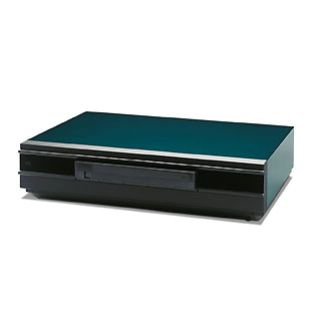
BeoCord V8000 video tape recorder matched the Beovision MX range of Bang & Olufsen televisions in looks as well as performance.
You could store a channel on the Beovision MX TV and it was automatically communicated to the V8000. Recording was a simple matter of selecting the programme directly from Teletext using the Beo4 remote control. It could be positioned by using one of the stands as part of a Beovision TV.
BeoCord V8000 rewound a three-hour tape in 95 seconds and it shifted from fast forward to play in a split second.
Other features included NTSC stereo playback. Looks-wise it embodied a black fascia with a choice of cabinets in pearlescent shades of blue, green, red, grey and black, plus glossy grey and glossy white.
A special Bang & Olufsen feature was ‘spontaneous videotaping’. If you wanted to record the programme you were watching it was simply a matter of pressing ‘record’ twice on the remote control handset – and the VCR would automatically find the right channel and start taping.
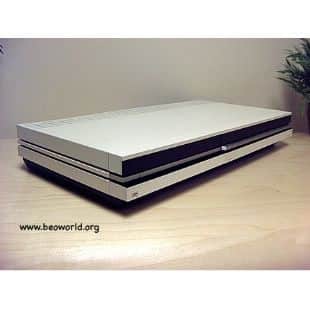
You could with Beocord VX5500 play back in slow motion all the way down to still. You could use the picture-in-picture module with the VCR and the B&O TV on which you had it linked up to and it was also possible to keep your video tapes organised. By using a graphic ‘notebook’ you could name every video tape you record. Then you use the Beolink 5000 or Beolink 1000 terminal to simply order up the number of your recording.