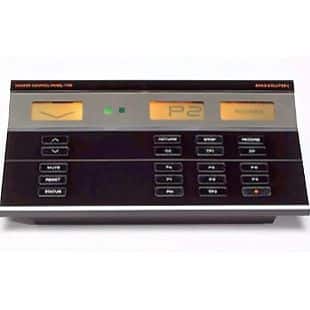
The first Master Control Panel and the first two way remote made by Bang & Olufsen, the MCP 7700 was designed to be used with the Beocenter 7700.
It can now be seen as the precursor to the Beosystem 5000 family though it was not as sophisticated as its descendants. It also had a back lit LCD display rather than the LED display used in the MCP 5000.
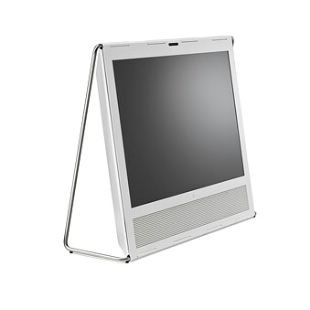
BeoPlay V1 is made the way you live and let play. Hang it, suspend it, lean it, or whatever works for you.
Customize your TV
Who says a black TV should always stay black. Give your BeoPlay V1 a twist of colour by changing the fabric sleeve behind the front grill. Grab your favourite among the four coloured sleeves and simply slide it in behind the grill. Now, all of a sudden, you have a completely new look. And don’t worry, you can always change to another colour later, if you want to make BeoPlay V1 fit a new room or a new style.
Adaptive contrast
The human eye has an amazing ability to adapt to different light conditions. We’ve been inspired by that ability and have built it into BeoPlay V1.
There’s a huge difference between watching the news in the middle of the day with bright light shining through the windows, and watching your favorite movie at night with the TV as the main source of light in the room. The BeoPlay V1 adaptive contrast uses a built-in light sensor and an advanced piece of software that will adjust not only the brightness, but the colours and image quality of your TV according to the surrounding light. In this way your eyes will not get tired of watching.
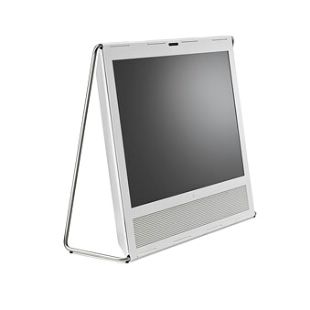
BeoPlay V1 is made the way you live and let play. Hang it, suspend it, lean it, or whatever works for you.
Customize your TV
Who says a black TV should always stay black. Give your BeoPlay V1 a twist of colour by changing the fabric sleeve behind the front grill. Grab your favourite among the four coloured sleeves and simply slide it in behind the grill. Now, all of a sudden, you have a completely new look. And don’t worry, you can always change to another colour later, if you want to make BeoPlay V1 fit a new room or a new style.
Adaptive contrast
The human eye has an amazing ability to adapt to different light conditions. We’ve been inspired by that ability and have built it into BeoPlay V1.
There’s a huge difference between watching the news in the middle of the day with bright light shining through the windows, and watching your favorite movie at night with the TV as the main source of light in the room. The BeoPlay V1 adaptive contrast uses a built-in light sensor and an advanced piece of software that will adjust not only the brightness, but the colours and image quality of your TV according to the surrounding light. In this way your eyes will not get tired of watching.
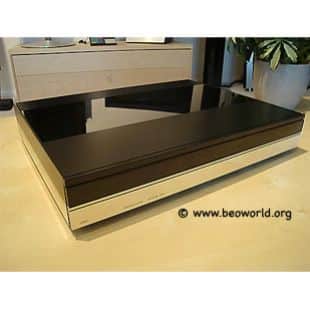
Beocord 7000 was a high-quality cassette recorder used specifically with Beosystem 7000. When playing cassettes, the order of the tracks could also be changed and the recorder could also find a specific track on a tape. Other functions included Auto Reverse, Auto Record levels, Dolby B and C as well as Bang & Olufsen’s recording system HX-Pro, which ensured that the sensitive treble range is captured in recording.
Beocord 7000’s features were supplemented by an abundance of special features. Space available precludes a more full description of elements such as the design of the peak programme meter, locally operated functions such as microphone recording, memo set/go, adjustment of the maximum record level and so on.
Main features:
Auto record level
Auto track search/auto reverse
HX Pro
Auto Dolby B-C
Auto tape switch
All operation available from Beolink 7000, with full display readout of track bar, counter, record level, Dolby NR, auto reverse functions, sequence programming etc.
Recording with Beosystem 7000 was a system feature, with benefits such as automatic signal routing, record lock, etc. Beocord 7000 contributed a lot to the convenience of the system and the unique auto record level was the feature that made remote controlled recording a real possibility – without compromising the quality of the recording. To further ensure a high and consistent sound quality level Beocord 7000 was equipped with HX Pro.
Auto record level
Auto record level is a unique Bang & Olufsen feature and ensures a uniform and optimal recording level from all sources, from tape to tape, without overload. Major benefits of auto record level are:
all tapes recorded with auto record level have the same optimum level, without overload and therefore without distortion
a recording can be started immediately and directly, without any pre-adjustments
you do not have to supervise a recording to adjust record level and the system recording even stops the recording when the source runs out, or stops the source when the tape runs out
if auto record level interferes and adjusts the recording it is done in such a way that it is not noticeable in playback. The dynamic range of the recording will not be impaired and the adjustments are carried out so early that overload is precluded.
The assets of auto record level are obvious when a comparison is made between those carried out on a standard recorder without auto record level and those with.
Recording on a standard recorder requires you to supervise the recording in order to step in if the manually set input level is too high. In this case you would have to adjust the record level down when a signal with a high dynamic content is to be recorded. If this is not carried out the tape will be overloaded and the music distorted. Without auto record level, copying is in real-time, which means that you will have to pay attention all the time you are recording (or risk a distorted recording). And when a very wide dynamic signal threatens to overload the tape being recorded, the record level must be lowered quickly, which will often be audible in subsequent playback, either as a suddenly lowered output volume or as a distorted signal because the record level was lowered too late.
Auto record level is an efficient remedy to this problem, without both disadvantages mentioned above. Primitive solutions reduce the record level when powerful signals are recorded and increase the record level when weak or no signals are recorded. The result can be a fluctuating dynamic range with, for example, pauses between tracks causing the recording level to rise dramatically and the noise level with it.
The Bang & Olufsen solution
The auto record level in Beocord 7000 was monitored by the microcomputer interacting with the peak programme meter indicator on the front of the cassette deck. Auto Record Level only reduces the record level and only if the signals exceed the set value for a certain period. In this way brief noise pulses, such as the ones resulting from scratches on a record, do not lower the record level. When a signal of more than +2 dB above the set value is encountered, the microcomputer lowers the record level with 2 dB. The recording continues at the lowered level unless even louder signals appear and trigger new reductions.
Other advantages of auto record level are:
it is applied to all sources, even if you record sound from a video source
the preset values can be changed, e.g. if you use special tape formulas
auto record level can be overridden while you are recording, or you can make a recording with manual adjustment of the record level
You did not have to pre-adjust Beocord 7000 before you started a recording. Another feature was the auto tape switch, i.e. an automatic adjustment to the three tape types, metal, chrome and ferro, by means of three electronic sensors located in the cassette holder. Auto-reverse was the default mode both in recording and playback, i.e. Beocord 7000 automatically continued the recording (and playback) on side two, when side one ran out. The turning time from side one to two was very short, because an optic sensor registered the lead-in tape and executed the 180 degree turning of the tape head immediately. Auto reverse could be cut out manually to protect side two from being recorded. This had to be done prior to record start.
Track Search
Beocord 7000 featured track search, based on pauses between individual tracks. You could also make a sequence programming, operated just like CD. Track search was available no matter if the track was on side one or two of the tape. Even if you executed a manual TURN function (i.e. change playback direction) the microcomputer registered the turning point and if you selected a track after the turning point the search for this track would be initiated at the turning point. Track numbers could be displayed on Beolink 7000.
Auto Dolby
Another convenience was the Auto Dolby function. All tapes recorded on a Beocord 7000 contained inaudible information as to whether the tape was recorded with Dolby B, Dolby C or no Dolby noise reduction. The registration of noise reduction type was dynamic and in case the circuit registered a change during playback the reduction was automatically changed. If no signal was registered, e.g. on a pre-recorded tape, the noise reduction last selected would remain active, until altered manually (see more below).
HX-Pro
Beocord 7000 was equipped with HX Pro, like all other ‘stackable’ Bang & Olufsen audio tape recorders. HX Pro is an acronym for Headroom Extension Professional and tapes recorded with HX Pro give a better reproduction quality on playback, no matter which tape deck they are played on. Both the dynamics and the the signal capability in the treble range is improved. The improvements are most noticeable in the reproduction of treble signals, but also the midrange will be influenced in a positive way. At 10KHz the signal loading capability is improved by approximately 8dB for chrome tape, 5dB for ferro tape and 3dB for metal tape formulas.
Beocord 7000 could ideally be used as part of Beosystem 7000.
A light touch to the front of the Beocord 6500 cassette recorder released the loader which glided out slowly and silently in order to allow you to insert a cassette. You could use whichever type of cassette you prefer; or choose between Dolby B or C Noise Reduction systems… and rejoice in Bang & Olufsen’s patented HX-PRO recording system which ensured optimal sound reproduction, particularly in the difficult, high-frequency range. And, naturally, Beocord 6500 had auto-reverse so that both sides of the tape played as one.
Beocord 6500 could be used as part of the Beosystem 6500 hi-fi system.
Auto Record level
One of the less-pleasant chores in making a recording is setting level control to its optimum position. Setting it too low raises the level of background noise on the recording. Setting it too high makes the recording distorted at high music levels. With this in mind, Bang and Olufsen introduced an automatic record mode which was called ‘Auto Record’.
Auto Record worked in two steps: when the record button was pressed for the first time, the cassette recorder went into a record pause mode, where the incoming signal was monitored. Under microprocessor control, the highest level was monitored and the record level was set at the optimum level for that music. On pressing the record button the second time, the tape was set in motion and the recording started, but continuing to make minor adjustments. If at any time during the recording, the level of music rose above the monitored level, the level control was lowered by exactly the amount required for the new optimum recording level.
This method of setting the level control closely imitated the action of a highly skilled recording engineer, if asked to set the level for a recording. It was the best that could be done when the full recording could not be monitored before recording started.
This feature incorporated a new method of monitoring the signal, which proved to be a more effective method over conventional methods. It was patented by the company with the patent number 158702.
As the boundaries between life and work blur, the computer is becoming more than just an information tool – it’s also a growing source of entertainment.
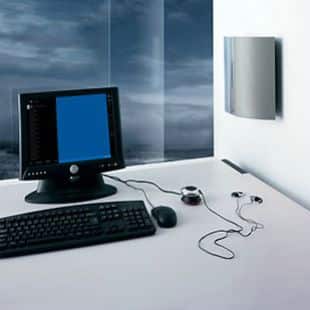
While others focus on bits, bytes and software updates B&O concentrates on possibilities. For Bang & Olufsen the challenge is about creating a link between the real and virtual world to give you options you never until now thought possible. Digital music stored on the computer can now be accessed throughout the home via Bang & Olufsen’s Beolink® system.
Combining Bang & Olufsen’s logical principles of operation and the successful BeoPlayer concept – Bang & Olufsen’s free MP3 player – Beolink® PC2 allows customers to extend the potential of their PC and receive additional enjoyment out of their Beolink® system. Twenty years of experience within distribution of sound and picture makes this integration between these two worlds possible.
It works like this: BeoPlayer has organised all your music on the PC in different categories such as artist, genre, album, etc. This means that you can access your entire collection of music just press N.MUSIC on the Beo4 remote control and the music starts playing through the loudspeakers in the room where you are placed.
You are able to record all you CD’s to your PC also with the Beolink® PC2, which means that you can have your entire music library stored the same place, but be able to access it from anywhere around the house.
If you want to improve the sound performance of your Internet music in the room where your computer is placed, a pair of BeoLab 4000 active speakers combined with Beolink® PC2 will turn your computer into an excellent music system. Furthermore, if you want to be able to remote control your Internet music, just add a Bang & Olufsen Beo4 remote control and an IR-receiver to your setup.
Whereas the music found on the computer may be distributed throughout the home, all other sources in your Beolink® system (Radio, TV, Satellite, DVD, VHS, etc.) can be accessed and operated via the on-screen Beolink® PC 2 control bar in the home office.*)
Tuner cards
To show video sources on your PC, you must have a Beolink compatible tuner card in your PC. For the moment, the following cards are compatible (Please check back on this site for latest updates on compatible tuner/graphic cards):
Beolink PC2 (From software version 3.10)
ATI All In Wonder 9000 and 8500, USA
ATI ALL-IN-WONDER 9600 PRO 128MB DDR
Hercules or Sapphire All In Wonder 9000 and 8500, EU
Hauppauge WinTV PCI-FM Model 747 (Pal B/G/I)
Hauppauge WinTV PCI-FM Model 628 (SECAM)
Hauppauge WinTV PCI-FM Model 401 (NTSC)
Hauppauge WinTV PCI-FM Model 647 (Pal I) UK
ATI ALL-IN-WONDER® RADEON Type: AGP Memory: 32MB DDR RAM
ATI ALL-IN-WONDER® RADEON Type: PCI Memory: 32MB DDR RAM
ATI ALL-IN-WONDER® 128 PRO Type: AGP Memory: 32MB RAM
BeoLink PC2 was renamed BeoPort from November 2005.
BeoSound 4 is a new audio product offering a complete audio experience. It has a CD player, FM / DAB radio and built-in SD memory card reader / writer. The DAB module will be included as standard for the UK and Irish markets is actually a factory-fitted option for any other markets. The unit is a full Audio Master (N.Music and N.Radio compatible) and can therefore be used to distribute sound through users’ BeoLink systems.
The new feature introduced on BeoSound 4 is the SD memory card reader / writer. This function replaces that traditionally provided by the audio cassette tape. The user can copy music from a CD or the Radio directly onto the memory card which will be compressed at 128kbps. The card can then be used in other compatible products such as BeoSound 2 and BeoSound 3. As it is possible to copy music onto a memory card using only BeoSound 4, this now offers access to digital music to a much wider audience – even those who do not own a computer. However, music can also be copied from a computer directly onto the memory card, be removed and then played back on BeoSound 4.
Placement
BeoSound 4 can be placed on a table or shelf as it is a free-standing product. Alternatively it is possible to mount it on a Floor Stand or on a Wall Bracket.
Mounting Options
From launch, BeoSound 4 could be wall mounted or positioned on a floor stand. The floor stand featured a turned stainless steel column which could not hide the connection cables. This solution was not a popular choice.
BeoSound 4 – the new compact audio system, with a touch of magic
Bang & Olufsen continues to surprise and delight music lovers with the new BeoSound 4, a compact audio system that exploits digital music storage and portability while offering the quality performance and usability expected from a traditional Bang & Olufsen audio system. BeoSound 4 will be available from November/December 2005.
BeoSound 4 is an audio system with built-in CD player, FM radio, and SD (Secure Digital) card slot. DAB radio is also available as an option, factory fitted. It is possible to record from the radio or CD to the SD card and play back the recording on BeoSound 4, or on another portable or stationary system.
Use and place anywhere at home
Bang & Olufsen’s well-known BeoLink system ensures the total integration of all entertainment at home, and BeoSound 4 offers the additional advantage of being able to send music played back from the SD card to loudspeakers throughout the house. The SD card increases flexibility in other ways as well, allowing the user to listen to recorded music in the garden with the new BeoSound 3 portable audio system or away from home on the BeoSound 2 digital music player.
“BeoSound 4 represents a new way of living with recorded digital audio entertainment, and yet the simplicity of the system and ease of use will have that reassuring feel of familiarity for the user,” says Michael Jensen, Product Manager, Bang & Olufsen. “BeoSound 4 has that touch of magic that shows its pedigree, and at the same time offers the integration with digital music formats that is increasingly important for how we listen to music.”
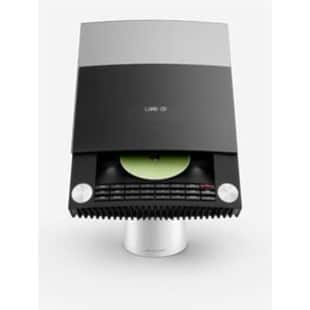
BeoSound 4 can be placed almost anywhere on its floor, table or wall stand. Angled for convenient operation, the glass door half-opens at the wave of a hand, and the operation panel with SD card slot is presented to the user. Press ‘Load’, and the glass cover rises further for the CD loader. Connect BeoSound 4 to any BeoLab loudspeakers, and in particular with the new and equally compact and refined BeoLab 4 loudspeakers.
Big impact expected
With a price that lies under what is usually expected of a Bang & Olufsen product, Bang & Olufsen expects that BeoSound 4 will capture a lot of interest from first-time buyers in the market. The digital portability offered by the SD card built into BeoSound 4 is consistent with Bang & Olufsen’s strategy to ensure that wherever the company’s customers may be, they can have their entertainment choices with them.
“With BeoSound 4, we have succeeded in building an audio system that lives up to the very high standards expected from Bang & Olufsen, from the idea behind the concept and design to the choice of materials and craftsmanship – and not least the ease of use and performance,” concludes Michael Jensen, Product Manager, Bang & Olufsen.
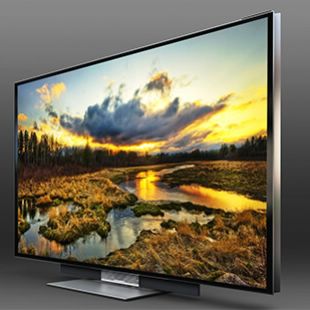
BeoVision Avant is a celebration of movement, designed to provide exceptional viewing and placement flexibility. It unfolds the experience and turns gracefully to your favourite viewing position. BeoVision Avant is a fusion of Ultra High-Definition (4K) picture and iconic Bang & Olufsen sound, redefining the audio impact a TV can deliver through a 3-channel speaker system with great speech intelligibility and power. BeoVision Avant takes control of any connected device from the BeoRemote One and provides one-touch access to the Bang & Olufsen experience.
BeoVision Avant – Turning to you
Unfolding sound
BeoVison Avant is a celebration of movement.
An unforgettable fusion of Ultra High-Definition (4K) picture and iconic Bang & Olufsen sound, that unfolds before your very eyes.
Redefining TV sound
Precision tuned to Bang & Olufsen’s most exacting standard, BeoVision Avant redefines the audio impact a TV can deliver. The 3-channel speaker system harnesses three dedicated tweeters, three midrange units and
two powerful bass drivers. The result is a fusion of clarity and power that truly embodies Bang & Olufsen’s commitment to ultimate sound.
Contrasted imagery
BeoVision Avant combines local dimming across more than 8 million pixels, bringing out the tiniest details in the action. Experience the most extreme sports or action footage with crystal sharp, dynamic precision.
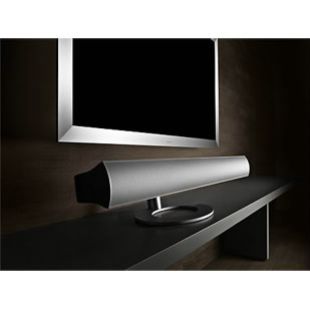
Packed with advanced technology, BeoLab 7 is, quite simply, the most powerful stereo speaker ever developed for TV. With six individual driver units, all powered by their own digital ICEpower amplifier, BeoLab 7 delivers an unequalled sound performance for your TV viewing. The beam-shaped loudspeaker below the screen provides superb acoustic performance and signifies the presence of sound as an integral part of your viewing experience. Musically, the speaker rivals many hi-fi systems, and is quite capable of being used as a BeoLink speaker.
The natural fit
BeoLab 7 is specially developed for BeoVision 7 to contribute the ultimate stereo sound performance to the viewing experience. BeoLab 7-1 is the natural accompaniment for the BeoVision 7-32 LCD television, while the broader beam of BeoLab 7-2 is designed for BeoVision 7-40. In addition, BeoLab 7 stereo loudspeakers fit naturally under the BeoVision 4 plasma screen, or under a projection screen. In this application, the speaker can be either wall-mounted or placed on a special tabletop stand.
Colours to match
Long and lean, BeoLab 7-1 and BeoLab 7-2 look at home under a BeoVision 7 or BeoVision 4, or as part of a projection screen setup. The shorter BeoLab 7-1 is best suited for the BeoVision 7-32” screen. The loudspeaker cabinet is made from a single piece of aluminium and coated in a resilient black soft-touch lacquer. The perforated aluminium front grill now comes anodised in five different colours: Light and dark grey, blue, red and black.
A firm grip on powerful sound
A special three-way bass reflex construction incorporates six individual units – two each for treble, mid-range and bass. Each driver is powered by a unique built-in ICEpower amplifier, delivering a combined effect of 750 watt. In addition, BeoLab 7-1 and 7-2 are equipped with thermal protection circuits and Adaptive Bass Linearisation (ABL), which ensures maximum performance without distortion, even at very high volume. Bang & Olufsen has a quarter of a century of experience making loudspeaker cabinets from extruded aluminium. This technique allows for very rigid and compact enclosures with powerful sound performance.
Note that BeoLab 7-1 was designed to be used with the BV4-37 and BV4-42. The wider BeoLab 7-2 may be used with the larger-version BeoVision 4: BV4-50 and BV4-65.
Mounting Options
All four versions of BeoLab 7 were designed for incorporation with Bang & Olufsen’s motor stand options.
BeoLab 7-4 brings extra authenticity to any film or TV experience. Using the same acoustic lens technology found in BeoLab 5, this compact but powerful speaker is optimised specifically to reproduce the sound of voices. This is essential in a surround sound set-up, as eighty per cent of the voice information goes through the centre channel. Next time you watch a movie, you won’t miss a whisper.
Surround sound centrepiece
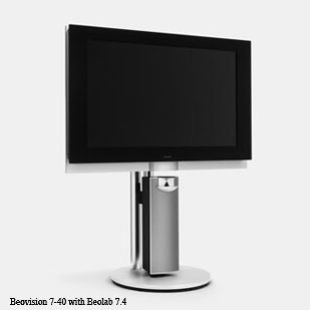
In a surround sound setup, BeoLab 7-4 is designed to give a powerful performance in the important centre channel. It can be used with all BeoLab loudspeakers and the BeoLab 2 subwoofer for the ultimate surround sound experience with the BeoVision 7-40 LCD or BeoVision 4 plasma televisions, or a projection screen. Moving with the motorised floor stand of your BeoVision 7, BeoLab 7-4 adds an extra dimension of sound to whatever you are watching on TV.
BeoLab 7-4 has a vertical construction that provides the best possible tonal balance found in speech. The deepest bass sounds are filtered out, ensuring greater power output and enabling BeoLab 7-4 to play up to the extreme capabilities of the BeoLab 5 loudspeaker. The acoustic lens, centred just beneath the screen as a visual emphasis of refinement, ensures an experience of tonal clarity in the horizontal plane. The sound of voices becomes extremely authentic, regardless of where you are seated.
Consistent lines and harmonious colours
The cabinet is coated in a durable yet silky black lacquer surface. Facing you is a front grill made out of anodised aluminium with a perforated pattern available in five different colours, giving a graphic touch to the overall look. As with all Bang & Olufsen products, there is always a consistency in the design lines, so you will quickly see a coherence between the curved DVD loader on BeoVision 7 and the curved front of BeoLab 7-4.
Mounting Options
All four versions of BeoLab 7 were designed for incorporation with Bang & Olufsen’s motor stand options.