BeoLab 3500 was the first-ever dedicated Beolink® speaker ever released from Bang & Olufsen.
At first it was designated LCS 9000 (Local Control System 9000 from 1992 to 1993) and was manufactured for the old Beolink® system, Master Control Link. But since one of Bang & Olufsen’s great advantages is compatibility it was of course already prepared for the new Master Link system.
Being a Beolink® speaker it houses all the electronics within it required to work as a part in a Beolink® system. No additional boxes are needed – only a cable between the hi-fi and the speaker. Even an infra-red transceiver is built in. BeoLab 3500 also has a display and a digital clock built in.
BeoLab 3500 is an active loudspeaker with two speakers for stereo sound and an integrated Beolink® receiver-unit complements the unit. It has been specially designed for the distribution of sound to rooms in which one moves around a lot, such as the kitchen. For the bedroom, a workshop, basement or even a children’s room, a BeoLab 3500 could be the right solution with full remote control via Beo4. A dedicated Beolink® loudspeaker, it fits into its standard bracket on the wall, on top of a book case, or over the door in the dining room. Its red LED display keeps you informed about which source you are playing.
With two bass and treble loudspeakers, each with its own amplifier, the sound level can be adjusted independently of the other loudspeakers in the system. Hang BeoLab 3500 on the wall on its standard wall bracket or use the optional polished aluminium stand to display it on a shelf or table.
“When it comes to sound reproduction we believe there’s only one relevant parameter: How close can we come to the originally recorded sound. We feel an obligation not to disturb the intentions of the artist by adding unnatural elements to the acoustic image. Therefore all Bang & Olufsen loudspeakers share the same goal. They differ in size and shape and in terms of sound pressure level. But they are all developed to reproduce the natural, unaltered sound as closely as possible ” – Bang & Olufsen catalogue 2001 – 2002
BeoLab 3500 as part of a Beolink® system:
BeoLab 3500 is an integrated link-room active loudspeaker comprising a Master Link (ML) connection, an IR receiver and a digital display. BeoLab 3500 also has Master Control Link (MCL) connection and a built-in clock.
BeoLab 3500 is supplied with a mains lead, a Master Link cable and a bracket for wall mounting is available as an optional accessory.
Application
BeoLab 3500 is used in link rooms where you wish to have an integrated active speaker. From the BeoLab 3500 it is possible to listen to both audio and video sources from the main room. There is built-in sound control, which means that tone, volume, balance and loudness controls can be adjusted independently of the main room.
B&O goes nano
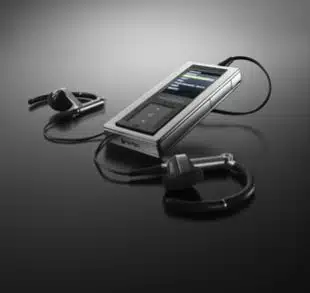
The new addition the B&O MP3 range, the Beosound 6 strikes out in a different direction for the company and embraces the prevailing trend for flash memory and a colour screen. Planned for launch in the summer, the Beosound 6 will come with a leather case and A8 earphones.
Unlike the Beosound 2, the Beosound 6 does not use SD cards but relies on an internal memory of 4Gb. This is addressed through a port at the base which attaches to the USB port on the computer.
It would appear that the Beosound 6 is based upon the Samsung YP-Z5 MP3 player and shares that players control interface. This moves away from the accustomed Beo4 type control and, if the Samsung is anything to go by, is not as user friendly.
The Beosound 6 could be seen as a me too type device and with little of the usual B&O flair, but B&O are clearly aiming at those people in the Apple iPod Nano market who want something a little different. The screen interface would seem to have been modified gently to resemble the B&O style. One would hope that the sound quality would be of the same standard as the Beosound 2 and the provision of the A8 earphones can only help this.
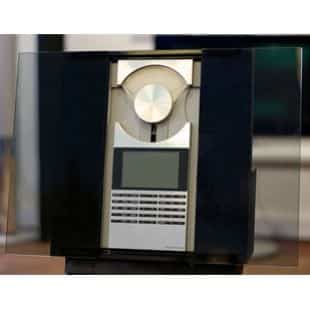
This special 2300 was produced in 500 examples for a test of DAB by Danish Radio.
Built on B&O’s 2300 platform, the 2300 DAB was modified with a Motorola Power PC 821 processor to control the special DAB-functions. The DAB receiver itself was placed in the accompanying “black-box” made by Bosch/Blaupunkt.
The radio can be used directly via the push buttons, or with help from a remote control unit, which is a modified computer made by Apple Newton NotePad.
A PCMCIA (PC Card) slot on the top left-hand side of the back casing was another difference from the ordinary 2300.
Mounting Options
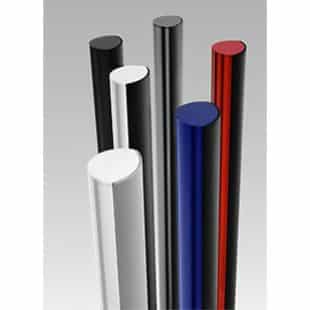
This classic design was reincarnated over a 21 year period with various mounts and stands. Floor stands were available with a pole stand or CD and tape storage, wall mount solutions allowed for the Hi-Fi only, or with BeoLab2500 speakers until these were discontinued
An update to the cheapest of the column speakers, this saw the Class AB amplification discarded along with the large heat sinks. Instead 2 cool running ICE amplifiers were fitted, both rated at 125W.
The LED was repositioned and the finish of the foot changed to match the TV range. A three position switch for wall, corner and free position settings was now fitted and the previous model’s phono plug was deleted. 2 Powerlink sockets were still present though.
BeoLab 3500 was the first-ever dedicated Beolink® speaker ever released from Bang & Olufsen.
At first it was designated LCS 9000 (Local Control System 9000 from 1992 to 1993) and was manufactured for the old Beolink® system, Master Control Link. But since one of Bang & Olufsen’s great advantages is compatibility it was of course already prepared for the new Master Link system.
Being a Beolink® speaker it houses all the electronics within it required to work as a part in a Beolink® system. No additional boxes are needed – only a cable between the hi-fi and the speaker. Even an infra-red transceiver is built in. BeoLab 3500 also has a display and a digital clock built in.
BeoLab 3500 is an active loudspeaker with two speakers for stereo sound and an integrated Beolink® receiver-unit complements the unit. It has been specially designed for the distribution of sound to rooms in which one moves around a lot, such as the kitchen. For the bedroom, a workshop, basement or even a children’s room, a BeoLab 3500 could be the right solution with full remote control via Beo4. A dedicated Beolink® loudspeaker, it fits into its standard bracket on the wall, on top of a book case, or over the door in the dining room. Its red LED display keeps you informed about which source you are playing.
With two bass and treble loudspeakers, each with its own amplifier, the sound level can be adjusted independently of the other loudspeakers in the system. Hang BeoLab 3500 on the wall on its standard wall bracket or use the optional polished aluminium stand to display it on a shelf or table.
“When it comes to sound reproduction we believe there’s only one relevant parameter: How close can we come to the originally recorded sound. We feel an obligation not to disturb the intentions of the artist by adding unnatural elements to the acoustic image. Therefore all Bang & Olufsen loudspeakers share the same goal. They differ in size and shape and in terms of sound pressure level. But they are all developed to reproduce the natural, unaltered sound as closely as possible ” – Bang & Olufsen catalogue 2001 – 2002
BeoLab 3500 as part of a Beolink® system:
BeoLab 3500 is an integrated link-room active loudspeaker comprising a Master Link (ML) connection, an IR receiver and a digital display. BeoLab 3500 also has Master Control Link (MCL) connection and a built-in clock.
BeoLab 3500 is supplied with a mains lead, a Master Link cable and a bracket for wall mounting is available as an optional accessory.
Application
BeoLab 3500 is used in link rooms where you wish to have an integrated active speaker. From the BeoLab 3500 it is possible to listen to both audio and video sources from the main room. There is built-in sound control, which means that tone, volume, balance and loudness controls can be adjusted independently of the main room.
” If your ultimate passion is to get as close to the music of your favourite artists as possible, the new BeoLab 5 will take you there. Conceived, designed and built by Bang & Olufsen, BeoLab 5 is (their) latest loudspeaker concept developed for everyone with a passion for listening and living with the ultimate in audio and video entertainment.”
Power
The amplifiers are made up of 1000W each for the main and upper woofers, together with 250W each for the midrange and tweeter giving a total of 2500W output. “Such power permits B&O to address the issues of thermal power compression (by calculating it and adding back sufficient gain offset) and to run effortlessly at something approaching real concert hall levels (i.e. sustained real-world levels of 108 dB SPL with peaks of 120 dB SPL, should you care to entertain all of the folks on your block). A typical high — end audiophile speaker system with two gigantic mono — block amplifiers running at 500 W apiece will run out of steam at probably 10 dB below these levels, all other things being equal. Such power also means that at all sane levels, the BeoLab 5 is simply loafing along, never stressed in the slightest, and if you encounter any signs of distortion, you can know for sure it is occurring elsewhere in your signal path.
Finally, the speaker is fully digital, so you can plug in an S/PDIF feed if you wish. The A/D and D/A converters are of extremely high quality, so no problems will be encountered there either. But the real payoff is that extensive DSP is present, which permits each speaker to be quickly and precisely matched (+/- .25 dB) and documented during manufacture. This, to my mind, is a huge breakthrough. It means that for all intents and purposes, speakers will not be audibly different (a first for mass-produced speakers), and because of thedocumentation, they can be maintained to hold that tolerance! (Just so you know, there’s an RS 232 port included, so the speaker can “talk” to the factory and its DSP is recalibrated to accept a replacement driver).” (Source)
The new technology:
Acoustic Lens Technology (ATL) * – invented by Dave Moulton and Manny LaCarrubba of Sausalito Audio Works LLC – which delivers sound in a 180 degree horizontal plane unlike ‘normal’ speakers which aim their sound directly away from themselves and towards the listener. The ATL technology is a new and effective means to redistribute the acoustic power of a conventional dome radiator. The resultant dispersion pattern has a very uniform frequency response over an extremely wide horizontal coverage angle
Adaptive Bass Control (ABC) actually ‘listens’ to the ambient sound within the room in which BeoLab 5 is placed and adjusts its output to suit the listening position
ABL (Adaptive Bass Linearisation)
As well as the two brand new technologies, BeoLab 5 employs Bang & Olufsen’s Adaptive Bass Linearisation which is a process patented by B&O and incorporated in newer (digital) BeoLab loudspeakers. The idea is to use the surplus capacity in amplifiers and driver units, arising by normal listening levels, for a bass extension – a sound reproduction with more bass, than the loudspeaker otherwise would be able to produce.
The function is adaptive. This means that the loudspeaker adapts to the signal it receives. Loudspeaker drivers are therefore fully exploited, without suffering mechanical or electronic abuse, and the built in amplifiers are not subjected to signals would otherwise create an overload situation.
ABL gives stunning bass reproduction considering the size of the loudspeaker in which it is incorporated, under normal listening levels.
Note: for BeoSound 9000 owners wish to use BeoLab 5 fully, there is a direct digital feed from the optical output of BeoSound 9000 (S/PDIF = Sony/Philips Digital Interface)
Acoustic Lens Technology for Loudspeakers: an introduction
Acoustic Lens Technology is a new and extremely effective means to improve the dispersion of high frequencies in loudspeakers, so that dispersion is much more uniform across the audible spectrum without the deleterious side-effects encountered with other engineering solutions to this problem.
The problem is fundamental: in an ideal loudspeaker it is axiomatic that frequency response should be flat across the audio spectrum. Flat response is designed for and measured “on-axis,” which is to say, in one direction only from the loudspeaker. In fact, the theoretical ideal loudspeaker (i.e. a pulsating sphere) should exhibit the same flat frequency response in all directions. Such a performance quality is, at the present time, impossible to achieve. All loudspeakers are more or less directional in output. Worse, loudspeaker directionality varies wildly as a function of frequency, crossover design and driver size.
So, not only is it virtually impossible for a loudspeaker to have a flat frequency response in all directions, it is equally difficult for a loudspeaker to have constant frequency response in all directions. As a rule of thumb, loudspeakers are omni-directional at low frequencies and highly directional at high frequencies, with erratic variations in between, particularly near cross-over frequencies.
We all have to accept this universal deficiency of loudspeakers. The cost of this deficiency is significant in terms of the quality of musical illusion, imaging and timbral accuracy in stereophonic music playback. Acoustic Lens Technology represents a successful effort to reduce this deficiency.
Acoustic Lens Technology is the outgrowth of more than a decade of invention, research and development. The lenses gather the sound output of a given speaker driver, re-focus it and emit it in the desired directions. Specifically, we have worked to develop a speaker with essentially flat frequency response to 15 kHz that remains constant across a horizontal angle of at least 180° with no lobing, phase anomalies, interference patterns or other undesirable side effects, and a vertical angle of 30°. At the same time, we have made Acoustic Lens Technology compatible with conventional drivers, comparatively inexpensive to manufacture, and reasonably small in size.
Speakers using Acoustic Lens Technology exhibit excellent imaging, depth of illusion and compelling timbral quality. Further, they exhibit an excellent “invisibility,” or sense of not being the source of sound. In surround sound production applications, Acoustic Lens Technology is extraordinarily effective for all speakers in the system.
* ATL Technology is licensed from Sausalito Audio Works LLC
For further information on Acoustic Lens Technology and Dave Moulton – developer of ALT – visit his site by clicking here.
“In BeoLab 5 design and acoustic engineering converge in the world’s most complete and powerful all-digital loudspeaker ever designed for use in domestic surroundings. The result is an intelligent loudspeaker with a pure and transparent sound uncoloured by the placement of the loudspeakers, the room itself or by your own listening position”
BeoLab 5 & Acoustic Lens Technology
ALT is short for Acoustic Lens Technology and is a patented geometric shape that when properly mated to a conventional dome radiator yields an extremely wide, uniform horizontal dispersion characteristic. Acoustic Lenses redistribute the sound power of a driver (a tweeter, for instance) such that the resulting dispersion is very uniform over at least 180° horizontally. The vertical radiation pattern is asymmetrical. It is limited such that very little sound is directed towards the floor. Somewhat more energy is directed upwards than towards the floor but, in general, the radiation pattern may be described as a ‘hemidisc’.
ALT’s unique dispersion characteristics help in several ways. The most obvious is that listeners seated off-axis hear virtually the same timbre as those on the reference axis. An ALT loudspeaker has a flatter power response curve than a conventional loudspeaker. This means that the total sound energy radiated by the speaker is more closely related to the axial frequency response or direct sound. This type of behaviour correlates positively with listener preference in controlled listening tests. This is why some manufacturers have rear firing tweeters. ALT does this while minimising reflections from the floor and the wall behind the speaker. The Archimedes Project, a 5-year multimillion dollar research project that delved into the relationships between acoustic reflections and the perception of timbre, revealed that such behaviour is desirable. Finally, ALT loads the driver to which it is mated so that less electrical energy needs to be applied to achieve the same SPL as a baffle-mounted driver. This increases power handling and lowers distortion. ALT does all of this while maintaining excellent axial frequency response.
Room placement of ALT speakers
As with most speakers, Sausalito Audio Works LLC – as inventors of the system – recommend placements of at least 1m and preferably 1.5m – 2m from any wall. Normally you would not aim an ALT speaker directly at the primary listening position – the reference axis for these speakers is 30° so it is advisable to keep them pointed straight ahead.
The only exception to this is if you must put the speaker less than 1m from a sidewall. In such an instance, aiming the speaker directly at the listening position usually yields better results.Sausalito also recommends that the primary listening position be located at the apex of the equilateral triangle formed by the speakers and the listener. Many audiophiles prefer to sit farther away from the speakers than this.
* ATL Technology is licensed from Sausalito Audio Works LLC
Member Review by Mr 10%
I purchased my Beolab 5s mid-June (2004) on spec via a telephone call without ever listening or seeing them “live” in a showroom. Slightly prejudiced by reading the information in the hi-fi press, I though they must be good if the normal hi-fi bores think they are. My first actual contact with the Beolab 5 was in the Manchester King Street Store, just as my units were being delivered to my overseas home. To say I was a little disappointed and began to questioned why I’d parted with so much cash on these things so easily. The listening room – annexed from the showroom was only sufficient to hold a Beovision 4, a Beosound 9000, the Beolab 5’s themselves and a 2-seater sofa. Too late.
A few weeks later I was presented with two boxes strapped on a couple of wooden pallets. The shipper trollied them into the living room and departed. The Beolabs arrived very well packed. One thing you cannot gauge from any of the sales literature is their size – much smaller than I had imagined before going to the store. Also the weight is incredible. Each weighs in at around 61kg! Moving them carefully on your own is a struggle even with the handy ring lifting point under the lower lens disk.
The Beolab 5’s are typically constructed from the same materials as the rest of the B&O range. The top of the lenses are roughly polished aluminium – almost identical to the trumpet foot stands of the Beovision 1 TV’s. The frets are standard fabric but give the impression of being thick, dense and softly cushioned. The remainder of the loudspeaker is metal (quite distinct from plastic) with the new-style rubberised coating found on the backs of the Beovision 1 and the Beocentre 2. The foot appears to be cast metal –a solid disk with the microphone mounting in the middle.
When closely examining the form of the Beolab 5, you actually have to appreciate the design rather than slate it. The complex and intricate ellipse shapes states everything on how the sound is dispersed over the lens. The neck – often an element of intrigue is quite clear:- nothing else would work design-wise giving each a distinction or separation between the lens structure and the bass section. This gives the loudspeaker an unexpected visual lightness in the flesh.
Setting them up was straightforward. You connect power, Powerlink and the Dig. Coax cable up in typical a la B&O style. I use a Beocentre 2. The whole set-up took 5 minutes. Including connecting them to two separate Belkin AV Pure surge protectors – an investment which I hope I will never need to rely on. Calibration is easy; one at a time, a light 3 second touch of the top lens activates the ABC calibration. Like a light-sabre from StarWars, the LED glows green and menacing. In the first 20 seconds the Beolab 5 emits a monotone so low in frequency you can only just hear it. However it was “loud” and the give-away was the fact your clothes throbbed. Sequentially, the emitted tones increased in frequency and shortened in duration. The cycle repeated twice per speaker with increasing extension of the microphone.
Then “that” moment had finally arrived. I selected Pink Floyds legendary “Dark Side of the Moon”. Having been used to playing CD’s with the Beocentre 2 via my Beovision 1 loudspeakers, the volume was set default at 50 (out of 90). Pheww! The first notes are of the heartbeat, which make you feel very strange –like having an embolism in your head. Your blood-pressure rises with each beat as the music gets louder and louder until breaking out into the main track. Quickly realising that the listening room in Manchester was way too small for these brutes and better suited to my larger living room, I reached for my classical music CD collection.
First, I played the last 5 minutes of Tchaikovsky’s 1812 Overture. Bang! Bang! Blown away! The clarity, separation and detail of these loudspeakers is totally awesome. I cannot write justice here of how they sound; only a poet could do so. The music presses right into you, envelops you, penetrates you. The cannon shots pounded the plasterboard walls with precise and punchy sound salvos. No hint of common or garden low-frequency smudge associated with separate sub-woofers. Even the Beolab 2, which I have owned, loved and sold for these loudspeakers just does not come anywhere close.
Further, the Beolab 5’s mock you to turn the volume right up. I reached for Coplands “Fanfare for the Common Man”. I went straight for the jugular:- Max Volume. Dum dum dum, blarrrrr went the kettledrums and horns blowing my eardrums to jelly. Everything remained crystal clear and totally undistorted (only the room bent and bowed). Just how loud that track was is unknown but after taking 5 minutes outside in the garden for some air, my ears were still ringing and I know that prolonged listening like this will, no matter how good it sound, will result in me selling-up all my audio equipment though hearing loss. These Beolab 5’s should carry a health warning; the total lack of any distortion fools the brain it to believing the sound is not loud. It is.
Over the weekend, I practically listened to every CD I own. Classical, Opera, Rock, Blues, Chill etc..etc.. Everything was delivered precisely and in a way I can only describe as emotional. I have fallen back in love with music – all music again. There was no hint of stress, aggressiveness or even coming close to the loudspeakers operating envelope with anything I played. It is totally incredible and like a blind man who can now see, I had several hundred new CD’s to listen to – and I’m a seasoned B&O owner. Track’s like Satie’s – Gymnopedie No.1 – that melodic piano solo is so moving. Get the volume right, close your eyes and you can see every key being pressed, every foot pedal depression, every string being struck and reverberate to decay – I kid you not. In fact, simple uncomplicated tracks containing solos, unplugged, blues etc. is delivered so life-like, it is easy for the loudspeakers to convince you that the artists are actually performing inside your living room. Yesterday, Norah Jones came to visit.
These loudspeakers do it all. They have enough brute power for you never to need more but delivered with a grace and finesse so life-like. They dare you to play them loud in a “come-and-have-a-go-if-think-your-hard-enough” way (And you do). They expose pirated CD’s for what they are and finger some recording studios for poor quality mixing and for not doing their job properly. Everything sounds good; even with music genres you may never have liked before. The acoustic lenses work magnificently making very little difference tonally from one side of the room to the other. (Naturally balance does change – but only slightly it seemed).
These controversial loudspeakers will I am sure be a design classic and in time be a true benchmark for all other loudspeakers – both B&O and others alike. Watch out Wilson and Sonus.
I cannot recommend them more highly enough. You will be moved.
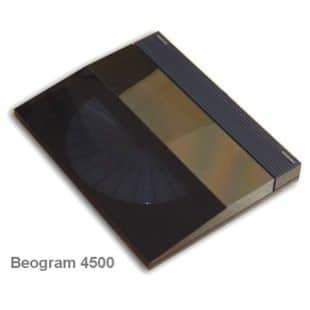
In building the Beogram 4500 turntable, Bang & Olufsen applied all its classic principles to ensure reproduction as close to perfection as possible.
The electronically-controlled tangential arm played each record exactly as it was recorded. And there were built-in systems that helped prevent vibrations reaching the cartridge or turntable. Beogram 4500 employed a finer, ultra-light MMC2 cartridge that combined distinguished sound reproduction with maximum protection for your records.
Beogram 4500 could be used as part of the Beosystem 4500 hi-fi system, and – having an inbuilt RIAA pre-amplifier can be plugged straight into the AUX port of your modern B&O equipment and enjoyed with the minimum of fuss!