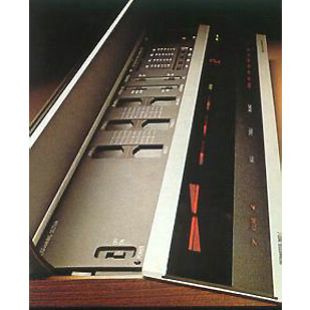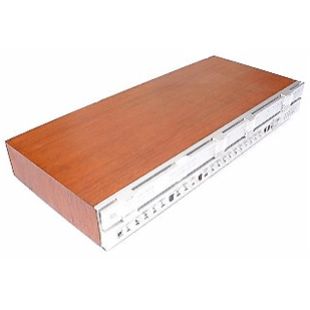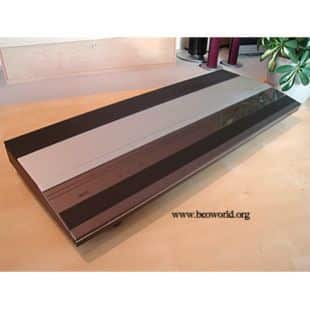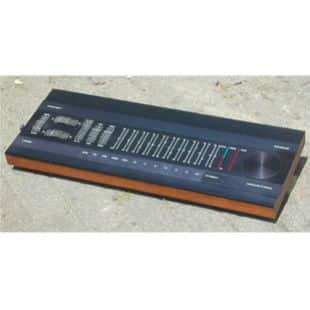
Beomaster 2300 was the receiver heart of Beosystem 2300, released in 1983.
The unit was a superbly-engineered FM radio/amplifier and delivered 2 x 30 watts RMS stereo output. Its sleek design was not only beautiful, but was intelligent too. Instead of buttons, touch-sensitive dimples operated all primary functions and the user’s instructions were confirmed on the read-out panel.
Five favourite FM radio programmes could be pre-set on individual tuning dials and the phase-locked loop decoder ensured excellent stereo separation, even in difficult reception conditions. The volume level could be pre-set at low, medium or high; each time Beomaster 2300 was switched on the music always started at the selected setting, however the volume control, was left the last time the receiver was used.
There were connections for two pairs of loudspeakers, headphones, record deck and cassette deck. The slim cabinet was finished in a choice of teak or rosewood and measured 62cm wide x 6cm high(13,5cm with the lid raised) x 25cm deep.
No remote control was included with the System; Beomaster 2300 in fact, was a direct descendant of Beomaster 1900, right down to the ‘dimple’ sensi-touch controls on the set top.
Beomaster 2400 together with Beomaster 1900 were two advanced FM stereo receivers. They had identical technical specification and performance. Both were easy to use and easy to live with.
Beomaster 2400 had the additional convenience of a cordless ultrasonic remote control module by which you could operate radio, amplifier and Beogram 2400 or 4004 record decks from a distance. Both receivers had touch-sensitive controls for operating the features and functions you used every day. All the secondary switches and adjustments were protected beneath a hinged lid, but an illuminated readout panel showed you the set’s operational status at a glance.
Equipped with the slim remote-control module you could select between four pre-set radio stations or record player input, adjust the volume up or down or put the System into Stand-by. The illuminated panel with its large display allowed to to easily see the state of play from anywhere in the room. The phase-locked loop decoder ensured a wide separation between stereo channels and remained stable over a very long lifetime. When a stereo broadcast was received, a symbol ‘S’ lit up automatically on the fascia of the set. Automatic Frequency Control (AFC) kept the selected radio station spot on tune, and a muting circuit cut out inter-station noise during tuning.
The stereo amplifier produced 2 x 30 watts RMS of high-fidelity output and had DIN sockets for the connection of two pairs of speakers, a record-player and a tape or cassette recorder.
A headphone connection was provided beneath the front edge of the unit. Controls not needed every day were situated beneath a hinged lid. These included tone and balance adjustment, FM pre-setting, loudness, AFC and MONO/STEREO switches, and a switch for selecting a basic initial volume level. This facility allowed you to choose the volume at which the amplifier began to play each time it was switch on – no matter how controls were left the previous time. On its primary control panel Beomaster 2400 had no knobs or buttons. The panel functioned electronically and needed only the contact of your finger to activate it. However, the ultrasonic remote control would have proved more useful. The set’s sophisticated indicator system would tell you instantly that your commands had been obeyed.
Beomaster 2400 was superceded by Beomaster 2400-2 in 1980.
Beomaster 2400 together with Beomaster 1900 were two advanced FM stereo receivers. They had identical technical specification and performance. Both were easy to use and easy to live with.
Beomaster 2400 had the additional convenience of a cordless ultrasonic remote control module by which you could operate radio, amplifier and Beogram 2400 or 4004 record decks from a distance. Both receivers had touch-sensitive controls for operating the features and functions you used every day. All the secondary switches and adjustments were protected beneath a hinged lid, but an illuminated readout panel showed you the set’s operational status at a glance.
Equipped with the slim remote-control module you could select between four pre-set radio stations or record player input, adjust the volume up or down or put the System into Stand-by. The illuminated panel with its large display allowed to to easily see the state of play from anywhere in the room. The phase-locked loop decoder ensured a wide separation between stereo channels and remained stable over a very long lifetime. When a stereo broadcast was received, a symbol ‘S’ lit up automatically on the fascia of the set. Automatic Frequency Control (AFC) kept the selected radio station spot on tune, and a muting circuit cut out inter-station noise during tuning.
The stereo amplifier produced 2 x 30 watts RMS of high-fidelity output and had DIN sockets for the connection of two pairs of speakers, a record-player and a tape or cassette recorder.
A headphone connection was provided beneath the front edge of the unit. Controls not needed every day were situated beneath a hinged lid. These included tone and balance adjustment, FM pre-setting, loudness, AFC and MONO/STEREO switches, and a switch for selecting a basic initial volume level. This facility allowed you to choose the volume at which the amplifier began to play each time it was switch on – no matter how controls were left the previous time. On its primary control panel Beomaster 2400 had no knobs or buttons. The panel functioned electronically and needed only the contact of your finger to activate it. However, the ultrasonic remote control would have proved more useful. The set’s sophisticated indicator system would tell you instantly that your commands had been obeyed.
Beomaster 2400 was superceded by Beomaster 2400-2 in 1980.
Beomaster 3000 was the central part of Beosystem 3000. It was an FM and AM receiver with four preset FM stations and a power output of 30 watts. Beomaster 3000 featured Automatic power Handling Control which protected amplifier and speakers against overload.
The electronic volume control ensured a smooth transition to more, or less, sound, and the volume level could be preset. By activating ‘mute’ you could silence a function without turning it off. Another touch, and the function resumed where it left off.
Add a Beocord 2000, a Beogram 3000 and maybe a Beogram CDX and you had a stylish and high performance set up. This receiver could be seen as the natural descendant of the Beomaster 2400-2.
Beomaster 3000-2 was a solid state FM stereo receiver. The receiver was the kind of product you wanted to both look and to listen to.
It delivered 2 x 40 watts RMS at 30-30.000 Hz and whose distortion was less than 0.5%. With additions to the receiver like Beogram 3000, a fully automatic record player whose operating functions were executed by one master control, and two Beovox 3800 pressure chamber loudspeakers, Beosystem 3000 formed a complete high-fidelity system which deserved to be included in serious evaluations by those who felt that a quality hi-fi system must be chosen in separate units.
The unit was a high fidelity stereo amplifier in which emphasis was placed on specifications, frequency correction and connection facilities. The LOUDNESS feature permitted switching between an objective or a subjective linear reproduction and the LOW and EH filter controls gave a sharper regulation of frequencies, in addition to the normal bass and treble controls. The LOW filter helped reduce rumble resulting from a poor or defective record. At 80Hz its slope was 12dB per octave. There were sockets and push buttons for two pairs of loudspeakers. The headphone socket was situated on the front of the receiver. The tape connection facilitated AB monitoring and there were two record-player inputs: a high and a low impedance. All input sockets could be adjusted from the receiver’s base so that all signals had the same sound level. This was an extra convenience because one needed not adjust the volume control on the amplifier when it was switched between programme sources. The FM section had six pre-set stations. A light indicator assisted accurate tuning and the indicator registered the signal strength of a station. The FM section was extremely sensitive (better than 1.4 uV, I.E.C.) and harmonic distortion was only 0.4%. Field effect transistors, ceramic filters and integrated circuits were used.
In 1972 the Museum of Modern Art in New York (MoMA) chose seven Bang & Olufsen products designed by Jacob Jensen to be included in their Design Collection as representing excellent examples of the Museum’s criteria for quality and historical importance; design, in fact, which had influenced the twentieth century. Beomaster 3000 was one of those seven products. Two years’ previously Beomaster 3000 won the iF Design Award.
Beomaster 3000-2 was introduced in 1972. Both units could be used as part of Beosystem 3000. The two models were visually indistinguishable except for the model number, but the Beomaster 3000-2 contained a few minor technical improvements. The effect of these was not visually or aurally evident; the improvements were seen as Bang & Olufsen’s desire at that time to offer the customer the best components and aural experience.
Beosystem 3300: a 2 x 40 watts RMS amplifier, an FM, long and medium wave radio, and a stereo record deck – was all combined into a single unit called Beomaster 3300. The record deck was fitted with the Bang & Olufsen MMC 20E cartridge. Two Beovox Uni-Phase S45 loudspeakers completed this value-for-money system.
Beosystem 3300: blending science and art
Bang & Olufsen designs are always refreshingly different – a pleasure to look at as well as to hear. Which could be why the company has earned itself over the years coveted places in the Museum of Modern Art in New York.
Beosystem 3300 was the latest addition to a collection which fascinated people from all over the world. You could hang it on the wall among your other works of art; or place it where you like – those sleek, modern shapes would always look good.
But Beosystem 3300 had a great deal more to offer than an ultra-modern appearance. With records, tapes, radio and compact discs it was a top quality music system that really knew how to perform, according to the 1988 catalogue.
Beomaster 3300 Type 2951
This receiver was the heart of the system, connected by Datalink to the other equipment and passing on the commands you gave via remote control, or by a light touch directly on the panel.
You could preset up to five radio stations. The amplifier had a power output of 2 x 30 watts and a power handling system which prevented overloading and distortion. Beomaster 3300 was part of Beosystem 3300 although it could be used as a stand-alone item.
Beomaster 3400 Type 2802 was a 4-channel receiver whose out put was stated as 4 x 20W or 2 x 30W, depending on how it was configured.
This receiver was a development of the Beomaster 2000 but as well as being quadraphonic, was FM only. The tuning scale was extremely unusual being a series of vertical scales rather than a single horizontal one. Despite the huge length thus provided, it still only read up to 104!
It was designed to be partnered by the Beogram 3400 which could provide the correct 4 channel input as well as the stereo cassette player, the Beocord 2200. S45 or P45 speakers made up the rest of the system.
This was a variant of the Beomaster 4400 but which had a black fascia instead of the aluminium front seen on the Beomaster 4400. It seemed to be designed mainly for the US market but numbers made seem to be few and it has attained almost mythical status amongst European collectors. Bang & Olufsen themselves have not got one in their collection and in fact did not even have a picture.
However the enthusiast is not so easily thwarted! Thanks to the superb investigating powers of Frede Kristenssen of Classic Audio, we present the Beomaster 4401!
A more detailed description will follow once the model has been serviced, but essentially it has the same design and performance as the Beomaster 4400.
Two of these receivers are known to exist and examination would suggest that these were design studies taken to a production level. Some evidence of prototype wiring is present but clearly the parts are anodised in black.
Investigations have not completely uncovered the status of this model. There is one line of thinking which suggests that a number of these were made – in the region of a thousand with the majority going to the United States. However other insiders at B&O suggest that only a handful exist and it would seem that they are now in the hands of enthusiasts.
Reports of a matching Beogram , the 4001, are not backed up by any official data and unlike the Beomaster 4401, no service manual has yet been found.
In use the Beomaster 4401 is no different from a normal 4400. Except in this case the 4401 was restored by Classic Audio. This means that this Beomaster exceeds all the factory specifications.
How does it sound? Very modern despite it being over 30 years old. Lots of power and superb dynamics and extremely neutral. Many Beomasters have a warm slightly veiled sound but this one is a clear as a bell. It works equally well with small and large speakers and is easily able to control the bass on Beovox M100s which are a bit of a handful.
The tuner is a delight, pulling in weak stations with ease though the pre-sets are no easier to use than those on the Beomaster 3000. The geared wheels on the Beomaster 2200 are vastly better.
Connections are limited to DIN sockets – the useful RCA sockets are no longer there. This receiver also was the last to feature ambiophonics and a switch to activate the rear channels was fitted to the rear of the unit where most users would never see it!
In this users opinion, this is the best receiver made by B&O. The later Beomaster 8000 was more powerful but the 8000 is prone to going off specification very quickly due to the use of a particular type of capacitor. Therefore an 8000 in proper fettle is a rare beast indeed.
The 4400 is therefore a hidden gem; clothed in the skin of the lesser 3000 and 4000, it hides its splendour till called upon to play. Buy one now – these are true bargains!
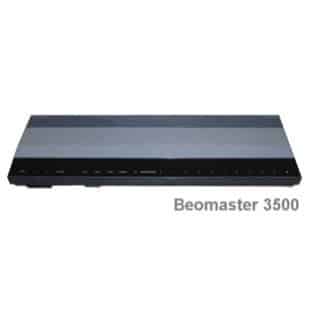
Beomaster 3500 was a part of Beosystem 3500 which comprised the Beomaster 3500 receiver, Beogram 3500 CD player, Beocord 3500 cassette recorder, a pair of Beovox RL35 speakers and a Beolink 1000 remote control.
The whole system in the autumn of 1991 cost just 1600 euros (about £1100). The system’s lines were pure with everything superfluous omitted. It was specially designed to hang either on a wall or sit on a shelf or table. A light touch on its illuminated display gave immediate access to AM/FM receiver, CD player and cassette recorder; all of which were the latest and best in their respective fields. The system was completed by a pair of RedLine RL 35 speakers and operated via a Beolink 1000 remote control unit.
The system was similar to Beosystem 4500 but had a matt finish on the top panels as opposed to Beosystem 4500’s shiny panels. The electronics were a cut-down version of its more expensive brother.