
Author: multicare
Bang & Olufsen classic service centre.
Repairs and refurbishment to both old and new.
BeoPlay M3
BeoPlay S8
BeoMaster 1000
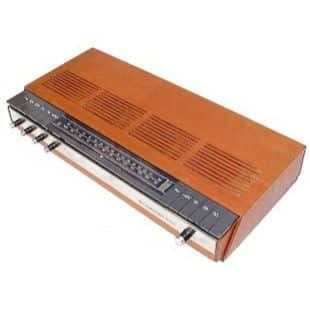
Beomaster 1000 – a compact all-transistor hi-fi 2 x 15 watt stereo amplifier equipped with a highly selective FL radio with extended FM band (to 108 MHz), 3-gang tuning capacitor and 4-stage intermediate-frequency amplifier, automatic control circuit which locks on FM stations and keeps them accurately tuned.
It is prepared for single-transmitter stereo broadcasts, having a B&O multiplex adaptor (stereo decoder); it is also equipped with a pilot lamp (“Beo-Beacon”) which lights up when the receiver is tuned to a station transmitting an FM stereo programme.
The stereo amplifier, which plays both stereo and mono gramophone records, delivers no less than 2 x 15 watts of power output; piano-key speaker change-over switches which control two sets of stereo speaker systems, separate extra-efficient bass and treble controls; balance control for correct stereo sound distribution; physiologically compensated volume control (provides full balance at all volume levels throughout the tonal range); separate scratch and rumble filters; piano-key switching between mono and stereo reproduction; piano-key selectors for switching between the following types of operation: FM Broadcasting, FM Automatic Frequency Control; Tape Recorder; Gramophone 1; Gramophone 2.
Dimensions: 87mm high, 505mm wide, 24mm deep.
Choice of teak or Brazilian rosewood finish. Awarded the 1966 iF Prize for Industrial Design”
BeoMaster 1001

This top-operated receiver was not just exciting in appearance, it was also designed to facilitate operational comfort.
Primary controls were easily accessible, while the rarely used secondary regulators were concealed. The large tuning scale had calibrations in MHz and channel numbers. Tuning accurately to a desired station was child’s play because the large transparent slider was also provided with three small thumbwheels which assisted fine tuning.
Your three favourite stations could be pre-set by individual controls which were safely concealed beneath a sliding panel on the upper right hand side of the set. Subsequent programme selection was by easy pushbutton. The use of Field Effect Transistors (FETs) and Automatic Frequency Control (AFC) ensured optimum FM reception and compensated for weak signal conditions during tuning.
The amplifier’s power output was 2×15 watts RMS or 40 watts total music. Ambiophonic reproduction could also be obtained simply by connecting four loudspeakers, 2 in front and 2 to the side. In this way you could obtain an ‘extended’ stereo reproduction, a more realistic recreation of musical experiences recorded, for example, in a concert hall, because ambience or room information were included as well as direct musical information. There was a push button, the ‘ambio filter’, by which you could damp or reduce the highest tones (treble) reproduced in the side speakers. This was sometimes desired since the reflected sound which is reproduced in the side speakers is mostly mid-range tones. By damping high tones in the side speakers you could obtain a more natural sound reproduction.
Balance regulation was solved in a unique way in Beomaster 1001. Volume was controlled by two sliders, one for right and the other for left channel. The two sliders cold be operated together with one grip or separately, so that the balance between the channels could be adjusted as desired. The receiver’s slim, compact cabinet allowed several playing positions. Mounted on a wall (with special mounting bracket), slightly slanted (by special supports fitted to its base), or the traditional horizontal position. There were connections for record-player (switchable between high and low ohms), tape-recorder, headphone and four loudspeakers. A light indicated when the receiver was switched on, when the FM programme source was in use and whether a programme was in mono or stereo.
Receivers and amplifiers with the ambio function were products which, apart from stereo, could also reproduce the ambience or sound information of a room. Ambient information was included on most stereo vinyl recordings but could not be reproduced by a sound system with two loudspeakers or an ordinary stereo amplifier. Bang & Olufsen systems with the ambio function had facilities which electronically subtracted the difference signal (i.e. the difference between left and right channels) which contained ambient information. This information was fed into two extra loudspeakers which were placed as side speakers in a room. Ambiophony was an extension of stereo reproduction and enhanced the sense of realism. It could be used with nearly all stereo programme materials.
FM room aerial
In order to receive FM programmes, an FM aerial must be connected to the Beomaster 1001. Within a certain radius of the transmitter you could use the Bang & Olufsen FM room aerial, type 8902010. This aerial was easily fitted and the telescopic elements could be pulled out and positioned favourably.
Wall mounting
If desired, the Beomaster 1001 could be mounted on a wall by means of a special bracket. type 8920243. The bracket was screwed onto the wall and the receiver easily hung in position.
BeoMaster 1100
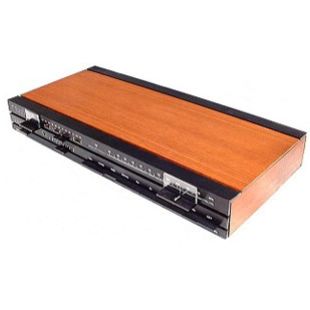
Beomaster 1100 in 1977/78 was a powerful, sensitive and compact unit incorporating an FM tuner and stereo amplifier.
The tuner had facilities for presetting four favourite stations, and once these had been permanently tuned, the programme of your choice could be instantly selected just by pressing a button. There was also a large slider and scale for manual tuning. An AFC (Automatic Frequency Control) switch was provided to help capture weak stations and keep them correctly tuned.
The amplifier section had a power output of 2 x 22 watts RMS with minimal distortion – less than 0,3% at full power. There were connections for two pairs of loudspeakers, a record player, headphones and a tape or cassette recorder (for which A monitoring facilities were also included).
Beomaster 1100 could be made up as part of the Beosystem 1100, together with other compatible Bang & Olufsen products.
BeoMaster 1200 RG
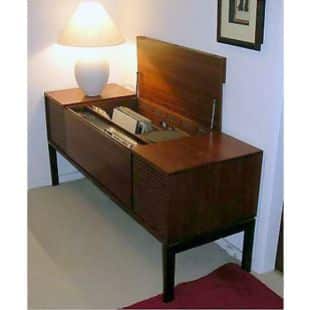
Beomaster 1200 RG Type 2226 was introduced in 1965 and was a forerunner to the Beomaster 900 RG radiogram. The unit had stereo speakers built into the wooden cabinet; a Beomaster 1200 receiver was situated at the front of the radiogram together with a Beogram 1000 record deck.
BeoMaster 1200
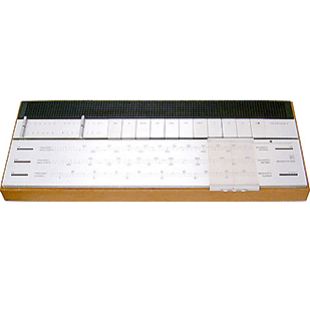
The Tombstone: The simple, modernist graphic is the essential element in Jacob Jensen mechanical designs for Bang & Olufsen. The type-face used on the surface is Helvetica, popular in the post-War era and used by many publications today. The Beomaster was only a plate with an inscription and so it was given the sobriquet of ‘The Tombstone’.
“The Danish Press in 1967 referred to the Beolab and Beomaster 5000 as a “cinema system in two cigar boxes”. With the Beomaster 1200, which was aimed at a broader sector, B&O were ready to go the whole hog and abandon all known notions as to how a radio receiver should look. The reduction was absolute: to a wooden frame around an operating surface. The body of the apparatus disappeared, and only a small cooler grill at the top serves as a reminder of the contents. The totally top-operated equipment can be hung vertically on the wall as a decoration along with the simply framed art products of the time.
This is a slide rule gone mad. The knobs have become part of the polished aluminium surface – flush”! However, not only have the knobs been made flush with the surface, but superfluous functions have also been removed. For Jensen design is a question of considering the consumer’s functional needs. Five permanently set stations are selected below the aluminium sheet in the right-hand corner; user friendliness in everyday life is at the heart. The compact technology has turned the designer into a fashioner of operating aggregates.” — taken from ‘Jacob Jensen’ by Christain Holmsted Olesen.
Beomaster 1200 – type numbers 2501, 2503 – was, at the time of its introduction in 1969, one of the world’s most modern-looking and sophisticated receivers. It incorporated an amplifier around an FM/AM tuner. Radio stations could be tuned in by means of a sliding scale. The format of Beomaster 1200 was to set the trend in Bang & Olufsen design for many years to come.
Beosystem 1200 – made up of Beomaster 1200, Beocord 1200 and Beogram 1200 was the second of Bang & Olufsen’s first ‘designed’ system. The very first was Beosystem 1000 in 1965. The design ‘kinship’, which emphasised the interdependence between B&O’s various products, became a characteristic of B&O for many years. Beosystem 1200 was one of the first products selected by the Museum of Modern Art for the museum’s permanent collection (not exhibition) in 1972.
In 1969 the Danish Society of Industrial Design awarded Bang & Olufsen and Jacob Jensen the ID prize for the Beomaster 1200 radio/amplifier, Beogram 1200 turntable and Beocord 1200 cassette recorder for unusually beautiful and user friendly design. The jury emphasised in particular the Beomaster 1200 receiver which pointed in a new direction for the design of radios.
And the year after, three Bang & Olufsen products designed by Jacob Jensen received the IF award. The winning products were: Beomaster 1200 tuner/amplifier, Beomic 2000 microphone and Beolit 600 transistor radio.
“Congratulations! Well, we have done this before”, said Prince Henrik – The Queen of Denmark’s husband – when he presented the Danish ID award of the Society of Industrial Design to Bang & Olufsen, represented by Jacob Jensen, the designer. The remark made reference to the fact that B&O had also received the award the year before.
In Jacob Jensen the Museum of Modern Art in New York (MoMA) chose seven Bang & Olufsen products designed by Jacob Jensen to be included in their Design Collection as representing excellent examples of the Museum’s criteria for quality and historical importance; design, in fact, which had influenced the twentieth century. Beomaster 1200 was one of those seven products.
The 1200 series represented the logical continuation of the line of development and design which put B&O at the forefront of manufacturers of entertainment electronics. The receiver was superseded by Beomaster 1001 in 1973.
These are superb looking receivers and are especially impressive when wall mounted. However to sound at its best, it really does need to use the recommended loudspeakers. With more modern speakers, the 1200 can sound a little weak and lacking in detail. The provision of Beovox 1200 speakers however reveals very satisfying performance. This is one of many examples where B&O have clearly designed a system.
BeoMaster 1400 (1967)
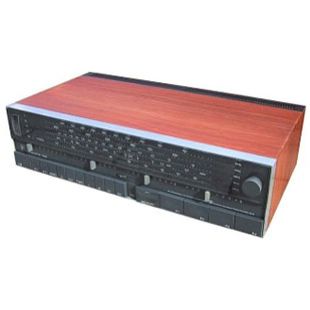
BeoMaster 1400 (1978)
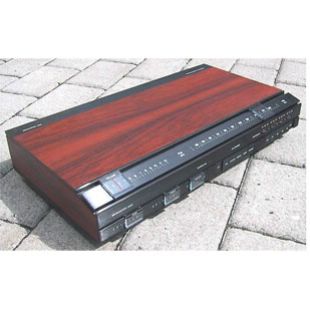
An FM only version of the Beomaster 1500 and available only with a black fascia, the 1400 was not popular in the UK and is now rarely seen. It actually shares many qualities with the more upmarket Beomaster 4400 and is very much under-rated.