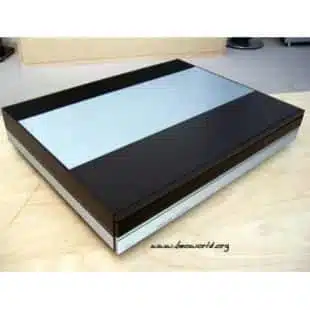
A top-quality cassette recorder, perfectly matched to Beomaster 5000 as part of Beosystem 5000. When the two units were used together the cassette deck could be operated entirely by remote control.
Beocord 5000 was of very advanced design in both its technical features and in its control/operations systems. For the home recording enthusiast it offered superb standards of sound quality and precision engineering. Bang & Olufsen’s patented HX PRO recording system, Dolby B and Dolby C Noise Reduction and a 6-layer Canon combination head with a 1.8mm gap all contributed to a recording and playback performance that delighted even the most exacting technician.
For the novice or the non-technical music lover, Beocord 5000 represented a supremely straightforward way of making high-quality recordings and subsequently enjoying them in relaxing comfort.
Every possible convenience was built into the Beocord’s control system. There was a START/GO function that rewound the tape to its beginning and played it without further instruction. And an automatic ADVANCE function (tape search) that found the start of any required track from either end of the tape.
Selection between ferric, chrome and metal tapes was fully automatic, and setting the correct recording level was quick and easy using the input sliders and LED signal strength meters. You could switch instantly from one tape transport mode to another (e.g. from play to fast rewind) without any danger of tangling the tape or harming the mechanism.
The cassette tray and direct operation controls were housed in a motor-driven drawer which opened and closed at a touch. When used with Beomaster 5000, Beocord 5000 could, of course, be programmed to record or play automatically at any set time.
Connections: stereo microphone (DIN); Aux input DIN; data-link to Beomaster 5000 (one socket, 3-way switchable)
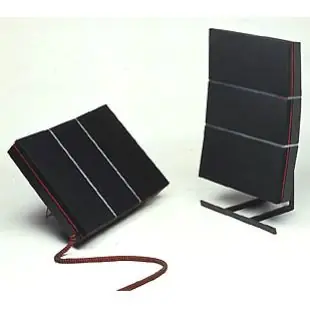
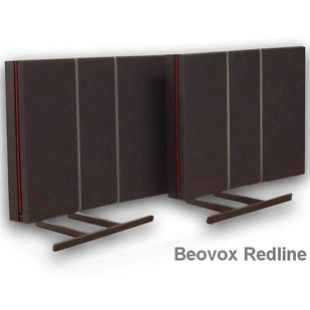
The idea behind Beovox Red Line speakers was one of flexibility. A Red Line speaker was so flexible that it could be placed anywhere. On the ceiling, the wall, or on the floor.
You could hang them semi-permanently on the wall, and if you had a party you could place them on the floor and thereby add extra emphasis to the bass. The different ways of placing them accentuated different frequencies. You could also tilt them if you chose to hang them on the wall. This allowed you to adjust the sound image and direct the sound right at your listening position. However, Red Line was more than merely flexible. It was an impressive bass reflex speaker with a revolutionary new cabinet that ‘curved’ round the sound thereby eliminating irritating resonance because there were no parallel surfaces.
Music that never stands still
Red Line loudspeakers followed your music tastes right up the wall if you wanted! All models except the RL35 could be hung on the wall or be suspended from the ceiling; and, if your dancing feet wanted to make the most of the bass notes, then Red Line could be positioned on the floor, supported by the built-in floor stand. By using Red Line speakers, you weren’t plagued by cables that wrapped themselves around your feet like spaghetti either; Red Line’s flexible spiral cables provided the decorative and practical answer.
The shell was cast in a hard synthetic material and the shape that was devised for the range was characterised by the fact that it allowed for practically no resonance whatsoever.
The idea behind Beovox Red Line speakers was one of flexibility. A Red Line speaker was so flexible that it could be placed anywhere. On the ceiling, the wall, or on the floor.
You could hang them semi-permanently on the wall, and if you had a party you could place them on the floor and thereby add extra emphasis to the bass. The different ways of placing them accentuated different frequencies. You could also tilt them if you chose to hang them on the wall. This allowed you to adjust the sound image and direct the sound right at your listening position. However, Red Line was more than merely flexible. It was an impressive bass reflex speaker with a revolutionary new cabinet that ‘curved’ round the sound thereby eliminating irritating resonance because there were no parallel surfaces.
Music that never stands still
Red Line loudspeakers followed your music tastes right up the wall if you wanted! All models except the RL35 could be hung on the wall or be suspended from the ceiling; and, if your dancing feet wanted to make the most of the bass notes, then Red Line could be positioned on the floor, supported by the built-in floor stand. By using Red Line speakers, you weren’t plagued by cables that wrapped themselves around your feet like spaghetti either; Red Line’s flexible spiral cables provided the decorative and practical answer.
The shell was cast in a hard synthetic material and the shape that was devised for the range was characterised by the fact that it allowed for practically no resonance whatsoever.
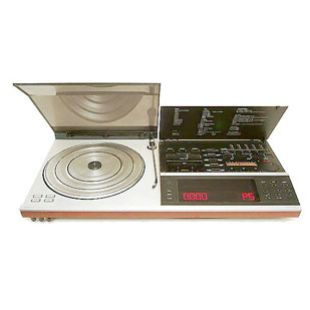
Top quality sound and maximum listening comfort were the main features of this integrated hi-fi system. Records, radio, cassette tapes and a 2 x 40 watts RMS stereo amplifier could all be controlled from anywhere in the room using the slim remote handset. Without moving more than a finger you could select any sound source, adjust volume level, fast wind the tape and even make recordings. This supreme ease of operation was made possible by microcomputer technology. In addition, there were two user-programmable microcomputers which allowed you to make unattended recordings at any time within a 24-hour period, or to play any sound source automatically at a pre-selected time – day after day, if you wished.
A further advantage was easy access to cassette recordings: just key in the appropriate counter reading (address) and the cassette would fast wind to the required passage of music. Ferric, chrome or metal tapes could all be used and Dolby B Noise Reduction was included to ensure clean, hiss-free recordings.
The automatic record deck had an ultra-lightweight arm carrying the MMC 4 pickup cartridge. The radio section covered Long, Medium and FM bands with facilities for pre-setting 6 favourite stations.
The recommended speakers were the Beovox S55 . Speaker pedestals or the SC70/ SC77 hi-fi cabinet could be added optionally if required.
In 1982, Bang & Olufsen introduced a completely new way of living with music. The company was then the only one in the world to fulfil the desire for perfect sound from attic to basement – from just the one central music system.
With the Beolink® system – around which Beocenter 7700 was based – you could enjoy and control you music system in several rooms. From acorns great oak trees spring, and most of the the current (2002) range of TV and hi-fi systems can be equally controlled to give you ’round the house music’ using the latest MasterLink system.
The very advanced (for its time) Beocenter 7700 system brought an entirely new range of possibilities to the serious music-lover. For the very first time ever, round-the-house hi-fi became an option, in whichever room you wanted to listen to it.
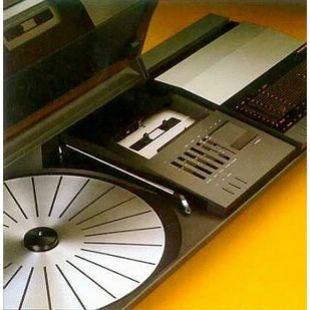
Beocenter 7700 featured Long, Medium and FM radio, automatic record deck, microcomputer controlled cassette recording and 2 x 40 watts RMS stereo amplifier. Two user-programmable 24-hour timers were included, and all sound sources are accessible by infra-red remote control.
From this comprehensive and desirable foundation, it was possible to build up (either immediately, or room by room) a sound system that could be enjoyed and operated from anywhere in the house ( a forerunner to the later Beolink® system).
This is how it worked.
The remote Terminal (Master Control panel) supplied with the Beocenter 7700 had control buttons for armchair access to all primary playing and recording functions.
But in addition, it also had three digital read-out panels on which your instructions were confirmed every time you pressed a button. So you had your means of “talking to” your Beocenter 7700, and it had a means of “talking to” you – right there in your hand.
Your instructions were carried to the Beocenter’s microcomputer by infra-red light, and confirmatory signals were returned to the remote control Terminal in the same way – in a fraction of a second.
This two-way communication could be extended to other rooms by fitting those rooms with a pair of speakers and an electronic Master Control Link, all available as optional accessories. When you wanted to listen to music or radio in a room away from the Beocenter, the remote control Terminal was taken with you. By directing it at the Master Control link (which you had fixed on the wall or on a shelf) in just the same way as you would normally direct it towards the Beocenter, you could control all primary functions and receive confirmation that the Beocenter was doing what you want.
The Master Link equipment could be fitted in up to four different rooms, and you could choose which speakers were to play and which were to be silent. It was like having a complete, top-quality hi-fi system in every room, but paying for only one (plus as many loudspeakers and Master Links as you needed). You could, if you wished, buy additional remote control Terminals if you didn’t want to carry one around the house. But this was not strictly necessary.
Beocenter 7700 offered top quality sound from records, radio and cassettes. Operation was fast, easy and foolproof because of a built-in microcomputer which blocked mistakes, automating many boring, repetitive operations – like switching off one sound source before switching on another. Two timers, each with a 24-hour memory and automatic repeat function, allowed you to record or play any programme at specific times – day after day if you wished. The digital clock could be displayed or not – it was up to you.
You could pre-set 6 favourite FM radio stations, or 5 FM and one AM (Long or Medium wave) for instant press-button recall – either by direct or remote control.
The cassette section had many advanced features to make recording easier and more accurate. Replay, too – it was necessary just to key-in the appropriate counter reading and the cassette would fast wind to any point on the tape. It was as easy as finding a particular track on a record.
Metal, ferric and chrome tapes could be used, and the Dolby Noise Reduction circuits ensured clean, hiss-free sound.
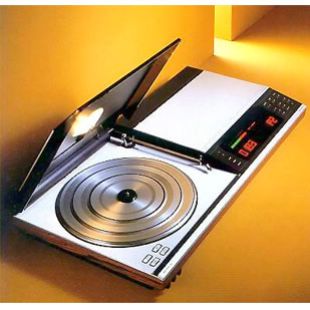
The record deck was fitted with the (then) very latest type of tone arm and miniature MMC 3 cartridge. This pick-up carried a tiny naked elliptical diamond and weighed only 1.6 grams. It had superb tracking ability and ensured the minimum of record wear.
The safe handling of records was also the idea behind the turntable light – fitted inside the hinged lid – which switched on automatically whenever the lid was opened, and stayed alight as long as the deck was in operation.
Beocenter 7700 was available in natural teak or rosewood finish. It measured 72cm wide x 9.5cm high (37.5cm with the lid open) x 38cm deep and could be accommodated in either SC.50 or SC.70 System Cabinet, available separately.
Your choice of loudspeakers for use with Beocenter 7700 was really a matter of listening and comparing the various Beovox models. Different households had different requirements – in size, in quality and in cost. Fortunately, with the Beovox range the choice was a wide one. Advice on speakers for the Beocenter 7700 included Beovox C40, C75, S45, S55 and S80.
Beocenter 7700 was introduced as a completely new way of operating a hi-fi system. A way which gave individuals the freedom to enjoy top quality sound all over the house; at the same time to control the music from anywhere in any room.
This was the world’s first high fidelity system that could be operated from another room. With the Beocenter 7700’s master Control Panel and and optional Master Control Link, you could control radio, record deck, cassette recorder and stereo amplifier even though you were in the kitchen or bedroom and the set itself was in the lounge.
So when you want music in another room, don’t move the hi-fi – just move the music!
A Master Control Panel (above) was supplied with every Beocenter 7700. It was used just like an ordinary remote control handset when you were listening in the lounge, close to your hi-fi system. It let you operate all sound sources and adjust volume levels without moving from the comfortable armchair.
Master Control Link was an optional accessory, like the additional loudspeakers you needed in order to enjoy your music in other rooms. The Link equipment consisted of two units – a discreet black box containing a mass of sophisticated electronic circuitry (which could be fitted out of sight behind furniture etc.), and a transceiver unit that was placed on a shelf or wall where it could pick up the infra-red signals from your Master Control Panel. The transceiver unit also let you switch the speakers in this room on or off, and gave access to programmes that were due to be played via the Beocenter’s automatic timers.
You could buy extra stereo speakers and Master Control links for one, two or three additional rooms, as well as enjoying the hi-fi system itself which you probably installed in the living room or the lounge.
The Master Link equipment was connected by cable ‘in series’, i.e. only the first extra room is connected direct to the Beocenter; the second extra room was connected to the first and so on, so wiring was kept to a minimum. And you could add each room one by one – as your needs changed or your budget allowed.
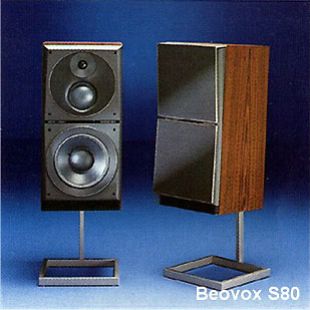
Beovox S80-2 speakers gave neutral sound reproduction with the added realism afforded by depth definition and perspective.
There was a 7,5cm mid-range/phase-link unit combined with a 20,5cm woofer and 2,5cm dome tweeter to provide a wide frequency response and no audible phase distortion. Overload protection was automatic. The cabinet was of pressure chamber construction. Optional pedestals and wall-fixing kits were available.
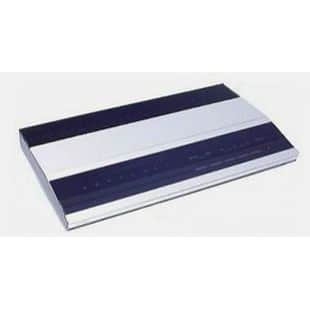
Designed as a perfect match, both physically and technically, for the Beomaster 2000, this advanced slim-line cassette deck was nonetheless a serious hi-fi product in its own right, combining a high-performance specification with supreme ease of operation.
Despite its unassuming appearance, Beocord 2000 contained a full pay-load of advanced circuitry plus a few extra features rarely found in cassette decks within this price frame. The primary controls – those concerned with tape movement – were totally electronic and designed on the Sensitouch principle. There were no knobs to turn or keys to press; a light fingertip touch was sufficient to activate any function.
Ferric, chrome or metal tapes could be used, and Dolby B noise reduction was included to ensure clean, hiss-free recordings. A clearly calibrated scale and input slider, together with large Peak Programme Meter, made it quick and easy to set accurate recording levels. These controls were placed adjacent to the cassette tray beneath a hinged lid which sprang open at a touch.
Beocord 2000’s built-in microcomputer made operation fast and foolproof. It was possible to switch directly between any and all tape transport modes without harming the tape, the mechanism or the motor. Microcomputer intelligence also opened the way for additional control functions that contributed in a very practical way to daily enjoyment of taped music.
A NEXT control allowed for easy track location (tape scan): one touch fast winds the tape to the next signal gap and plays the following track – automatically. So if you wanted to hear, for example, track number 5, just touch-and-wait four times and the place would be found for you. Similarly, you could repeat play-back of a favourite track up to five times with just a single touch. It’s such a convenient way of listening to exactly what you want, when you want.
Beocord 2000 had a socket for data-link connection to Beomaster 2000 so that direct switching was possible between Beomaster, Beogram and Beocord in the Beosystem 2000. The deck could also be data-linked to Beomaster 5000 or Beomaster 6000, when all tape functions could be operated via the receiver’s remote control system. Beocord 2000 could be made up as part of the Beosystem 2000, when linked together with other compatible Bang & Olufsen products. It was also part of Beosystem 3000 if that is how you wished to use it.
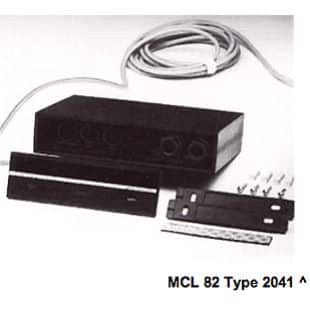
This was the first version of Master Control Link and was used with the Beosystem 5000 and the Beocenter 7000 series.
It allowed control of all elements in the main system whilst in a link room. The first incarnation was used with the remote controls of the Beosystem 5000 and Beocenter 7000 and when used with the MCP-5000 and MCP-7700, allowed two way communication. One could add four rooms in this system. It was superseded by the later MCL2 system which used Beolink 1000 codes.
Beocenter 2200 was a distinctive high fidelity system offering 3-waveband radio, record player and cassette facilities in a very compact, slim-line format. Maximum power output was 2 x 25 watts RMS.
The radio section covered long, medium and FM bands. Four favourite FM stations could be pre-set for instant recall. A horizontal thumbwheel on the front of the unit controlled manual tuning: the large graph-grid tuning scale was very easy to see and use.
The record deck featured the (then) latest Bang & Olufsen tone arm carrying the ultra-light MMC 5 pickup. Operation was entirely automatic and needed just a single touch on the PHONO button. Built-in logic circuits identified the size and speed of any record placed on the lightweight turn-table and would cue the pickup arm onto the run-in groove with absolute accuracy and safety.
The cassette recorder had electronic control so you could switch directly between, say, fast rewind and PLAY without danger of straining the mechanism or damaging the tape. Dolby B noise reduction and automatic selection between ferric and chrome tapes was included. Metal tapes could also be used, so you were assured of top class sound quality for those really special recordings.
Listening to tapes was also quick and easy: the NEXT button allowed you to scan the tape track by track until you found the one you wanted to hear.
The recommended speakers for use with this system were the Beovox X25.
Connections: Mono microphone; 2 pairs speakers; headphones; external tape recorder with two-way copying; AM and FM aerials
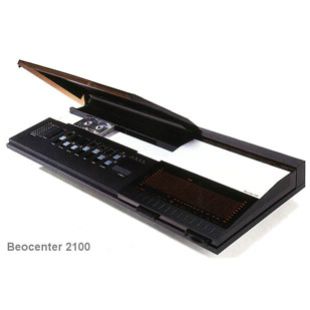
Beocenter 2100 – three variations and a one-finger exercise
Beocenters 2200, 2100 and 4000 – each with a totally distinctive style but sharing the unmistakeable themes of Bang & Olufsen quality and simplicity.
If you loved true hi-fi but you weren’t a record fan, then Bang & Olufsen ‘had your radio perfectly taped’! Beocenter 2100 had all the features of Beocenter 2200 but without the record deck so that it took up even more of a conveniently small space.
Beovox X25 loudspeakers were the offered choice but you could equally mix and match the Beocenter with any other Bang & Olufsen speaker on the market at that time. When linked with Beovox X25 loudspeakers, the combined system was known as Beosystem 2100. A recommended record deck to complement your system would be either the Beogram RX2 or TX2.