Posted on

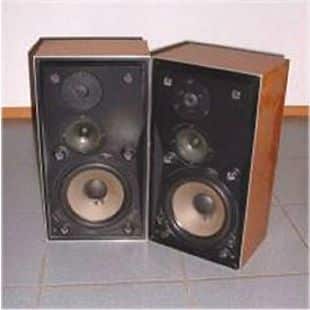
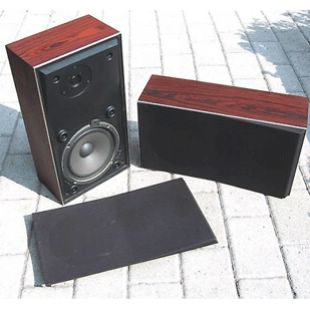
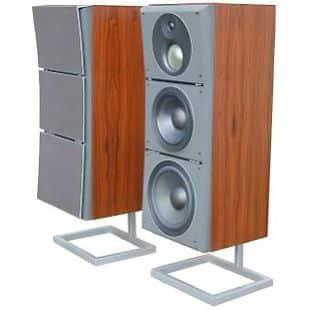
Beovox MS150

Bang & Olufsen Beovox MS150

Beovox Uni-Phase MS150 and M150 were Bang & Olufsen’s answer to the need for loudspeakers that could cope with greater dynamic range and increased demand for serious, no-gimmick sound reproduction.

They were B&O’s biggest and most perfected loudspeakers up to the time of their introduction, designed to reproduce sound with a natural, linear phase quality – even at very high sound pressure levels. Their power handling capacities were specified at 150 watts RMS. However, effective overload protection circuits enabled them to handle brief passages of music way above their ratings

Both speakers reproduced all types of music – from the faintest to the loudest notes – with extreme accuracy and precision, without adding to or subtracting from the signals they received.

In addition, the MS150 was designed to reproduce a clean, powerful bass in a relatively large room. That is why it was fitted with a monitor quality sub-woofer and had a net volume of 64 litres. It reproduced the lowest of tones that any record, tape or FM broadcast could deliver. Apart from the sub-woofer, all other speaker drivers in both models were identical.

Beovox Uni-Phase MS150 were well-balanced loudspeakers that would reproduce all types of music – from the faintest to the loudest tones – with accuracy and precision. They were an excellent match for the BeoLab 8000 music system, and other serious high fidelity systems.

Beovox Uni-Phase MS150 loudspeakers had linear phase and linear amplitude transfer characteristics. This meant that they would reproduce sound accurately, without adding to, or subtracting from the signals they received. Power handling capacity was specified at 150 watts RMS but an effective overload protection circuit enabled them to handle much greater loads.

Behind this successful design lay a new acoustic technology, an integrated loudspeaker design which put Bang & Olufsen in control of all the parameters that affected the loudspeakers’ performance. That is, all, except the room acoustics in which they were situated. The new technology was based upon the use of Fourier analysis, computer-aided design and simulation techniques and laser holography. It helped prove measuring, calculating and testing techniques and thereby led to better cross-over filters’ design, refinement of patented linear phase techniques, control cabinet resonances and the minimisation of diffractions caused by the cabinet’s traditionally sharp-edged profiles. There was also a redesigning of the necessary drivers in order to meet precise construction requirements and perform optimally.

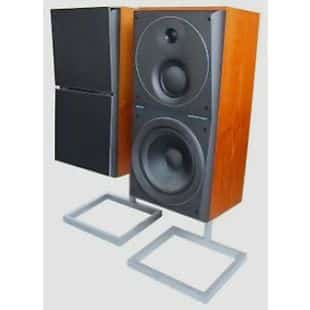
A monitor quality sub-woofer, a 20cm bass unit and a 64 litre net cabinet secured clean, powerful, bass reproduction. The mid-range unit, a 7,5cm dome tweeter, was aperiodically tuned to secure the exact frequency response characteristic required, while the super tweeter ensured excellent high frequency response.

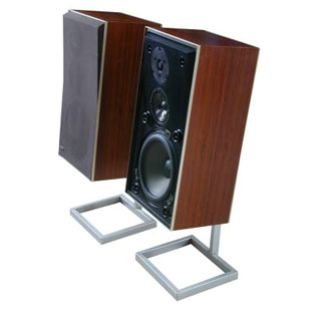
Beovox MS150-2 handled a full 150 watts of power easily and accurately. Even musical peaks exceeding this level offered no danger to the drive units as they were protected by an automatic safety cut-out. All frequencies were reproduced faithfully via the 25cm sub-woofer, 20,5cm bass, 7,5cm mid/phase-link and a 2,5cm tweeter unit. Overall, frequency range was 30 – 20000Hz; the extended bass response being a benefit of the ported reflex cabinet design. Sturdy metal pedestals were included to place the speakers at the correct height and vertical angle.

Posted on

Beovox MS150.2

Bang & Olufsen Beovox MS150.2

Beovox Uni-Phase MS150 and M150 were Bang & Olufsen’s answer to the need for loudspeakers that could cope with greater dynamic range and increased demand for serious, no-gimmick sound reproduction.

They were B&O’s biggest and most perfected loudspeakers up to the time of their introduction, designed to reproduce sound with a natural, linear phase quality – even at very high sound pressure levels. Their power handling capacities were specified at 150 watts RMS. However, effective overload protection circuits enabled them to handle brief passages of music way above their ratings

Both speakers reproduced all types of music – from the faintest to the loudest notes – with extreme accuracy and precision, without adding to or subtracting from the signals they received.

In addition, the MS150 was designed to reproduce a clean, powerful bass in a relatively large room. That is why it was fitted with a monitor quality sub-woofer and had a net volume of 64 litres. It reproduced the lowest of tones that any record, tape or FM broadcast could deliver. Apart from the sub-woofer, all other speaker drivers in both models were identical.

Beovox Uni-Phase MS150 were well-balanced loudspeakers that would reproduce all types of music – from the faintest to the loudest tones – with accuracy and precision. They were an excellent match for the BeoLab 8000 music system, and other serious high fidelity systems.

Beovox Uni-Phase MS150 loudspeakers had linear phase and linear amplitude transfer characteristics. This meant that they would reproduce sound accurately, without adding to, or subtracting from the signals they received. Power handling capacity was specified at 150 watts RMS but an effective overload protection circuit enabled them to handle much greater loads.

Behind this successful design lay a new acoustic technology, an integrated loudspeaker design which put Bang & Olufsen in control of all the parameters that affected the loudspeakers’ performance. That is, all, except the room acoustics in which they were situated. The new technology was based upon the use of Fourier analysis, computer-aided design and simulation techniques and laser holography. It helped prove measuring, calculating and testing techniques and thereby led to better cross-over filters’ design, refinement of patented linear phase techniques, control cabinet resonances and the minimisation of diffractions caused by the cabinet’s traditionally sharp-edged profiles. There was also a redesigning of the necessary drivers in order to meet precise construction requirements and perform optimally.

A monitor quality sub-woofer, a 20cm bass unit and a 64 litre net cabinet secured clean, powerful, bass reproduction. The mid-range unit, a 7,5cm dome tweeter, was aperiodically tuned to secure the exact frequency response characteristic required, while the super tweeter ensured excellent high frequency response.

Beovox MS150-2 handled a full 150 watts of power easily and accurately. Even musical peaks exceeding this level offered no danger to the drive units as they were protected by an automatic safety cut-out. All frequencies were reproduced faithfully via the 25cm sub-woofer, 20,5cm bass, 7,5cm mid/phase-link and a 2,5cm tweeter unit. Overall, frequency range was 30 – 20000Hz; the extended bass response being a benefit of the ported reflex cabinet design. Sturdy metal pedestals were included to place the speakers at the correct height and vertical angle.
Posted on

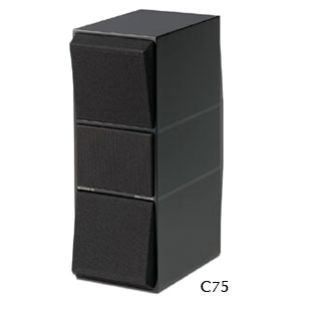
BeoVox C75

Bang & Olufsen BeoVox C75

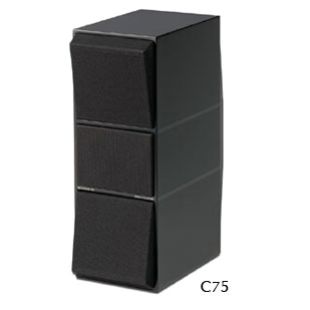
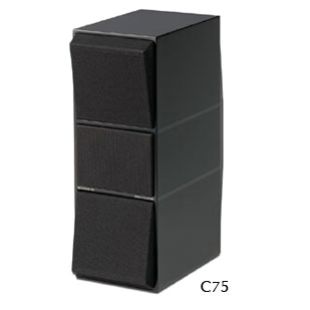
When B&O’s engineers had discovered that the signals from respectively the bass unit and the tweeter in a loudspeaker do not reach the human ear at the same time, and that as a consequence a very slight distortion occurs, they asked Jacob Jensen to design a loudspeaker cabinet in which the units were skewed in relation to each other.

Jensen illustrated B&O’s technical discovery with an angle: “form follows function”. B&O’s loudspeakers in this way achieved a characteristic visual identity in the 1970s and 1980s.” – taken from ‘Jacob Jensen’ by Christain Holmsted Olesen.

Although the speaker was the tallest in the original line-up of aluminium compact passive speakers, Beovox C75 was no taller than an LP record, yet its reproduction quality equalled some of the full-size Beovox models. The one-piece aluminium log-line casing and separate bass (2 x 10cm bass drivers) and treble drivers (1 x 2,5cm) were specially designed to sound best in small rooms. Power handling was 75 watts RMS. Both the C75 and their smaller counterpart, the C40, benefited from the advantages of the “log line transmission system” and exploited the acoustic properties of small rooms to ensure well-balanced sound reproduction quality from these physically small cabinets.

As part of the Beovox Uni-Phase family, they also had linear phase and linear amplitude characteristics, which meant that they reproduced all types of music naturally. The range of C-type speakers won the ID Award in 1978.

Beovox C75 was eventually replaced by the CX100 in 1984.

Beovox C30 and C40 speakers were two compact bookshelf units offering high performance from deceptively small cabinets. The 10cm woofer and 2,5cm tweeter were mounted in thick aluminium casings to eliminate audible resonance. Log-line transmission ensured wide frequency response and clean, clear sound. Ideal for smaller rooms, their power handling capabilities were 30 watts and 40 watts RMS respectively.

The one-piece aluminium log-line casing and separate bass and treble drivers of the Beovox C75 were specially designed to sound best in small rooms. Power handling was 75 watts RMS

Posted on

BeoVox C40

Bang & Olufsen BeoVox C40

When B&O’s engineers had discovered that the signals from respectively the bass unit and the tweeter in a loudspeaker do not reach the human ear at the same time, and that as a consequence a very slight distortion occurs, they asked Jacob Jensen to design a loudspeaker cabinet in which the units were skewed in relation to each other.

Jensen illustrated B&O’s technical discovery with an angle: “form follows function”. B&O’s loudspeakers in this way achieved a characteristic visual identity in the 1970s and 1980s.” – taken from ‘Jacob Jensen’ by Christain Holmsted Olesen.

Although the speaker was the tallest in the original line-up of aluminium compact passive speakers, Beovox C75 was no taller than an LP record, yet its reproduction quality equalled some of the full-size Beovox models. The one-piece aluminium log-line casing and separate bass (2 x 10cm bass drivers) and treble drivers (1 x 2,5cm) were specially designed to sound best in small rooms. Power handling was 75 watts RMS. Both the C75 and their smaller counterpart, the C40, benefited from the advantages of the “log line transmission system” and exploited the acoustic properties of small rooms to ensure well-balanced sound reproduction quality from these physically small cabinets.

As part of the Beovox Uni-Phase family, they also had linear phase and linear amplitude characteristics, which meant that they reproduced all types of music naturally. The range of C-type speakers won the ID Award in 1978.

Beovox C75 was eventually replaced by the CX100 in 1984.

Beovox C30 and C40 speakers were two compact bookshelf units offering high performance from deceptively small cabinets. The 10cm woofer and 2,5cm tweeter were mounted in thick aluminium casings to eliminate audible resonance. Log-line transmission ensured wide frequency response and clean, clear sound. Ideal for smaller rooms, their power handling capabilities were 30 watts and 40 watts RMS respectively.

The one-piece aluminium log-line casing and separate bass and treble drivers of the Beovox C75 were specially designed to sound best in small rooms. Power handling was 75 watts RMS

Posted on

BeoVox C30

Bang & Olufsen BeoVox C30

When B&O’s engineers had discovered that the signals from respectively the bass unit and the tweeter in a loudspeaker do not reach the human ear at the same time, and that as a consequence a very slight distortion occurs, they asked Jacob Jensen to design a loudspeaker cabinet in which the units were skewed in relation to each other.

Jensen illustrated B&O’s technical discovery with an angle: “form follows function”. B&O’s loudspeakers in this way achieved a characteristic visual identity in the 1970s and 1980s.” – taken from ‘Jacob Jensen’ by Christain Holmsted Olesen.

Although the speaker was the tallest in the original line-up of aluminium compact passive speakers, Beovox C75 was no taller than an LP record, yet its reproduction quality equalled some of the full-size Beovox models. The one-piece aluminium log-line casing and separate bass (2 x 10cm bass drivers) and treble drivers (1 x 2,5cm) were specially designed to sound best in small rooms. Power handling was 75 watts RMS. Both the C75 and their smaller counterpart, the C40, benefited from the advantages of the “log line transmission system” and exploited the acoustic properties of small rooms to ensure well-balanced sound reproduction quality from these physically small cabinets.

As part of the Beovox Uni-Phase family, they also had linear phase and linear amplitude characteristics, which meant that they reproduced all types of music naturally. The range of C-type speakers won the ID Award in 1978.

Beovox C75 was eventually replaced by the CX100 in 1984.

Beovox C30 and C40 speakers were two compact bookshelf units offering high performance from deceptively small cabinets. The 10cm woofer and 2,5cm tweeter were mounted in thick aluminium casings to eliminate audible resonance. Log-line transmission ensured wide frequency response and clean, clear sound. Ideal for smaller rooms, their power handling capabilities were 30 watts and 40 watts RMS respectively.

The one-piece aluminium log-line casing and separate bass and treble drivers of the Beovox C75 were specially designed to sound best in small rooms. Power handling was 75 watts RMS

Posted on

Beovox S55

Bang & Olufsen Beovox S55

Beovox S55 was an ideal bookshelf speaker, but could also be used as a wall-mounted or free-standing model with the optional fittings available separately.

The pressure chamber cabinet contained a 21cm bass driver, an 11,5 mid-range/phase-link unit and a 2,5cm tweeter. Power handling was 55 watts RMS.

Posted on

Beovox S45-2

Bang & Olufsen Beovox S45-2

An exceptional little bookshelf speaker of hi-fi quality with a frequency range of 38 – 20000 Hz and less than 1% harmonic distortion.

You will find these speakers regularly recommended on BeoWorld. They have the same height and width as the lesser S35 speakers but are 3cm deeper and 1kg heavier. This small size difference makes an immense difference to the sound though. The extra filler drive unit adds hugely to the all important midrange sound and this is, to many users’ ears, the best balanced bookshelf speaker made by B&O. What it lacks in ultimate bass, it repays in accuracy and tone. The optional floor stand is elegant and effective and worth hunting out. A capacitor change may be needed to make an old pair sing but you are very unlikely to be disappointed by purchasing a pair of these.

For those in search of more bass, S75s are the bigger brother but lack the sonic purity found in the S45.2. To beat these in this range, you need M100s and a bigger house!

Linear phase sound reproduction. Speaker units include a 20cm woofer, a special 8cm Phase Link unit, and a 2,5cm dome tweeter. Volume 25 litres; weight 7kg.