Posted on

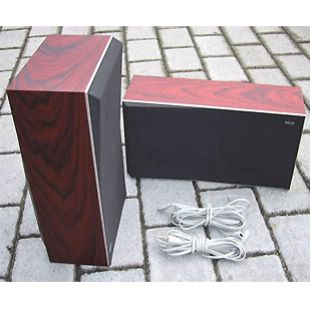
BeoVox C30

Bang & Olufsen BeoVox C30

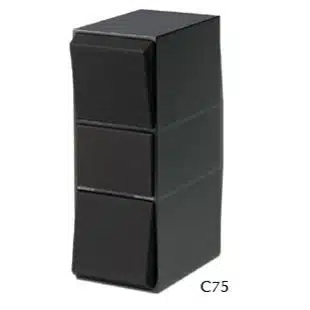
When B&O’s engineers had discovered that the signals from respectively the bass unit and the tweeter in a loudspeaker do not reach the human ear at the same time, and that as a consequence a very slight distortion occurs, they asked Jacob Jensen to design a loudspeaker cabinet in which the units were skewed in relation to each other.

Jensen illustrated B&O’s technical discovery with an angle: “form follows function”. B&O’s loudspeakers in this way achieved a characteristic visual identity in the 1970s and 1980s.” – taken from ‘Jacob Jensen’ by Christain Holmsted Olesen.

Although the speaker was the tallest in the original line-up of aluminium compact passive speakers, Beovox C75 was no taller than an LP record, yet its reproduction quality equalled some of the full-size Beovox models. The one-piece aluminium log-line casing and separate bass (2 x 10cm bass drivers) and treble drivers (1 x 2,5cm) were specially designed to sound best in small rooms. Power handling was 75 watts RMS. Both the C75 and their smaller counterpart, the C40, benefited from the advantages of the “log line transmission system” and exploited the acoustic properties of small rooms to ensure well-balanced sound reproduction quality from these physically small cabinets.

As part of the Beovox Uni-Phase family, they also had linear phase and linear amplitude characteristics, which meant that they reproduced all types of music naturally. The range of C-type speakers won the ID Award in 1978.

Beovox C75 was eventually replaced by the CX100 in 1984.

Beovox C30 and C40 speakers were two compact bookshelf units offering high performance from deceptively small cabinets. The 10cm woofer and 2,5cm tweeter were mounted in thick aluminium casings to eliminate audible resonance. Log-line transmission ensured wide frequency response and clean, clear sound. Ideal for smaller rooms, their power handling capabilities were 30 watts and 40 watts RMS respectively.

The one-piece aluminium log-line casing and separate bass and treble drivers of the Beovox C75 were specially designed to sound best in small rooms. Power handling was 75 watts RMS
Posted on

Beovox S45-2

Bang & Olufsen Beovox S45-2

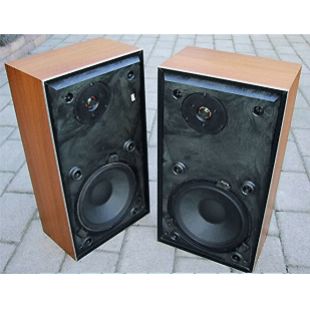
An exceptional little bookshelf speaker of hi-fi quality with a frequency range of 38 – 20000 Hz and less than 1% harmonic distortion.

You will find these speakers regularly recommended on BeoWorld. They have the same height and width as the lesser S35 speakers but are 3cm deeper and 1kg heavier. This small size difference makes an immense difference to the sound though. The extra filler drive unit adds hugely to the all important midrange sound and this is, to many users’ ears, the best balanced bookshelf speaker made by B&O. What it lacks in ultimate bass, it repays in accuracy and tone. The optional floor stand is elegant and effective and worth hunting out. A capacitor change may be needed to make an old pair sing but you are very unlikely to be disappointed by purchasing a pair of these.

For those in search of more bass, S75s are the bigger brother but lack the sonic purity found in the S45.2. To beat these in this range, you need M100s and a bigger house!

Linear phase sound reproduction. Speaker units include a 20cm woofer, a special 8cm Phase Link unit, and a 2,5cm dome tweeter. Volume 25 litres; weight 7kg.

Posted on

Beovox S30

Bang & Olufsen Beovox S30

Beovox S30 and S40 both used a two-unit configuration and pressure chamber design to reproduce music faithfully and clearly.

They handled up to 30 watts and 40 watts respectively and were ideal for mounting within a shelving system. Beovox S40 worked in conjunction with Beosystem 2300 if that is how you wished to use them. They featured a 20cm bass driver (woofer) and a 2,5cm dome treble unit (tweeter) offering wide frequency response and clean, clear sound reproduction.

Posted on

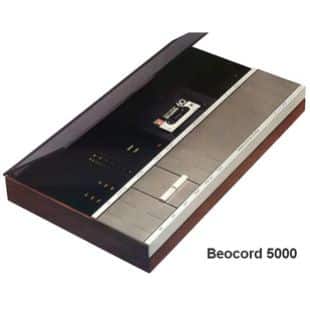
BeoCord 5000 (1975)

Bang & Olufsen BeoCord 5000 1975

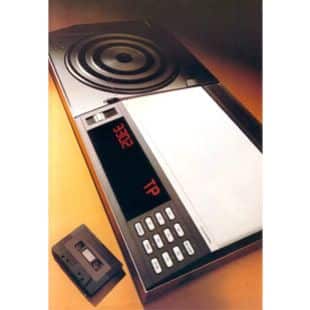
Beocord 5000 was a superior cassette deck with a Sendust tape head, dual capstans and a special servo drive system which secured low wow and flutter-data. Electronic recording level indicators (Peak Programme Meters) and the Fade in/Fade out functions facilitated exceptional recordings of the most demanding types of music. An automatic demagnetizing device helped ensure optimum signal/noise ratio at all times.

A Hall generator secured the most reliable automatic stop at the end of play. Because it worked electronically it was superior to mechanical systems which are always subject to wear and tear, stress and strain. Naturally Beocord 5000 incorporated Dolby B Noise Reduction circuits. You could also switch from fast forward to fast rewind, or normal play, without endangering your tapes or damaging the drive mechanism.

Despite these technological refinements Bang & Olufsen still didn’t forget the greatest advantage of the compact cassette – that of convenience. That’s why Beocord 5000 was so easy to use. The logically-arranged easy-touch buttons were clearly marked to aid simple, problem-free operation. An illuminated read-out panel told you the operational status of the deck at all times. The display could be read through the black Perspex cover which protected the cassette housing against dust. The unit had two peak programme meters which reacted faster than conventional VU meters in registering recording level and thus ensuring optimum recording quality.

There were two main design models in the Beocord 5000 range:the three head type 4705 was replaced in 1977 with the twin head 4715/4716 models.

What you need to know is that these were the only cassette deck with a B&O designed mechanism. It was designed to be to cassette decks what the Beogram 4000 was to record players. From a technical point of view, it was way ahead of its time.

However it was stupendously complicated and this hit reliability hard. The three head version hardly ever worked fully and the later two head was only a little better. Gorgeous to look at and packed with features, it will break your heart! B&O replaced this with the Beocord 8000, which had a bought in tape transport….

Posted on

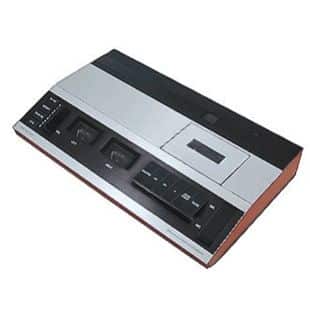
BeoCord 1500 (1979)

Bang & Olufsen BeoCord 1500 1979

Beocord 1500 matched several Beomaster receivers in design, concept and performance level. It was also technically compatible with non-Bang & Olufsen products. If you simply wanted to record and play back cassettes without any extra refinements or facilities, this deck was for you.

The slanted control panel was logically planned and really simple to use. The VU meters and sliding input control made the setting of correct recording levels easy and accurate. The 3-digit tape counter had a memory function that helped you locate the start of a particular passage of music.

Quality recording and playback was further ensured by the super Permalloy tape head, highly stable motor/drive system and Dolby B Noise Reduction circuit.

Posted on

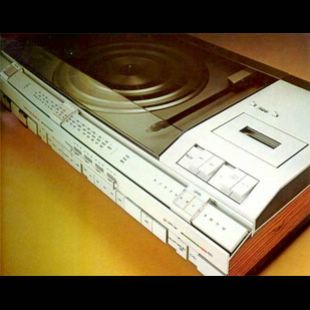
BeoCenter 4600

Bang & Olufsen BeoCenter 4600

Beocenter 4600 was a multi-way combination unit incorporating a 2 x 25 watts RMS AM/FM receiver, an easy to use hi-fi cassette deck and an automatic record player. The lightweight arm had built-in bias compensation and carried Bang & Olufsen’s MMC 20S pickup cartridge with spherical diamond stylus.

The AM radio covered long and medium wavebands. Outstanding reception quality and high selectivity was secured by an Automatic Gain Control circuit, active noise suppression and hybrid filters.

The FM tuner was highly sensitive. Four stations could be pre-set for subsequent instant recall. The hi-fi cassette deck had all the features and qualities normally expected only in a separate deck:

* 3-digit counter with memory function

* electronic tape stop at end of play

* Dolby B Noise Reduction

* chrome or normal tapes could be used

The super Permalloy tape head was hard-wearing and had a long, useful lifetime. The record player too was automated: all functions were controlled by a single button. The anti-skating device worked automatically too. Bang & Olufsen’s MMC 20 S pickup cartridge with a spherical diamond was an integral part of this unit. Two Beovox S40 speakers complete this system if this was your choice.

Posted on

BeoCenter 7000

Bang & Olufsen BeoCenter 7000

Beocenter 7000 upon its release, represented one of the most advanced hi-fi centres on the market. One touch produced instant music from a record, cassette tape or an FM or AM radio station. Illuminated symbols on the set’s communication panel confirmed instructions or rejected mistakes and kept you informed on the set’s operational status at all times.

in short, Beocenter 7000 offered two-way visual communication in high-fidelity.

The cordless remote control module put you in command of most of the functions from anywhere in the room. You could select any programme which would also switch on the set. You could regulate the volume – 2 x 40 watts RMS – make cassette recordings, and switch off the set. Comprehensive memory and timer facilities enabled you to program the set’s microcomputer to operate within a 24-hour period. It could record an important radio programme while you were out, and even instruct the Beocenter to wake you up with an early morning broadcast.

Each of Beocenter 7000’s three sound sources had the quality and performance level normally found in much more expensive separate units. The record deck had Electronic Servo Drive for absolute speed accuracy and its operation was fully automated. Stop, start or pause could be controlled via the remote control terminal. The cassette recorder had a Sendust record/replay head and a double-gap erase head that could even cope with metal tapes. You could locate any point on the tape simply by asking the set’s microcomputer to search for this required counter reading. The radio had facilities for pre-setting 5 FM and 1 AM stations which could then be selected instantly at the touch of a button.

Beocenter 7000 was designed by Jacob Jensen. In 1979 three more of the designer’s creations for Bang & Olufsen were included in the Design Collection of the Museum of Modern Art in New York including the Beocenter 7000 music system.

Posted on

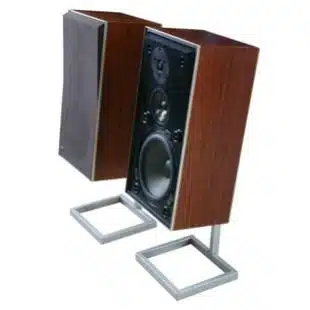
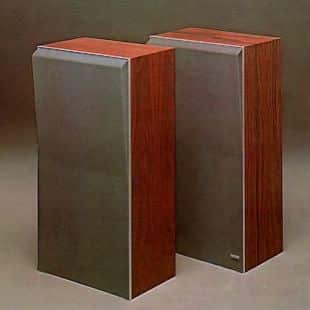
BeoVox S75

Bang & Olufsen Beovox S75

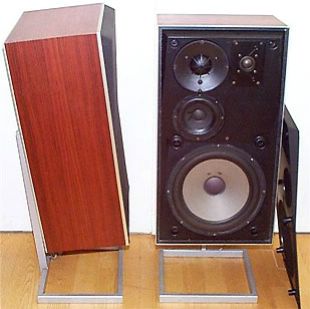
The S75 was a four way speaker designed for stand mounting and was a suitable match for any of the receivers offered at the time. It could be regarded as the bigger brother of the fabled S45.2 and replaced the very similar S60 in the speaker range.

The cross over was changed along with a redesign of the cabinet. The result was a speaker with more bass emphasis than the S60 but still with a soaring top end. Criticism could be levelled that the bass was at times slightly overblown, but for rock music, it hit the spot.

The extra size also emphasised the cabinet makers’ skill with the rosewood model in particular often showing a wonderful selection of flame veneer.

Although these speakers lack the accuracy of the S45.2, many will find the extra bass an attraction and will choose these in front of their fabled brother.

Beovox Uni-Phase S75

Pressure chamber speaker with linear phase sound reproduction and wide frequency range: 36 – 20000 Hz. Was suitable for placement in a shelving system but also available with aluminium pedestal for those who prefer a free-standing model. Speaker units included a 25cm woofer, a special 12,5cm Phase Link unit, a 5cm mid-range dome and a 2,5 dome tweeter. Volume was 40 litres; weight 11kg