Posted on

BeoMaster 4400

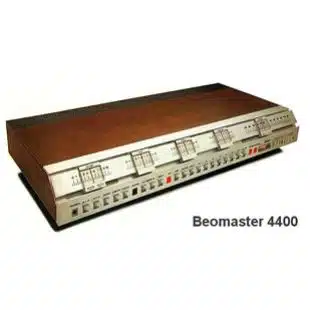
Beomaster 4400 was an advanced high-fidelity FM receiver which represented significant refinements in the design of domestic sound equipment. It incorporated a number of technical innovations and highly creative circuit designs which would not be out of place in a professional unit. In terms of technical finesse and power output, Beomaster 4400 was Bang & Olufsen’s top of the line stereo receiver in 1979 – 80.

The amplifier’s rated output of 75 watts RMS per channel (into 4 ohm speakers) provided more than enough power even in large rooms. There were DIN sockets for connecting a record-player, two tape or cassette recorders (one socket allowed monitoring), headphones and two pairs of stereo speakers. One pair of speaker outputs could be switched to ambiophonic use. In addition to the more usual controls and adjustment facilities, Beomaster 4400 had switchable high and low filters, a loudness control for physiologically compensated output at low volume settings and a linear function which caused the signal to by-pass all tone and filter circuits for truly unadulterated output. An overload indicator was provided to show when the amplifier’s limit for undistorted sound had been reached. Transient Intermodulation Distortion (also called transistor sound) was reduced substantially thanks to carefully designed circuits upon special research at Bang & Olufsen.

Receivers and amplifiers with the ambio function were products which, apart from stereo, could also reproduce the ambience or sound information of a room. Ambient information was included on most stereo vinyl recordings but could not be reproduced by a sound system with two loudspeakers or an ordinary stereo amplifier. Bang & Olufsen systems with the ambio function had facilities which electronically subtracted the difference signal (i.e. the difference between left and right channels) which contained ambient information. This information was fed into two extra loudspeakers which were placed as side speakers in a room. Ambiophony was an extension of stereo reproduction and enhanced the sense of realism. It could be used with nearly all stereo programme materials

The tuner was extremely sensitive and had low distortion levels over the entire FM waveband. Naturally, it incorporated all the latest technical and scientific advances such as a symmetrical Quadrature detector with the Phase Locked Loop stereo decoder which guaranteed low distortion and long-term channel separation on FM stereo programmes. The AFC (Automatic Frequency Control) circuit had characteristics which reduced inter-station noise during tuning. This circuit was also triggered automatically to eliminate loud ‘switch’ noise when changing between radio, record or tape programmes. There were six small dials for pre-tuning FM radio stations, so subsequent programme selection was just a matter of pressing a switch.

Beomaster 4400 could be made up as part of the Beosystem 4400, when linked together with other compatible Bang & Olufsen products.
Posted on

BeoVision 6002

BeoVision 6002

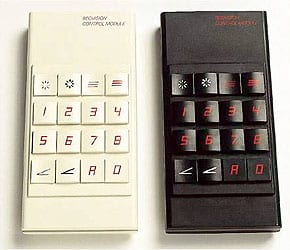
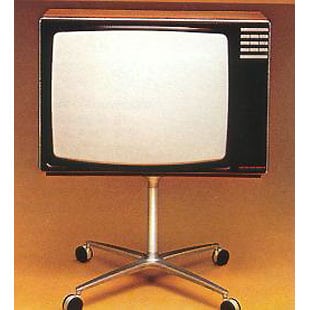
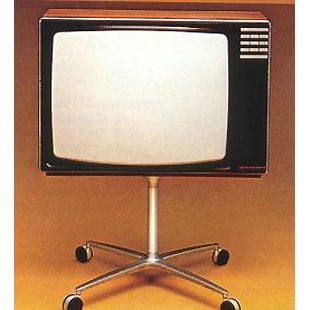
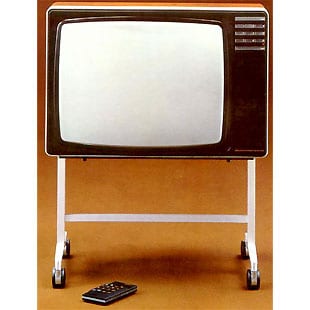
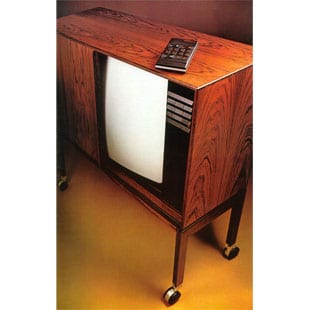
Beovision 6002 was a luxurious colour TV receiver with a 66cm (viewable) screen and cordless, ultrasonic remote control. The slim remote control module allowed you to select up to eight TV programmes, adjust volume, brightness and colour strength from the correct viewing and listening position. You could also switch the set off without moving away from your armchair. The ‘recall’ facility provided a digital on-screen display indicating the channel currently being viewed. The reset function automatically returned volume, colour and brightness to pre-set levels.

Picture quality was outstanding, with sharp, bright, precise image definition and natural colours. The automatic cut-off circuit monitored the balance of colours fifty times a second, guaranteeing long-term colour truth.

Sound reproduction was of hi-fi quality because Beovision 6002 was fitted with a 6,5 watts RMS amplifier which had a wide frequency range and less than 0,8% harmonic distortion. The loudspeaker was of a pressure-chamber construction as used in many hi-fi audio systems. There were separate controls for bass and treble and sockets for connecting headphones and additional speakers. The receiver could also be equipped with a module for Teletext reception and video cassette programmes could be reproduced without additional technical adjustment.

Beovision 6002’s genuine wood-finished cabinet had a unique tambour screen door for protecting the screen when the set was not in use. The self-styled wooden undercarriage with smooth-running castors was both practical and elegant.

Posted on

BeoVision 601

BeoVision 601

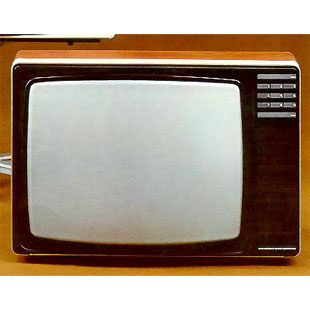
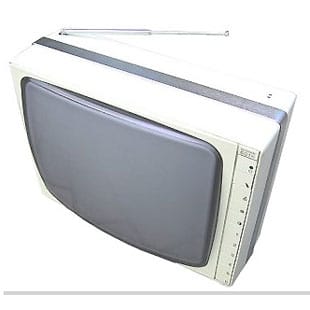
The Beovision 601 was visually very similar to the Beovision 600, but it used a mildly redesigned chassis. The changes centred mostly around the receiver section, which made greater use of integrated circuits that the previous model had done.

The Beovision 601 was the last true Bang & Olufsen portable television, in as much as it was designed and produced by them in Denmark. It would be the late 1980’s before another portable model would appear, which was the disappointing MX 1500, a Philips set made in a Philips factory in Italy.

Posted on

BeoVision 4002

BeoVision 4002

Beovision 4002 and 4402 were colour receivers with 26″ screens. Natural colours, sharp, precise image definition and high-fidelity sound reproduction are all features you can take for granted, according to the 1970 – 80 Bang & Olufsen product catalogue. Their high reliability levels were due to modular construction techniques and low heat-generation. Beovision 4002 consumed only 110 watts – less than a black and white set of years previously.

Both sets were extremely easy to use. There were facilities for presetting up to eight stations so that subsequent programme selection was just a matter of pressing one button. This turned the set on at the same time.

Beovision 4402 had the additional convenience of a cordless (ultrasonic) remote control. The set could also be supplied equipped for Teletext reception. There was automatic synchronisation of VCR programmes on all channels.

Posted on

BeoVision 4402

BeoVision 4402

Beovision 4002 and 4402 were colour receivers with 26″ screens. Natural colours, sharp, precise image definition and high-fidelity sound reproduction are all features you can take for granted, according to the 1970 – 80 Bang & Olufsen product catalogue. Their high reliability levels were due to modular construction techniques and low heat-generation. Beovision 4002 consumed only 110 watts – less than a black and white set of years previously.

Both sets were extremely easy to use. There were facilities for presetting up to eight stations so that subsequent programme selection was just a matter of pressing one button. This turned the set on at the same time.

Beovision 4402 had the additional convenience of a cordless (ultrasonic) remote control. The set could also be supplied equipped for Teletext reception. There was automatic synchronisation of VCR programmes on all channels.

Posted on

BeoVision 3602

BeoVision 3602

Like other Bang & Olufsen colour TVs, Beovision 3602 had the automatic cut-off regulating circuit which ensured natural colours throughout the set’s useful lifetime. The in-line picture tube allowed for easier and better convergence in order to avoid the usual discoloured edges – not least when viewing a black & white transmission.

Internally the Beovision 3602 was identical to the Beovision 3502 so one obtained the same outstanding picture quality and equally good sound reproduction from the large, forward-facing loudspeaker.

On the easy-touch panel one could select programmes and turn on the set in the same action. Regulators that are not used often are hidden in tow touch-release compartments – one for sound and one for video adjustments. Power consumption was exceedingly low – only 110 watts and the low heat generation made this set suitable for placing in a shelving unit.

Optional accessories: Mobile X-shaped undercarriage or trumpet-shaped stand, both in polished alloy.

Posted on

BeoVision 3702

BeoVision 3702

Beovision 3702 was a 56cm colour TV with small outer dimensions, a highly advanced construction throughout and the most logical operation facilities then on the market.

The ultrasonic remote control was designed to be operated with one hand and its most important regulators could be ‘read’ by the finger tips. These regulators – for brightness, colour saturation and sound are set in relief, so there was no need to look. The user could feel which position was which by the tactile buttons.

Any of eight pre-set stations could be called, and, by pressing the special reset facility, all adjustment levels including sound, would revert to their predetermined basic levels.

Beovision 3702 could be switched off at the main ‘off button on the set’s simple operation panel. Or one could switch it off with the remote control module in which case, the set goes into stand-by position. By pressing one of the programme selectors there is a picture on-screen within 5 seconds together with sound. The picture tube was of the in-line type which needed fewer adjustments and consumed less power – only 115 watts.

The chassis was modular and there was an automatic cut-off regulating circuit to maintain long-term colour purity. Beovision 3702 could accommodate a VCR without further technical adjustment and could be fitted with a special optional kit to reproduce sound through a hi-fi system. Two pre-stamped blanks on the set’s fascia allowed for the insertion of a headphone or extension speaker terminal and switch.

Posted on

BeoVision 3800

Beovision 3800 and 3900 were 22″ colour TV receivers finished in genuine wood veneers (teak or rosewood). They superceded models 3602 and 3702 in 1979. The sets were slim and elegant and their classic design suited any home décor according to the 1979 – 80 catalogue. High Bright picture tubes allowed for satisfactory daylight viewing since they permitted around 70% more light than from the screen than conventional picture tubes.

Beovision 3800 was for direct (set box) operation while Beovision 3900 permitted you to operate the set via an ultrasonic remote control handset. Beovision 3900 could also be supplied equipped for Teletext reception.

Automatic cut-off circuits guaranteed correct balance between the three basic colours (red, green blue) even after a long period of use. In fact, these sets incorporated every refinement which still makes Bang & Olufsen’s television sets among the market’s best. VCR programmes could be played without additional technical adjustment. There was an automatic synchronisation on all channels.

A choice of two mobile undercarriages were available. A tall undercarriage (42cm high, type 3057) depicted here, and a lower one (34cm, type 3058). Both were sold as optional accessories