Posted on

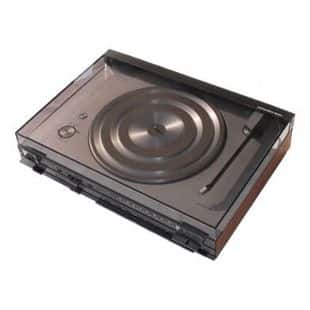
BeoCenter 1800

Bang & Olufsen BeoCenter 1800

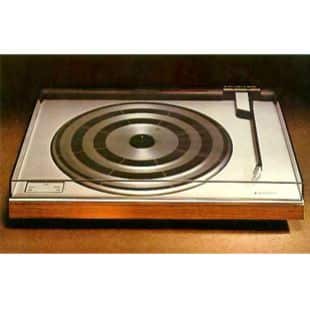
Beocenter 1800 fulfilled hi-fi standards by a wide margin. The product was also way above the average in terms of ease and operation. Experience from Beomaster 1100 and Bang & Olufsen’s integrated gramophones were combined in the special space-saving unit, which on a specification level was on a par with many separates.

The FM section had automatic frequency control (AFC), four pre-set stations and light indicators. The amplifier’s power output was 2 x 22 watts RMS with less than 0,3% distortion at full power output.

The integrated gramophone was fully automatic. The user simply chose the size of the record and pressed a button – the machine did the rest. The pickup arm was of magnesium which was extremely light. This, together with the MMC 3000, a low-mass cartridge, made this one of the very few turntables on the marker that was capable of tracking warped records. The anti-skating device also worked automatically.

The pickup arm and the turntable mechanism had a special spring suspension which made the turntable shock and vibration resistant.

Records could be played with the dust lid closed, thus protecting both the turntable and the record collection from damaging dust particles. Beocenter 1800 had connections for tape recorder, two sets of stereo speakers and a pair of headphones.

When connected to a pair of Beovox Uni-Phase passive loudspeakers, it was known as Beosystem 1800.

Posted on

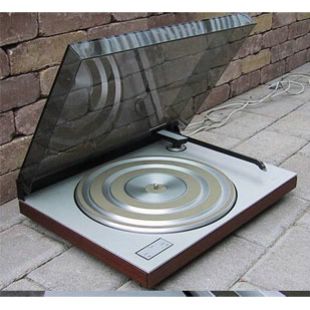
BeoGram 1902

Bang & Olufsen BeoGram 1902

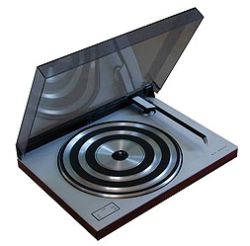
Beogram 1902 was a newly developed (1979/80) fully automatic, hi-fi stereo record player with Electronic Servo Drive (ESD) which meant that you never had to adjust speed. The Beogram 1902 did that automatically. It was resistant to variations in the mains current.

All functions were chosen via the single rectangular operating panel; Beogram 1902 did the rest. It was resistant to vibrations and shock because it rotatory mechanism and pickup arm had an efficient spring suspension. The pickup was so light that even warped records could be tracked. In fact, the arm was so light and the pickup’s diamond stylus so highly polished that it would not audibly damage your record even if the arm was thrown against the grooves.

The cartridge was the MMC 4000 which had a naked elliptical stylus. Recommended stylus pressure was 1,0g and frequency range was 20 – 25000 Hz.

Posted on

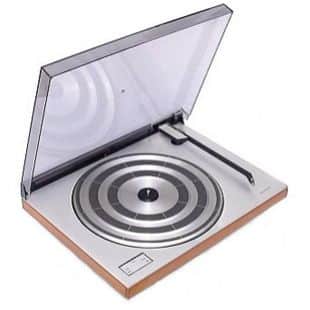
BeoGram 1102

Bang & Olufsen BeoGram 1102

Beogram 1102 was a fully automatic, hi-fi stereo record player with electronic servo-drive and high specification level. Operation was easy and straightforward. All functions were controlled by pressing the rectangular operating panel and if dissatisfied with the pitch of the record, speed could be adjusted by depressing the panel and rotating the little thumbwheel.
The pickup was an MMC 3000 with a spherical diamond. It tracked records at a stylus pressure of 1,2 grams. In order to fully exploit the pickup’s outstanding qualities, B&O constructed an extremely light magnesium pickup arm which, together with its unique suspension, ensured low inertia and thereby good conditions for correct contact between stylus and both walls of the record groove – at all times. Even warped records could be played satisfactorily.

Despite high specification levels, Beogram 1102 and 1902 automatic record-players are extremely easy to operate. All the technicalities are hidden under the surface.

Bang & Olufsen’s Electronic Servo Drive ensures that the rotatory speed of the Beogram 1102 and 1902 was always correct despite variations in the mains current supply. This is so because the system has a special feedback circuit which effects automatic corrections to compensate for these inherent variations

Beogram 1102 could be made up as part of the Beosystem 1100, together with other compatible Bang & Olufsen products

Beogram 1102 UK price in 1978: £97.00

These decks are beautifully made and offer super sound quality for almost no money. Much easier to maintain than the tangential decks simply because they are very simple! Excellent isolation from external vibrations – strongly recommended – and they were when new by Hi-Fi Choice! Simpler than the earlier 1100 – and better for that! A DC motor replaced the AC motor fitted to the 1100 and was electronically regulated with speed adjustment done through a potentiometer as opposed to the complicated measures used in earlier decks. This method would roll out across the range of Beograms.

Posted on

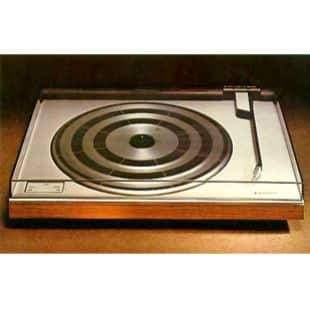
BeoGram 1100

Bang & Olufsen BeoGram 1100

The most basic of a new range of beograms, this model was amongst the first to use the new MMC range of cartridges.

In the case it used the bottom of the range MMC3000 and was designed to be partnered by systems such as the Beomaster 1100.

Much more slim and elegant than the 2000 that it replaced, it featured the triple leaf spring suspension that was a feature of all Beograms from that point onwards. As one of the earlier models in this range, the 1100 used a belt and idler wheel drive mechanism. This would be replaced in the later 02 models with a simple belt drive.

These decks are beautifully made and offer super sound quality for almost no money. Much easier to maintain than the tangential decks simply because they are very simple! Excellent isolation from external vibrations – strongly recommended – and they were when new by Hi-Fi Choice!