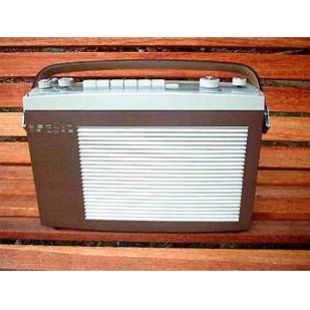
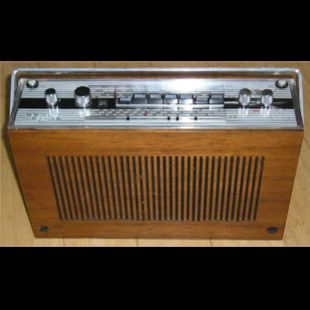
Beolit 611 de Luxe was an AM/FM portable radio with two telescopic aerials side by side. It received FM, LW, MW and F (SW) bands, and had a little visual meter (top left of the radio) for battery level and tuning adjustment for maximum station reception.
On the bottom there was an output for external aerial and speaker so that the Beolit could be used as a car radio when the handle was detached. The handle unclipped from the body by pressing it on both sides. There were seven push-button keys in white on the top of the unit, together with separate bass and treble controls as well as two separate tuning controls and tuning strength indicator.
Once the base of the unit is removed, the car radio antenna socket can be seen to the left and on the right are two outputs: one for external or car speaker and one for a tape recorder. Also in the right-hand section is situated the serial number. The batteries go under the white section in the centre.
The seven white-coloured push-buttons on the top are from left to right: On/Off, AFC, L (LW), M (MW), F(SW), tape and FM.
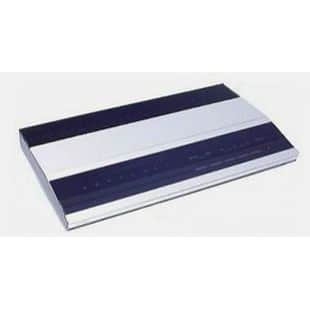
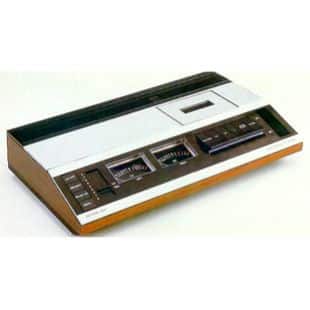
Designed as a perfect match, both physically and technically, for the Beomaster 2000, this advanced slim-line cassette deck was nonetheless a serious hi-fi product in its own right, combining a high-performance specification with supreme ease of operation.
Despite its unassuming appearance, Beocord 2000 contained a full pay-load of advanced circuitry plus a few extra features rarely found in cassette decks within this price frame. The primary controls – those concerned with tape movement – were totally electronic and designed on the Sensitouch principle. There were no knobs to turn or keys to press; a light fingertip touch was sufficient to activate any function.
Ferric, chrome or metal tapes could be used, and Dolby B noise reduction was included to ensure clean, hiss-free recordings. A clearly calibrated scale and input slider, together with large Peak Programme Meter, made it quick and easy to set accurate recording levels. These controls were placed adjacent to the cassette tray beneath a hinged lid which sprang open at a touch.
Beocord 2000’s built-in microcomputer made operation fast and foolproof. It was possible to switch directly between any and all tape transport modes without harming the tape, the mechanism or the motor. Microcomputer intelligence also opened the way for additional control functions that contributed in a very practical way to daily enjoyment of taped music.
A NEXT control allowed for easy track location (tape scan): one touch fast winds the tape to the next signal gap and plays the following track – automatically. So if you wanted to hear, for example, track number 5, just touch-and-wait four times and the place would be found for you. Similarly, you could repeat play-back of a favourite track up to five times with just a single touch. It’s such a convenient way of listening to exactly what you want, when you want.
Beocord 2000 had a socket for data-link connection to Beomaster 2000 so that direct switching was possible between Beomaster, Beogram and Beocord in the Beosystem 2000. The deck could also be data-linked to Beomaster 5000 or Beomaster 6000, when all tape functions could be operated via the receiver’s remote control system. Beocord 2000 could be made up as part of the Beosystem 2000, when linked together with other compatible Bang & Olufsen products. It was also part of Beosystem 3000 if that is how you wished to use it.
“One of the best semi-professional fully transistorised hi-fi stereo tape recorders. It has professional data for speed, wow and flutter that meet international standards for studio tape recorders. New modern design concepts distinguish the Beocord 2000 de Luxe K from conventional tape reorders. Here are some of them: 4-track recording/2-track and 4-track playback; built-in 4-channel mixer section with twin faders for both mono and stereo recordings provides individual control and mixing of microphone, gramophone, radio and line signal inputs.
These faders make it possible to balance channels during recording. An aurally compensated twin fader makes it possible to balance playback volume levels, too. These features permit recordings of every kind, such as Multi-playback, or sound-on sound; that is, rerecording from one track to another whilst making another recording on the other track.
Synchro-playback – this feature consists of synchronising two recordings on separate tracks which you do wish to mix by recording, and may be used for language laboratory purposes and for automatic control of lantern slides. Echo – adding echo to both mono and stereo recordings. The amplifier equipment is an outstanding new system consisting of no less than seven fully transistorised easily replaceable amplifier units.
Monitoring: separate records and playback heads with individual amplifiers permit both before-the-tape and off-the-tape monitoring. Power output is 2 x 8 watts undistorted.
Recording level is indicated by two illuminated V.U. meters which indicate the sum of signals in each of the two tracks that can be recorded simultaneously.
Slack absorbers: Two smooth-running specially engineered slack absorbers take up slack, ensuring absolutely smooth starting and stopping at all tape speeds.
Electronic protection circuit prevents damage due to electrical overloads. No other tape recorder in this price bracket has these professional standards for electrical and mechanical specifications. Fine low-noise tape drive motor mounted on rugged non-torsion steel chassis. Four tape heads, 4-track recording but – a remarkable feature – the instrument plays back both 2-track and 4-track tapes.
The erase head (long-life dual-gap ferrite erases “right to the bottom” (70dB). The 2000 de Luxe permits recording from one tape recorder to another, parallel recording on a number of tape recorders, and simultaneous copying of both tracks. The Beocord may also be used as: public address system, permanently installed hi-fi control centre, and orchestra and guitar amplifier.” – taken from the 1967 – 1968 Bang & Olufsen product catalogue .
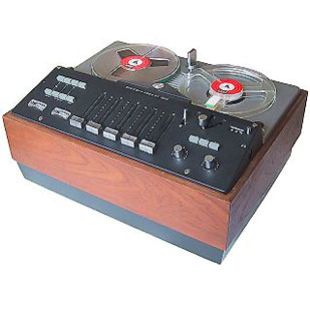
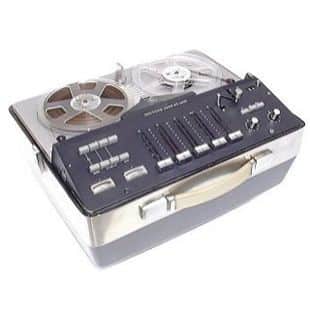
Beocord 2000 de Luxe T is almost a recording studio in a case. Compact, transistorised circuitry allowed a previously impossible amount of facilities to be offered by a portable machine. Independent stereo recording preamplifiers for microphones, a turntable, a radio or second recorder and line/off tape recording allowed huge flexibility.
Recording and playback amplifiers were completely separate, as were the heads, expanding the possibilities even further, to include off-tape monitoring, track to track copying and echo functions. A built in power amplifier, similar to that fitted to Beogram 1500, made the Beocord 2000 Deluxe a complete stand alone unit, even a pair of quality loudspeakers, which doubled as a hard protective lid, were included.
Internally, the electronics were built on 8 plug in cards, the radio and phono amplifier ones having switches to alter the input level that they could use. A single large synchronous motor, supplied by Papst of Germany, drove the mechanism via a series of rubber wheels. The motor pulley had a number of different radiused sections, including three precision machined surfaces for speed selection. These were selected with a stepped cam, lifting an idler wheel into the correct position to drive the large cast flywheel at the desired speed. Included on the same shaft as the cam were switches to automatically correct the equalisation settings of the recording and playback amplifiers for the speed being used.
Beneath the die-cast head cover, one could see the four head stacks, they were, from left to right, a stereo erase head, a stereo playback head set for replay of half tape stereo or four track recordings, a full width stereo record head and a full width stereo playback head. Also visible were sensing posts for both mechanical and electrical automatic stop, a brake pad linked to the pause control, a large rubber pressure roller and a thick, heavily chromed capstan spindle.
The control panel contained two simple levers to operate the tape transport, but was dominated by a stereo mixing section with 4 channels. The versatile switching functions, controlled by eight small grey buttons on the left of the panel, allowed the user to record either on the full width in stereo (so only allowing one “side” of the tape to be used), or two independent parallel tracks in mono, making two passes of the same side of the tape, or two tracks in mono, running to the end of the tape for the first one, them turning the tape over to record the second.
This, coupled with a choice of three speeds and a deck large enough to take spools up to 18cm in diameter, gave the user the chance to, at one end of the scale, record 45 minutes of music in stereo at as good as studio quality, or at the other extreme, store over 8 hours of speech quality material on a single spool of tape. Recordings from four-track recorders could be played, be they two tracks of stereo or four tracks of mono, though it was not possible to record in the four track format.
A well specified microphone amplifier made this machine ideal for live recordings, and there was space in the cover to store the microphones, such as a pair of Beomic 2000s, while not in use. B&O also made an excellent range of ribbon microphones which could be used with the Beocord 2000 Deluxe.
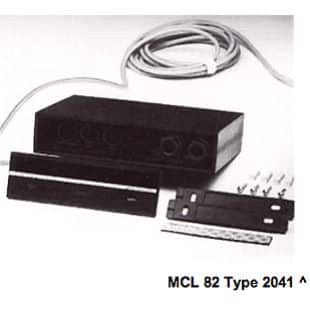
This was the first version of Master Control Link and was used with the Beosystem 5000 and the Beocenter 7000 series.
It allowed control of all elements in the main system whilst in a link room. The first incarnation was used with the remote controls of the Beosystem 5000 and Beocenter 7000 and when used with the MCP-5000 and MCP-7700, allowed two way communication. One could add four rooms in this system. It was superseded by the later MCL2 system which used Beolink 1000 codes.
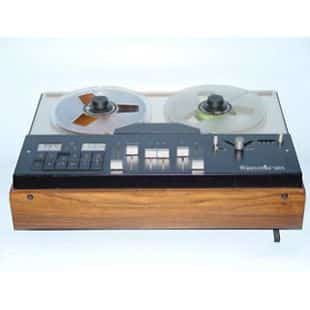
Beocord 1600 matched the Beomaster 1600 and Beogram 1600 both physically and technically. It combined high performance with easy, straightforward operation.
Ferric, chrome or metal tapes could be used. The Sendust tape head, Dolby B Noise Reduction circuits and Peak Programme Meter all contributed to high quality recording and playback. You could switch between all modes of play without fear of tangling the tape or damaging the mechanism.
Beocord 1600 Type 4205 was a reel-to-reel tape recorder. Among its special features it had sound on sound, automatic recording level control and mixing controls The PA Amplifier could be operated without the motor running.
Bang & Olufsen’s Beocord 1600 tape recorder was designed by Jacob Jensen and was the second product to receive the iF Award in 1971.
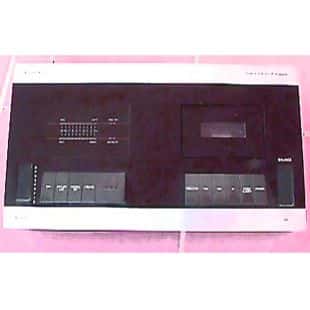
This highly specified top-loading cassette deck closely matched Beomaster 2300 both in appearance and technical compatibility. But it was also worth serious consideration for use with any good hi-fi system, especially if ease-of-use was one of your demands.
Ferric, chrome and metal tapes could be used and the Dolby B noise reduction system kept your recordings clean and hiss-free. The large split-channel VU meters made it easy to set optimum recording levels using the input slider. The combined record/replay head was of long-life Sendust.
The 3-digit tape counter had a press-button reset; a memory function aided easy location of favourite tracks for repeat playing.
Piano-key controls separated all tape-transport functioned: these included a very precise pause control and a double-key record control – a safety check for preventing the accidental erasure of tapes.
Tape speed was highly accurate with deviation of less than +/- 1% and wow and flutter below +/- 0,15% DIN.
Beocord 2400 measured 40cm wide, 8cm high (11cm with cassette holder open) and 25cm deep. The slim cabinet was finished in either natural teak or rosewood.
At the 1969 Hanover Fair Bang & Olufsen and Jacob Jensen – designer of Beocord 2400 – were presented with the iF award for no less than 4 products for ‘outstanding industrial design’ including this sleek cassette recorder.
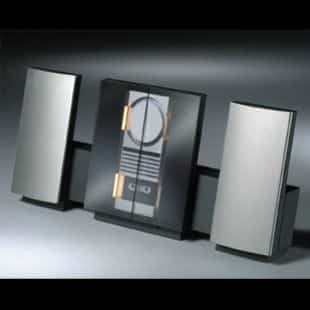
“BeoSound Ouverture: the design may be a Bang & Olufsen classic, but BeoSound Ouverture and BeoSound 3000 refuse to rest on their laurels. Access to new musical sources and fresh loudspeaker options ensure that the concept remains an open invitation to make something special out of your music” (B&O catalogue 2001 -2002)
This stereo has two different names: BeoSound Ouverture in Europe and BeoSound 4000 in the rest of the world. This is the only stereo system, so far, to support the new MasterLink system without any add-ons. It’s really a follow up to the Beocenter 2500 which was the first and original stereo with this somewhat different look. Along with the launch of this unit in 1991 (as the BeoSound 2500) Bang & Olufsen also started selling the new remote control – Beo4. The difference between the Ouverture and Beocenter 2500 is that the newer model doesn’t feature two-way communication and it has instead a completely new CD mechanism. It also holds some new features when it comes to the CD. But the most important difference is the MasterLink connection. With this system you can connect the unit to, for example, a BeoLab 2000 or BeoLab 3500 without any further electronics. Reach out and the doors glide quietly aside, while a gentle light spreads from within. It’s BeoSound Ouverture’s way of saying, “welcome” and part of the experience every time you put on a new tape or CD. CD player with programming, tape recorder with auto reverse, FM/AM radio with pre-set, timer function, optional Beo4 remote control operation, connections for Beolink® and headphones, optional wall bracket and floor stand. BeoSound Ouverture’s unassuming rubber key pad hides a contact foil, which, in turn, covers a matrix of vertical and horizontal cords. When a control is pressed, the cords connect and the microprocessor is activated.
Design
Music is more than just something you listen to, it’s an emotion you experience. So isn’t it time your favourite music was played on something that lets it express itself to the full? BeoSound Ouverture stands up and invites you to make something special out of your music – over and over again.
Features
Bring new life to old CDs by changing their track sequence with the Random Play function. Or programme it to skip over any unwanted tracks and to play the ones you want in the order you prefer. Transferring the music of a CD onto tape doesn’t have to mean poorer quality. The Ouverture constantly monitors and adjusts the signal during any recording to ensure a uniform sound level throughout – and will automatically stop recording when the CD finishes playing. There’s room for up to 30 pre-set stations on the Ouverture’s intelligent AM/FM radio.
So how do the sliding glass doors work?
The glass doors on the BeoSound 3000 and BeoSound Ouverture are opened and closed by steel wires driven by an electric motor via a gearbox. The motor is triggered by an infrared system that detects your approach… Why wake up to an annoying alarm clock when it could be your favourite piece of music instead? The timer function on the Ouverture can be programmed for the entire week and will automatically turn itself off again after playing for any length of time you choose.
Specials
Just raise a hand and watch as the glass doors glide silently aside. It’s the Ouverture’s way of saying “welcome” and reveals that a special experience is about to begin. Of course, a simple on/off button would do, but then what would be so special about that?
Easily Placed
It’s a dream come true – a music system that can fill your life with music without filling your home with equipment. The flat upright design of BeoSound Ouverture means that it’s slim enough to sit by itself upon the narrowest shelf or light enough to be hung directly on a wall with a pair of loudspeakers.
Use
With its mix of glass and aluminium, the Ouverture grabs the attention without shouting out loud. Its compact size and visual presence ensures that it enhances rather than dominates the surroundings in which it’s placed – which makes it the perfect audio system for the home and place of work. The stereo can also be controlled by the optional Beo4 remote control.
Mounting Options
This classic design was reincarnated over a 21 year period with various mounts and stands. Floor stands were available with a pole stand or CD and tape storage, wall mount solutions allowed for the Hi-Fi only, or with BeoLab2500 speakers until these were discontinued