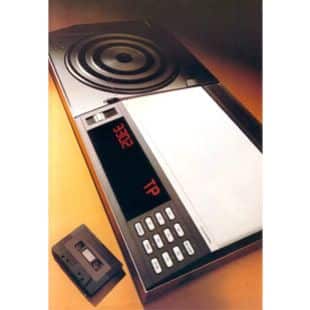
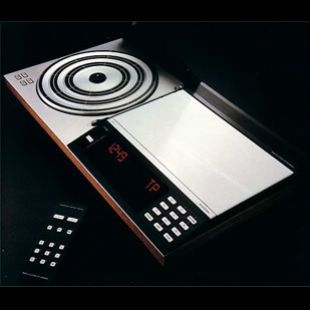
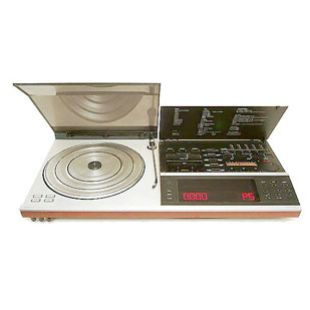
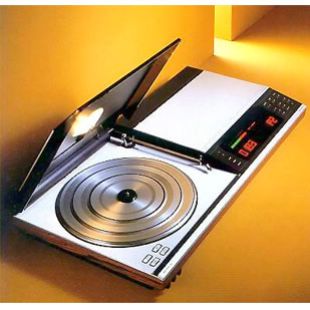
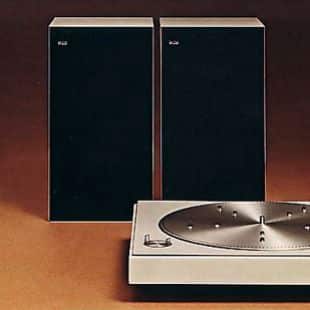
Beocenter 7000 upon its release, represented one of the most advanced hi-fi centres on the market. One touch produced instant music from a record, cassette tape or an FM or AM radio station. Illuminated symbols on the set’s communication panel confirmed instructions or rejected mistakes and kept you informed on the set’s operational status at all times.
in short, Beocenter 7000 offered two-way visual communication in high-fidelity.
The cordless remote control module put you in command of most of the functions from anywhere in the room. You could select any programme which would also switch on the set. You could regulate the volume – 2 x 40 watts RMS – make cassette recordings, and switch off the set. Comprehensive memory and timer facilities enabled you to program the set’s microcomputer to operate within a 24-hour period. It could record an important radio programme while you were out, and even instruct the Beocenter to wake you up with an early morning broadcast.
Each of Beocenter 7000’s three sound sources had the quality and performance level normally found in much more expensive separate units. The record deck had Electronic Servo Drive for absolute speed accuracy and its operation was fully automated. Stop, start or pause could be controlled via the remote control terminal. The cassette recorder had a Sendust record/replay head and a double-gap erase head that could even cope with metal tapes. You could locate any point on the tape simply by asking the set’s microcomputer to search for this required counter reading. The radio had facilities for pre-setting 5 FM and 1 AM stations which could then be selected instantly at the touch of a button.
Beocenter 7000 was designed by Jacob Jensen. In 1979 three more of the designer’s creations for Bang & Olufsen were included in the Design Collection of the Museum of Modern Art in New York including the Beocenter 7000 music system.
Beocenter 7002 was one of the most advanced hi-fi music centres on the market at the time of its release. One touch gave you music instantly from a record, cassette tape or an AM or FM radio station.
Illuminated symbols on the set’s communication panel confirmed your instructions or rejected mistakes, and kept you informed of the set’s operational status at all times. In short, Beocenter 7002 offered two-way communication in high fidelity.
The cordless remote control module put you in command of all functions from your chosen listening position. Select any programme; this action also switched the set on. Regulate the volume level – there were 2 x 40 watts RMS at your disposal. Make cassette recordings. Or switch off the set – all without leaving your chair.
Comprehensive memory and timer facilities enabled you to programme the set’s microcomputer to operate any function at a given time within a 24-hour period. It could record an important radio programme while you were away from home. You could even instruct the Beocenter to wake you up with an early morning broadcast.
Each of the Beocenter 7002’s three sound sources had a high quality and performance level normally found only in much more expensive separate units.
The record deck had electronic Servo Drive for absolute speed accuracy and its operation was fully automated. Stop, start or pause by remote control. The cassette recorder had a Sendust record/replay head and a double-gap erase head that could even cope with metal tapes. You could locate any point on the tape simply by asking the set’s microcomputer to search for this required counter reading. The radio had facilities for pre-setting 5 FM and 1 AM stations which could then be selected instantly at the touch of a button.
Beocenter 7002 offered the same musical facilities and powerful 2 x 40 watts RMS output as Beocenter 5000. The two models were identical in the matter of sound quality too, but only the Beocenter 7002 had Bang & Olufsen’s very advanced timer-track location and remote control systems. The black anodised lid of its cassette compartment further differentiated Beocenter 5000 from the 7002.
Top quality sound and maximum listening comfort were the main features of this integrated hi-fi system. Records, radio, cassette tapes and a 2 x 40 watts RMS stereo amplifier could all be controlled from anywhere in the room using the slim remote handset. Without moving more than a finger you could select any sound source, adjust volume level, fast wind the tape and even make recordings. This supreme ease of operation was made possible by microcomputer technology. In addition, there were two user-programmable microcomputers which allowed you to make unattended recordings at any time within a 24-hour period, or to play any sound source automatically at a pre-selected time – day after day, if you wished.
A further advantage was easy access to cassette recordings: just key in the appropriate counter reading (address) and the cassette would fast wind to the required passage of music. Ferric, chrome or metal tapes could all be used and Dolby B Noise Reduction was included to ensure clean, hiss-free recordings.
The automatic record deck had an ultra-lightweight arm carrying the MMC 4 pickup cartridge. The radio section covered Long, Medium and FM bands with facilities for pre-setting 6 favourite stations.
The recommended speakers were the Beovox S55 . Speaker pedestals or the SC70/ SC77 hi-fi cabinet could be added optionally if required.
In 1982, Bang & Olufsen introduced a completely new way of living with music. The company was then the only one in the world to fulfil the desire for perfect sound from attic to basement – from just the one central music system.
With the Beolink® system – around which Beocenter 7700 was based – you could enjoy and control you music system in several rooms. From acorns great oak trees spring, and most of the the current (2002) range of TV and hi-fi systems can be equally controlled to give you ’round the house music’ using the latest MasterLink system.
The very advanced (for its time) Beocenter 7700 system brought an entirely new range of possibilities to the serious music-lover. For the very first time ever, round-the-house hi-fi became an option, in whichever room you wanted to listen to it.
Beocenter 7700 featured Long, Medium and FM radio, automatic record deck, microcomputer controlled cassette recording and 2 x 40 watts RMS stereo amplifier. Two user-programmable 24-hour timers were included, and all sound sources are accessible by infra-red remote control.
From this comprehensive and desirable foundation, it was possible to build up (either immediately, or room by room) a sound system that could be enjoyed and operated from anywhere in the house ( a forerunner to the later Beolink® system).
This is how it worked.
The remote Terminal (Master Control panel) supplied with the Beocenter 7700 had control buttons for armchair access to all primary playing and recording functions.
But in addition, it also had three digital read-out panels on which your instructions were confirmed every time you pressed a button. So you had your means of “talking to” your Beocenter 7700, and it had a means of “talking to” you – right there in your hand.
Your instructions were carried to the Beocenter’s microcomputer by infra-red light, and confirmatory signals were returned to the remote control Terminal in the same way – in a fraction of a second.
This two-way communication could be extended to other rooms by fitting those rooms with a pair of speakers and an electronic Master Control Link, all available as optional accessories. When you wanted to listen to music or radio in a room away from the Beocenter, the remote control Terminal was taken with you. By directing it at the Master Control link (which you had fixed on the wall or on a shelf) in just the same way as you would normally direct it towards the Beocenter, you could control all primary functions and receive confirmation that the Beocenter was doing what you want.
The Master Link equipment could be fitted in up to four different rooms, and you could choose which speakers were to play and which were to be silent. It was like having a complete, top-quality hi-fi system in every room, but paying for only one (plus as many loudspeakers and Master Links as you needed). You could, if you wished, buy additional remote control Terminals if you didn’t want to carry one around the house. But this was not strictly necessary.
Beocenter 7700 offered top quality sound from records, radio and cassettes. Operation was fast, easy and foolproof because of a built-in microcomputer which blocked mistakes, automating many boring, repetitive operations – like switching off one sound source before switching on another. Two timers, each with a 24-hour memory and automatic repeat function, allowed you to record or play any programme at specific times – day after day if you wished. The digital clock could be displayed or not – it was up to you.
You could pre-set 6 favourite FM radio stations, or 5 FM and one AM (Long or Medium wave) for instant press-button recall – either by direct or remote control.
The cassette section had many advanced features to make recording easier and more accurate. Replay, too – it was necessary just to key-in the appropriate counter reading and the cassette would fast wind to any point on the tape. It was as easy as finding a particular track on a record.
Metal, ferric and chrome tapes could be used, and the Dolby Noise Reduction circuits ensured clean, hiss-free sound.
The record deck was fitted with the (then) very latest type of tone arm and miniature MMC 3 cartridge. This pick-up carried a tiny naked elliptical diamond and weighed only 1.6 grams. It had superb tracking ability and ensured the minimum of record wear.
The safe handling of records was also the idea behind the turntable light – fitted inside the hinged lid – which switched on automatically whenever the lid was opened, and stayed alight as long as the deck was in operation.
Beocenter 7700 was available in natural teak or rosewood finish. It measured 72cm wide x 9.5cm high (37.5cm with the lid open) x 38cm deep and could be accommodated in either SC.50 or SC.70 System Cabinet, available separately.
Your choice of loudspeakers for use with Beocenter 7700 was really a matter of listening and comparing the various Beovox models. Different households had different requirements – in size, in quality and in cost. Fortunately, with the Beovox range the choice was a wide one. Advice on speakers for the Beocenter 7700 included Beovox C40, C75, S45, S55 and S80.
Beocenter 7700 was introduced as a completely new way of operating a hi-fi system. A way which gave individuals the freedom to enjoy top quality sound all over the house; at the same time to control the music from anywhere in any room.
This was the world’s first high fidelity system that could be operated from another room. With the Beocenter 7700’s master Control Panel and and optional Master Control Link, you could control radio, record deck, cassette recorder and stereo amplifier even though you were in the kitchen or bedroom and the set itself was in the lounge.
So when you want music in another room, don’t move the hi-fi – just move the music!
A Master Control Panel (above) was supplied with every Beocenter 7700. It was used just like an ordinary remote control handset when you were listening in the lounge, close to your hi-fi system. It let you operate all sound sources and adjust volume levels without moving from the comfortable armchair.
Master Control Link was an optional accessory, like the additional loudspeakers you needed in order to enjoy your music in other rooms. The Link equipment consisted of two units – a discreet black box containing a mass of sophisticated electronic circuitry (which could be fitted out of sight behind furniture etc.), and a transceiver unit that was placed on a shelf or wall where it could pick up the infra-red signals from your Master Control Panel. The transceiver unit also let you switch the speakers in this room on or off, and gave access to programmes that were due to be played via the Beocenter’s automatic timers.
You could buy extra stereo speakers and Master Control links for one, two or three additional rooms, as well as enjoying the hi-fi system itself which you probably installed in the living room or the lounge.
The Master Link equipment was connected by cable ‘in series’, i.e. only the first extra room is connected direct to the Beocenter; the second extra room was connected to the first and so on, so wiring was kept to a minimum. And you could add each room one by one – as your needs changed or your budget allowed.
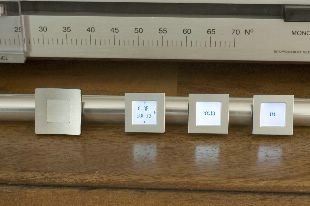
In the dark days of a recession, which threatens the type of luxury brand that B&O epitomises, somebody has let the B&O designers produce a device which is simply a little piece of joy, made to lift one’s heart and bring a smile. This is the BeoTime. A visual and tactile delight, this is a clock in the shape of a flute, with the most central of the ‘keys’ being a control surface and three slightly smaller keys having LCD screens in them. It is beautifully made from a single piece of aluminium with the four keys on the top surface. Small plastic ribs at either end protect both the BeoTime and any surface it is put upon.
Functionally it is an alarm clock, either using its own alarm or activating a B&O audio or TV system – it has a single alarm time with no day or date functions and the ability to choose between either a 12 or 24 hour format. There is a sleep function as well and, if desired, the device can be used as remote for any B&O system with the ability to change source, channel and volume through a fairly intuitive set of controls. Once again we have a B&O product for which a manual is relatively superfluous.
The control surface is a square, slightly upwardly curved, piece of aluminium with a central square button. The only other controls are an end plunger to activate the alarm feature and a motion sensor which is automatic and makes sure the display is always the correct way up.
The displays lateral to the control surface are slightly smaller with an aluminium frame surrounding the small LCD screens. These have a white/blue back-light which is activated by tapping the BeoTime. The first screen shows either the status of the alarm, giving a time and source, or acts as an indicator of the function you are using by being a navigation panel. The displays are a simple monochrome design but clear with a very pleasant scrolling action. A definite case of less being more.
The second and third screens are the time panels with the first being hours and the second minutes. These double up as displays when using the BeoTime as a remote or when using the more complex functions.
Is this a ground breaking product? No. There are better clocks and better remote controls, but I cannot think of either a remote or a clock that has the jovial charm shown by the BeoTime.
This would make an ideal gift for either a loved one or a friend, with or without a B&O system. For those without, it shows the best in design and ergonomics to a new audience which could only encourage further purchases.
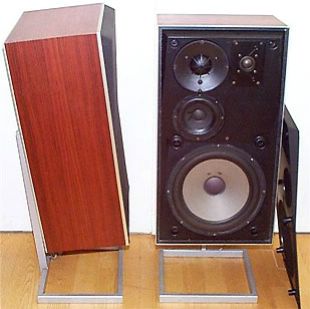
The S75 was a four way speaker designed for stand mounting and was a suitable match for any of the receivers offered at the time. It could be regarded as the bigger brother of the fabled S45.2 and replaced the very similar S60 in the speaker range.
The cross over was changed along with a redesign of the cabinet. The result was a speaker with more bass emphasis than the S60 but still with a soaring top end. Criticism could be levelled that the bass was at times slightly overblown, but for rock music, it hit the spot.
The extra size also emphasised the cabinet makers’ skill with the rosewood model in particular often showing a wonderful selection of flame veneer.
Although these speakers lack the accuracy of the S45.2, many will find the extra bass an attraction and will choose these in front of their fabled brother.
Beovox Uni-Phase S75
Pressure chamber speaker with linear phase sound reproduction and wide frequency range: 36 – 20000 Hz. Was suitable for placement in a shelving system but also available with aluminium pedestal for those who prefer a free-standing model. Speaker units included a 25cm woofer, a special 12,5cm Phase Link unit, a 5cm mid-range dome and a 2,5 dome tweeter. Volume was 40 litres; weight 11kg
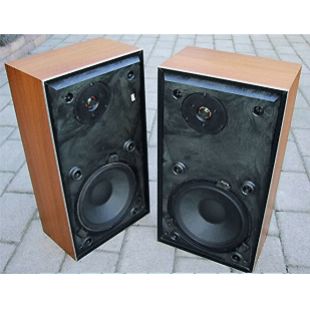
Beovox S30 and S40 both used a two-unit configuration and pressure chamber design to reproduce music faithfully and clearly.
They handled up to 30 watts and 40 watts respectively and were ideal for mounting within a shelving system. Beovox S40 worked in conjunction with Beosystem 2300 if that is how you wished to use them. They featured a 20cm bass driver (woofer) and a 2,5cm dome treble unit (tweeter) offering wide frequency response and clean, clear sound reproduction.
They may not have looked like high-specification loudspeakers – more like works of art – but their sound immediately gave them away. Even at full volume, they kept the total sound picture in perfect balance.
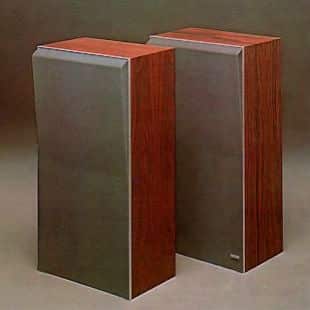
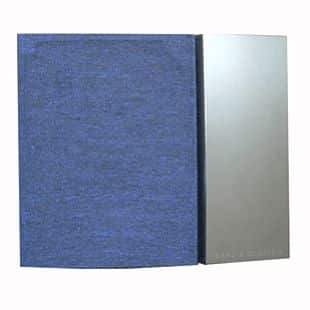
Bang & Olufsen’s BeoLab and Beovox 5000 / 3000 speakers had both the voice and the looks for a leading, acoustic role. And because of their looks, they were known as Bang & Olufsen’s range of panel loudspeakers. Panel loudspeakers were one of the most exciting and interesting examples of how Bang & Olufsen united advanced technology and stunning design to achieve totally new effects.
Design as a work of art
The elegant, flat panel loudspeakers were created to hang on the wall. And with their calm surfaces of blue or grey fabric coupled with polished steel, they could be taken for works of art. But the design was only partly for visual effect. The form of the panel speakers was founded on an advanced, acoustic principle that uses the wall as an active part of the sound reproduction process – without causing the wall itself to vibrate.
Optional display and amplifier
The panel loudspeakers were available in two sizes – each with or without amplifier and a display showing which source was playing and at what volume. Also it told you which track number on a CD or tape you were listening to. With display and amplifier the loudspeakers were called BeoLab. Without, they were called Beovox. The option depended upon which Bang & Olufsen sound system was connected. BeoLab speakers were designed to match Beosystem 6500, 4500, 3500 and Beocenter 9500 and 8500.
Mounting Options
Wall mounting brackets were supplied with this model. No other mounting solution wall offered.
In spite of its modest size, Beovox 1702 was highly efficient and had good sound quality. Frequency range was 50-20.000 Hz and it handled an output of up to 20 watts RMS or 40 watts total music power.
The bass unit had a diameter of 15cm and the treble was a tweeter with a 2,5cm diameter. Beovox 1702 met the DIN 45500 high-fidelity norms.
The speakers could be used as part of Beosystem 1001 (comprising BeoGram 1001 and BeoCord 1001 – see links at bottom of page), for example.